Thursday, 10 November 2022

Conclusion: Globalization and the Future of Postcolonial Studies

Hello! This blog is a response to the task assigned by Dr. Dilip Barad. In this blog I am going to summarize two articles from Ania Loomba's book "Colonialism and Postcolonialism" about postcolonial studies, Conclusion: Globalization and the future of postcolonial studies and Conclusion: The future of postcolonial studies.

Globalization and Postcolonialism

What is Post- Colonial Studies?
Postcolonial studies is the critical analysis of the history, culture, Literature and modes of discourse that are specific to the former colonies of England, France, Spain and other European imperial powers. Postcolonial studies have focused on the third world countries in Caribbean Islands, Asia, South America and Africa.

CONCLUSION: GLOBALIZATION AND THE FUTURE OF POSTCOLONIAL STUDIES

The Article begins with the description of the events of 11 September 2001 ( 9/11), the so-called Global War on terror and the US invasion of Afghanistan and Iraq. li which makes it harder to see our world as post colonial, at the same time these all events can be considered as a part of globalization.

Globalization seems to have transformed the world so radically that many of its advocates and critics suggest that there is no longer need to have a critical and analytical perspective which takes the history and Legacy of European colonialism at the focal point. Globalization cannot be analyzed using the concept of margin and centers today it is better to be described in the term of transnational network, regional and international flows and The dissolution of Geographic and cultural borders, paradigm which are familiar to post colonial critic but we can now invoked to suggest a radical break with the narratives of colonialism and anti colonialism.

Book argues that the contemporary Global order has produced a new form of sovereignty which should be called ‘Empire' but which is best understood in contrast to European umpires.

In contrast to imperialism, the Empire establishes no territorial center of power and does not rely on fixed boundaries or barriers. It is a decentralized and deterritorializing apparatus of rule that progressively incorporates the entire global realm within its open, expanding frontiers. Empire manages hybrid identities, flexible hierarchies, and plural exchanges through modulating networks of command. The distinct national colors of the imperial map of the world have merged and blended in the imperial global rainbow.
(Hardt and Negri 2000: xiii-xii)


Hardt and Negri, do not identify the United States as this new power, they argue that the Empire is born through the global expansion of the internal US constitutional project- a project which sought to include and incorporate minorities into mainstream rather than simply expel and exclude them.

Hardt and Negari suggested the new Empire is better compared to the Roman empire rather than to European colonialism, Imperial Rome also loosely incorporated subject state rather than controlling them directly.

The controversy about the Empire is shaped by a wider and ongoing debate about the nature and effects of globalization. Tim Brennan observes that the Empire has almost nothing to say about the actual peoples and histories that the Empire left behind… The colonization of today is given little place in a book’s sprawling thesis about multitudes, biopolitical control and the creation of alternative value.

The Global mobility of capital, industry, workers, goods and consumers dissolves earlier hierarchies and inequities, democratizes nation and the relations between nations, and creates new opportunities which percolate down in some form or another to every section of society.

Lists down ‘multiple locations’ and new hybridities, new forms of communication, new foods, new clothes and new patterns of consumption are offered as evidence for both the newness and the benefits of globalization.

Simon Gikandi in his work "Globalization and the claim of Postcoloniality" observes that despite the fact that globalization is so often seem to have made redundant the terms of postcolonial critique, the radical newness of globalization is in fact asserted by appropriating key terms of postcolonial studies such as ‘hybridity’ and ‘difference’.


Etienne Balibar connects neo- racism to the anti- semitism. According to Baibar, the new racial ideologies are not less rigid simply because they invoke culture instead of nature. Phobai about Arabs carries with it at image of Islam as a ‘conception of the world’ which is incompatible with Europeanness. Thus Muslims are regarded as people who can never successfully assimilate into western societies, or who are culturally conditioned to be violent, ideas that dominated the media coverage of Islam after the attacks on the WTC and the Pentagon in the US on 11 September 2001.

Some forms of post colonial critique have already detached culture from its social and economic moorings, and these tendencies are exaggerated in accounts of endlessly mobile and hybrid Global identities. but it is also worth remembering that on the whole no other critical practice has foregrounded the link between cultural forms and geopolitics to the degree that postcolonial studies has over the past four decades. It is not an accident that Muslims are regarded as barbaric and given to acts of violence and Asians are seen as diligent but attached to their own rules of Business and family, both modes of being we are seen as differently in relation with the western world. These views were not only applicable in the older colonial views about Muslims as despotic and intractable and Asian as incredible and hard working but speak to contemporary Global economic and political libraries.


Conflicts are we supposed to read in literature as postcolonialism critics in the times of 'Capitalize controlled Globalization'?
Postcolonialism scholarship must engage with new socio-economic realities and thus, it is necessary to keep pace with newer developments 'without being in thrall to the cultural kaleidoscope of contemporary world capitalism'. None of the traditional or modern or postmodern conflicts in literature will help us in identifying the dynamics of 'Capitalist controlled Globalization'.


- Man vs Market Fundamentalism (which is even more dangerous than Religious Fundamentalisms)
-Man vs Nexus between Private Corporations and Democratically Elected Politicians
- Man vs Private Companies
-Man vs Multinational Companies (MNCs)

Critics of globalization have not denied fact or doubt the transformative power of the phenomenon of globalization or the ways in which it marks a departure from the old world order. But they oppose its supposedly democratizing effects or radical potential and point out that treating contemporary globalization as if it does not have any history is unfair. There is no doubt that globalization has made Information and Technology more widely available and has brought economic prosperity to new sections of the world.

P. Sainath observes that the mobility of capital far from fostering ideological openness has resulted in its own fundamentalism (strict adherence to the basic principle of any subject or discipline).

‘Market fundamentalism destroys more human life than any other simply because it cuts across all national, cultural, Geography, religious, and other boundaries.It's as much at home in Moscow as in Mumbai or Minnesota, based on the premise that the market is the solution to all the problems of the human race, it is, too a very religious fundamentalism. it has its own Gospel: the Gospel of St. growth of, St. choice…’

Globalization carries an overwhelming connotation of cosmopolitanism (belief that all people are entitled to equal respect and consideration), of The dissolution of national boundaries, of the free flow of capital labor and benefits across the confines of locally vested interest.

Indian Research group has recently argued that
The great range of actual measures carried on under the label of globalization .. were not those of integration and development. Rather they were the processes of imposition, disintegration, underdevelopment and appropriation. They were of continued extraction of debt servicing payments of the third world; depression of the prices of raw materials exported by the same countries; removal of tariff protection for their vulnerable productive sectors; removal of restraints on foreign direct investment, allowing giant foreign corporations to grab larger sectors of the third world's economies; removal of restraints on the entry and exit of massive flows of speculative international capital, allowing their movements to dictate economic life; reduction of State spending on productive activity, development and welfare; privatization of activities, assets and natural resources, sharp increases in the cost of essential services and goods such as electricity, fuel, health care, education, transport, and food (accompanied by the harsher depression of women's consumption within each family's declining consumption); withdrawal of subsidized credit earlier directed to starved sectors; dismantling of workers' security of employment; reduction of the share of wages in the social product; suppression of domestic industry in the third world and closures of manufacturing firms on a massive scale; ruination of independent small industries; ruination of the handicrafts/handloom sector; replacement of subsistence crops with cash crops; destruction of food security.

(Research Unit for Political Economy, 2003: n.p.)

If the earlier period of colonial globalization, integrated the world into a single economic system and divided it more deeply into the haves and the have nots. The new Empire both facilitates global connections and creates new opportunities and entrenches disparities and new divisions.

the World bank statistics concedes that the number of poor worldwide has grown during the 1990s. A third of the world's labor force is unemployed and underemployed.

“Globalization is just another name for submission and domination” (Nicanor Apaza, 46, an unemployed minor)


Joseph E. Stiglitz, Nobel laureate and once Chief Economist at the World Bank, uses phrase ‘market fundamentalism’ in his critique of globalization as it has been imposed upon the world by institutions like the World Bank and the IMF:

‘The international financial institutions have pushed a particular ideology- market fundamentalism- that is both bad economics and bad politics.’

Stiglitz connects these developments to colonialism, suggesting that ‘the IMF’s approach to developing countries has the feels of a colonial ruler’, and that developing countries dealing with the IMF have been forced to ask ‘a very disturbing question: Had things really changed since the ‘official’ ending of colonialism a half century ago?”

Hardt and Negri’s suggestion that United States acts as an Imperial power ‘not as a function of his own motives but in the name of global right’. as the worldwide protest against the war have made it clear, neither people at large not even most Nation States have given the US the right to act on their behalf and they certainly regard the US as simultaneously ultra-nationalist and imperialist

It is clear that US nationalism and National interest remain at least as important as the interest of particular multinational corporations in shaping these and other conflicts around the globe. Instead of countposing the new global order against nation and nationalist ideologies it is better to see them as both forming new alliances and also engaging in new conflict.

North Korea and India's nuclear program were developed in disobedience to the US, but nuclear proliferation can hardly be seen as a progressive in any way. At the same time India state is repressive towards its own subjects especially in Kashmir and North Eastern states and it collaborates with multinationals whenever it can. religious, linguistic or ethnic nationalism have also escalated in the last decades. They can also fuel assistance movements against multinational as well as movements which may be anti us but are politically socially and ideological backward.


Is radical change at all possible? According to Hardt and Negri, the Empire can be challenged from multiple sites and is vulnerable to all manner of rebellion. resistance is more than the simple effect of dominate. The resistance of globalization takes a very local shape and involves the struggle against the national authorities as that is an example of the case of Narmada Bachao Andolan (NBA) in India.


Narmada Bachao Andolan was a protest against project Narmada Valley development, to build large dams across central India, Dams which were not only unsustainable in themselves but which could cause the displacement of thousands of tribal people all across the Narmada Valley. The project was funded by multinational as well as indigenous capital following a long and systematic struggle led by the NBA, the World bank pulled out of the project in 1993. Palit discusses the way in which and they developed new forms of resistance by drawing on a rich experience of the local people and their knowledge of the let there practice the methods of Gandhian anti-colonial struggle and gather enormous effort from the women's group, Trade Union and left parties in the countries and from diverse movements internationally. Although at this point and be has not managed to stop the building of the terms it has politicized and galvanized millions of people and exposed one signal instance of the Nexus of local and global economic and political power.

ROLE OF UNIVERSITIES
The new imperialism directly implicates educational institutions. Niall Fergusson suggested that the US must learn from Britain and send its best and the brightest students from its leading universities on the Imperial mission. but how will the best students be prepared to do so?

In the report called Defending Civilization: How Our Universities are Failing America and What Can be Done About it, the American Council of Trustees and Alumni (ACTA) suggests that universities are not up to this task because, unlike the rest of the country, large numbers of American academics and students are critical of US policies. On US campuses, it has become commonplace to suggest that Western civilization is the primary source of the world's ills even though it gave us the ideals of democracy, human rights, individual liberty, and mutual tolerance'. After 9/11, the report went on to complain, instead of ensuring that students understand the unique contributions of America and Western civilization-the civilization under attack-universities are rushing to add courses on Islamic and Asian cultures'

Those who do teach Western history and literature are not exempt from critique; in an earlier report, ACTA had complained not only that Shakespeare was being dropped from required courses but that Shakespeare and Renaissance classes were being polluted by a focus on social issues such as poverty and sexuality.

The core premise of postcolonial theory is that it is immoral for a scholar to put his knowledge of foreign languages and Cultures at the service of American power.

If universities are to remain sites of dissent and free intellectual inquiry, if scholarship is not to be at the service of America Or any other power, critiques of the past and ongoing empires are going to be more necessary than ever.


SOME EXAMPLES OF GLOBALIZATION

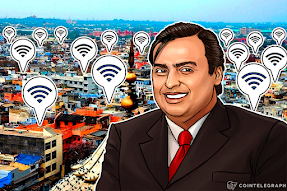
Looking at the contemporary examples of Globalization, we get a strike of reliance companies. Which has turned into a threat to various other companies like Vodafone, Idea, Airtel etc. There was a time where BSNL was considered to be the best but this globalization and privatization failed BSNL. Recently, Vodafone and Idea had to merge together for their existence. Vodafone-Idea merger: A telecom giant is born amid Reliance Jio threat


Examples from the Bollywood

Ghayal Once Again

the conflict of youngsters who witnessed Murder of RTI activist against multi-business owner Bansal (represents Ambani's)

Reluctant Fundamentalist
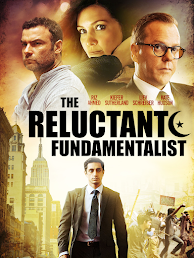

the conflict between market fundamentalism and religious fundamentalism in the aftermath of 9/11

Zee5 Original Web-movie 'Tigers'


based on a Pakistani salesman's conflict with giant MNC Nestle

Madaari

The conflict between common man (father whose child died in bridge crash) and nexus between construction company and politicians

Sonali Cable

conflict between a girl who runs local tv/internet cable service vs giant company 'Shining' which started providing broadband

Rang De Basanti

A nexus between politician and businessman vs young college boys (one them has to murder his own father who was corrupt businessman before murdering the politician)

Real incidents



The NestlĂ© boycott can be seen as special in a sense that it linked human rights regulations and humanitarian activism with corporate responsibility and market capitalism. Consumers were basically acting as global citizens by aiding people in need outside their close communities – mothers in developing countries –, “using the marketplace not as a way of generating revenue, but rather as a space for protest”.
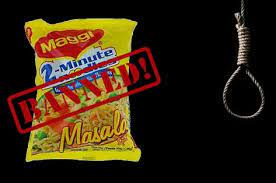


But in 2015, Maggi was also at the center of a massive food safety scandal, during which the noodles allegedly tested positive for high lead content, and the Food Safety and Standards Authority of India issued a brief, nationwide ban on all Maggi products.



Pesticide residue was 24 times above limits set by the Bureau of Indian Standards in 57 samples tested, the report said. In one bottle of Coca-Cola bought in Calcutta, the level of the carcinogenic pesticide Lindane exceeded the bureau's standards by 140 times.



The blog is quite lengthy, I have tried to give the overall idea presented in the essay. I hope it will be useful. Thank you.

[Words- 2700]

Wednesday, 9 November 2022

Sunday reading- My Daughter Joined a Cult

Hello! This blog is a response to a Sunday reading task assigned by Yesha Bhatt ma'am. This blog deals with the review on a web series named 'My Daughter joined Cult ' as part of the thinking activity in reference to 'The Wretched of the Earth ' by Frantz Fanon. Here, we will see how a man flaunts himself as a powerful person and traps everyone and its real life incident.

MY DAUGHTER JOINED A CULT


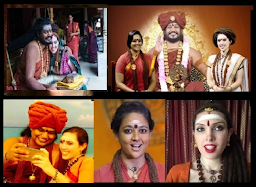
The three-part series, produced by VICE Studios, follows the story of the self-styled godman whilst giving a voice to individuals who were at the epicenter of it all. Directed by Naman Saraiya, the show captures the exposure of the godman, who allegedly deceived his believers by luring them into joining his ashram and gurukul trust ‘Nityananda Dhyanapeetam’, and then later allegedly abused them.


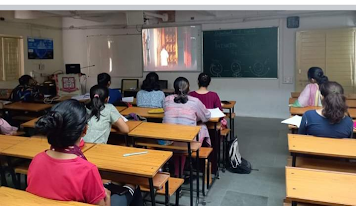
We had the screening of this Docu- series at our Department. We watched this documentary for a better understanding of Frantz Fanon’s Wretched of the Earth.

India is a country of religion, spirituality and mysticism but with the increasing time, the fraud in the religion is also increasing. In recent times, we have seen so many people who fake themselves as a spiritual person or a sadhu baba and brain- wash hundreds of people and do fraud with them, financially, physically, mentally or psychologically. Here is the list of some fake Indian sadhus. In this blog we will discuss in brief about Nityananda Swami, a self-styled godman who has run away and formed his own new country named Kailash with an individual flag and currency. In August 2020, Nityananda launched the Reserve Bank of Kailasam and released its official gold currency, Kailashian dollar. He said the design of the coins was inspired by the currency of "the ancient 56 Hindu nations"

The documentary on Nityananda Swami, My daughter Joined a Cult begins in 2019, as a desperate Janardan Sharma and his wife arrive at Nithyananda's ashram in Ahmedabad – desperate to find their two daughters who were brought here from Bengaluru without their knowledge.

"Please ask them. Ask them where my daughters are!" cries the wife to journalists there, who have just begun to unravel the devious schemes underway in this nondescript ashram.

To this family, ahead of the 'abduction,' Nityananda was a guide, philosopher, and spiritual guru.


BRAINWASHING
Swami Nityananda is an educated person and has a degree of Engineering. We all know that everyone has some minor or major issues in real life and common issues have common solutions like having a control over nature, changing the behavior, living with family and time management. Guru like Nityananda start playing mental games with the devotees by giving this basic answers to solve their problems.

Sarah, who was a well- recognized devotee of Nityananda, explains how followers at the ashram did 'mental gymnastics' to actually disbelieve allegations against their guru, despite evidence staring them in the face.


‘If We Don’t Do as He Tells Us, We Are Made To Seem Like a Raakshas'

The former head of Nithyananda's social media team, Sarah Landry, and another core member, Jordan Loazada, add depth to the documentary as they clearly demarcate when they went from thinking that they had chosen an alternate way of living to realizing they had joined a cult.

Nityananda used to keep everyone with love and care. When they became blind devotees, slowly and steadily he started taking advantage whether he is a female or a male. He used to say that having a physical relationship with him is a Prasad of a God. He used to call himself Avatar of Lord Shiva.


BHAKTA
When the series started at that time Nandita's parents tried to find her but when she got she refused to come back home as she is happy with Nityananda. So people who follow Nityananda can see the truth but they're not able to accept it as it was about baba. For them, Nityananda is 'ADHINAM'.

His narcissism, arrogance, and overconfidence is well captured through footage from his own social media channels, but while they mention that he has powerful benefactors and supporters, they do not go beyond the surface of this story line.

Bhaktas, devotees of Nityanand were blind. They were not ready to accept the truth of Nityananda. There were many less devotees who stood up for themselves and came forward and brought out the truth of the fraud. people were blind behind him, they used to get hypnotized by him, they were not even ready to listen to their family members and their parents, they were ready to leave their social life to be a devotee of Nityananda.

ENGLISH LANGUAGE
As we all know, the English language is a Universal language. outside India people might not know Hindi, Gujarati but they can easily understand English and the English language had a lot to do with Nityanadswami to increase his fame. Due to the help of the English language he became an internet sensation overnight. Sarah Landry who helped him to make his YouTube videos and his funny videos, a lot of memes got viral based on Nityananda Swami. he got viral over the social media which help him to attract more devotees towards him which increased his fame in the society. he didn't only had an Indian devotees there were large number of foreigner devotees who were subdued to Nityananda not. only the common man but we also find a Tamil actress who was his devotee and their MMS also went viral.


Why do people believe him even after the CD incident?

People believe in himbecause when media interviewed him he claims that this video is morphed by some one he has given witty reply on this incident even his devotee also believe that video is morphed Immediately after the scandal broke out on March 2, Nityananda had claimed that some of his senior devotees had sent a copy of the video for analysis to London - a step which was never taken. They don't want to know about the reality or dark side of Nityananda because of their blind faith.


CONNECTING TO ‘THE WRETCHED OF THE EARTH’.
Of course we can see the clear connection between the wretchedness of the earth and Nityananda 's way of attracting his devotees after watching the docu- series based on him, my daughter joined a cult. The first topic if we see is of colonization- how White people came into India and this slowly and steadily started showing us that they are superior and we are barbarians. And so they have come to our country to civilize us and teach us how to live. by torturing and brainwashing they started colonizing us as we so in the docuseries. if the devotes is after the time wanted to leave the Ashram or discontinue to be the devotee of Nityanand they were not allowed and if they went against it and they were beaten physically tortured.

The bourgeoisie class of the society, the celebrities and upper class people politicians helped from the people who were finding them. As we see that when he was to be jailed, the media was getting a chance to talk with him. They had an interview with him but police were not able to catch Nityananda. The question arises how it's possible that the media is able to contact Nityananda and have an interview but this is not which completely shows that an upper class society was helping him and that was letting him to do all the frauds.

Is the Decolonization of this possible? Does it lie in atheism?
Yes, decolonization is possible. But for that devotees need to have the power of acceptance. They need to accept the truth of Nityananda and remove the blindfold of his fake power. As the third world countries could decolonize themselves from the 200 years rule/ colony of Britishers.

To come out this fraud doesn't mean to distrust everyone. But to keep your eyes open and accept when someone tries to bring you out of the trap you are in. Being a devotee doesn't mean to be blind. Fanon maintains that colonialism divides the world into light and dark—or in this case, black and white—in a process he refers to as Manichaeism. In the series baba divided people into believers of non-believers.

This documentary aptly shows a journey of GODMAN to CONMAN

Nityananda, who faces charges of illegal confinement of children and has been charge-sheeted in a rape case, fled the country in 2019. There were reports later that year stating that he had created a Hindu nation, Kailasam, with its own flag and political setup on an island near Ecuador.

I hope this bog is useful. Thanks for visiting.
[words- 1500]

Saturday, 5 November 2022

Assignment 205: Cultural Studies

 Popular Culture


Name – Jheel Barad

Roll No.: 12

Enrollment No.: 4069206420210003

Paper no: 205 (A)

Paper code: 22410

Paper name: Cultural Studies

Sem.: 3 (Batch 2021- 2023)

Submitted to: Smt S.B. Gardi Department of English, M.K. Bhavnagar University

E-mail- jheelbarad@gmail.com


There was a time before the 1960s when popular culture was  not studied by academics- when it was, well, just popular culture. But within American Studies programs at first and then later in many disciplines, including semiotics, rhetoric, literary criticism, film studies, anthropology, history, women's studies, ethnic studies, and psychoanalytic approaches, critics examine such cultural media as pulp fiction, comic books, television, film, advertising, popular music, and computer cyberculture. They assess how such factors as ethnicity, race, gender, class, age, region, and sexuality are shaped by and reshaped in popular culture.


Popular culture accounts for the taste of the common people. Often called low culture, the popular culture defines itself through the blatant disregard of the Elite class. popular culture is commonly associated with television, internet and comic books. In addition to the elite culture, popular culture is generally considered the antithesis of folk culture and working- class culture. The centerpiece of popular culture is the middle class which constitutes the maturity of society. popular culture is considered the mainstream culture of a society at any given point of time. it is amalgamation of the trends of that particular time period. Movies, music, and video games play a vital role in creating and propagating popular culture. It is generally considered more accessible for common people and suit their taste


The popular culture has origins in 19th Century England when it was considered the inferior culture of the common folk as opposed to the official culture of the common folk of the educated elite. After the rise of industrialization, the common people became more educated and spent more money on entertainment. This resulted in the emergence of entertainment that satisfied the needs of these newly formed middle class. With the education afford to the middle class being markedly different from that of the elite, the forms of entertainment of the middle class was also different. instead of complex plays and poems the educated middle class were much more interested in the newly emerged entertainment mode cinema. through popular music, cinema and comic books the popular culture became a platform of mass consumption.


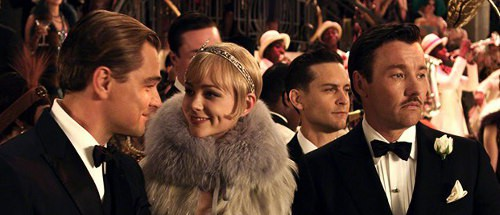
We can take an example of Fitzgerald's Novel ‘The Great Gatsby’ to understand the difference between the elite class and new working class and their growing culture. Jay Gatsby in the novel is a new rich person and so everything for him is new and he follows a popular culture like he throws parties and follows Jazz music which is not liked by the elite class society.


The advent of popular culture has paved the way to the rise of popular culture studies. At the core of what we know as popular culture studies today is the work of Scholars associated with or influenced by the Birmingham Center of Contemporary Cultural Studies. popular culture itself and intellectual interest in its risks and possibilities, however, long predate this moment. Earlier in the 20th century, members of the Frankfurt School took an active interest in what was then referred to as ‘mass culture’ or the culture industry.


Semiotics, emerging in the latter half of twentieth century as an exciting new methodology of cultural analysis, turned to popular culture for many of its objects as it redefined textuality, reading, and meaning. The works of Roland Barthes and Umberto Eco are exemplary in this regard. 


There have been many subsequent approaches to popular culture studies. important among these are feminist approaches to popular culture exemplified by work on Hollywood cinema and women's melodrama in particular, the study of images and representations through a Mass Communication approach , and ethnographic studies of readers of popular romances and television audiences. a minor, theoretically weak tradition of popular cultural studies initiated by Ray Browne parallelly in the United States may also be mentioned. More recently Slavojzizek has introduced new ways of drawing popular cultural text into philosophical debates. If all these can be taken together as constituting what is generally referred to as popular cultural studies today, it is still limited to the 20th century.

Popular culture has always faced fierce criticism from supporters of traditional, upper-class culture. in Britain Matthew Arnold and in his wake F.R. Leavis Ada undertook this task as they sought to insulate ‘the best of what was thought and said’ - essentially the upper class culture from the debasing influence of the commercial press and mass culture in general. but the history of popular culture as an object of Investigation and social concern goes further back still to the 19th and 18th centuries, the period of the rise and spread of mass literature, boosted by the rise of working class readership.


 Aside from precursors such as Umberto Eco and R. Barthes, popular culture studies as we know them today were developed in the late 70s and 80s. The first influential works were generally politically left wing and rejected the aristocratic view. However, they also criticized the pessimism of the Frankfurt School: contemporary studies on mass culture accept that popular culture forms do respond to widespread needs of the public. They also emphasize the capacity of the consumers to resist indoctrination and passive reception. Finally, they avoid any monolithic concept of mass culture. Instead they tried to describe culture as whole as a complex formation of discourses which correspond to particular interests, and which can be dominated by specific groups, but which also always are dialectically related to the producers and consumers.


An example of this tendency is Andrew Ross’s ‘No respect: Intellectual and Popular Culture (1989).  His chapter on the history of Jazz, Blues and rock does not present a linear narrative opposing the authentic popular music to the commercial record industry, but shows how popular music in the US from the twenties until today, evolved out of complexity.


There are four main types of popular culture analyses: 

  1. production analysis, 

  2. textual analysis, 

  3. audience analysis, and 

  4. historical analysis. 

These analyses seek to get beneath the surface (denotative) meanings and examine more implicit (connotative) social meanings. These approaches view culture as a narrative or story-telling process in which particular texts or cultural artifacts (i.e., a hit song or a television program) consciously or unconsciously link themselves to larger stories at play in the society. A key here is how texts create subject positions or identities for those who use them. 


Postmodernists tend to speak more of subject positions rather than the humanist notion of independent individuals. 

Production analysis asks the following kinds of questions: Who owns the media? Who creates texts and why? Under what constraints? How democratic or elitist is the production of popular culture? What about works written only for money? 

Textual analysis examines how specific works of popular culture create meanings. 

Audience analysis asks how different groups of popular culture consumers, or users, make similar or different sense of the same texts. 

Historical analysis investigates how these other three dimensions change over time.


Chetan Bhagat (born 22 April 1974) is an Indian author, columnist and youtuber. He was included in Time magazine's list of World’s 100 Most Influential People in 2010. Chetan Bhagat writes in very Indian language, it has no great quality like the professional writer who wins the booker prize etc. but he is read a lot by many people and loved too. But he is trolled for writing in the local language by many readers. He plays a great role in Popular culture and its reading. 


Popular culture is the totality of distinct memes, ideas, perspectives, and attitudes that are deemed preferred per an informal consensus within the mainstream of a given culture. heavily influenced by mass media and perpetuated by that culture’s vernacular language, this collection of Ideas permeates the everyday lives of the society. Popular culture is often viewed as being trivial  and dumped down in order to find consensual acceptance throughout the mainstream. as a result of this perception, it comes under heavy criticism from various scientific and non main- stream sources which deem it superficial, consumerist, sensationalist and corrupted


 It is manifested in preference and acceptance or rejection by features in such various subjects as cooking, clothing, consumption, and the many facets of entertainment such as sports, film, music and literature.


Popular culture is what we have made out of products and practices of mass produced culture. popular culture is an expensive content that is produced and consumed. It is light entertainment that is delivered through the channels of mass media and finally absorbed voluntarily, to be observed by the individual who receives it. Popular culture consists of the many facets of music, fashion, slang, and entertainment and the newer forms of media like the internet.


Advertising promotes more than a product in our popular culture. images used in advertising are often idolized; they eventually set the standard which we in turn feel we must live up to. Advertisements serve to show us that the ideal image is, and further  tell us how to obtain it. Advertisers essentially have the power to promote positive images or negative messages. This in turn affects our culture.


For example the cosmetics and fashion Industries keep telling people that they will improve their self image with their cosmetics for fashion.

Works Cited

What Is Pop Culture? | Mr. Pop Culture, https://mrpopculture.com/what-is-pop-culture/. Accessed 5 November 2022.

gowda, sukesh, and Nadeem Siddiqui. “Advertising and culture.” SlideShare, 27 April 2011, https://www.slideshare.net/sukeshgowda/advertising-and-culture. Accessed 5 November 2022.

Hayes, E. Bruce. Rabelais's Radical Farce: Late Medieval Comic Theater and Its Function in Rabelais. Taylor & Francis, 2016. Accessed 5 November 2022.

Kaushal, Sweta. “Chetan Bhagat, please stop writing books, concentrate on Bollywood instead.” Hindustan Times, 2014, https://www.hindustantimes.com/books/chetan-bhagat-please-stop-writing-books-concentrate-on-bollywood-instead/story-WQG3VzHs9oFjSXwLVQ5X8H.html.

“Popular Culture & Globalization: Teacher Candidates' Attitudes & Perceptions of Cultural & Ethnic Stereotypes.” ERIC, https://files.eric.ed.gov/fulltext/EJ1090398.pdf. Accessed 5 November 2022.

Venugopal, Rajitha, et al. What about theory? Bodhi Tree Books, 2019.

Assignment 204: Contemporary Western Theories and Film Studies

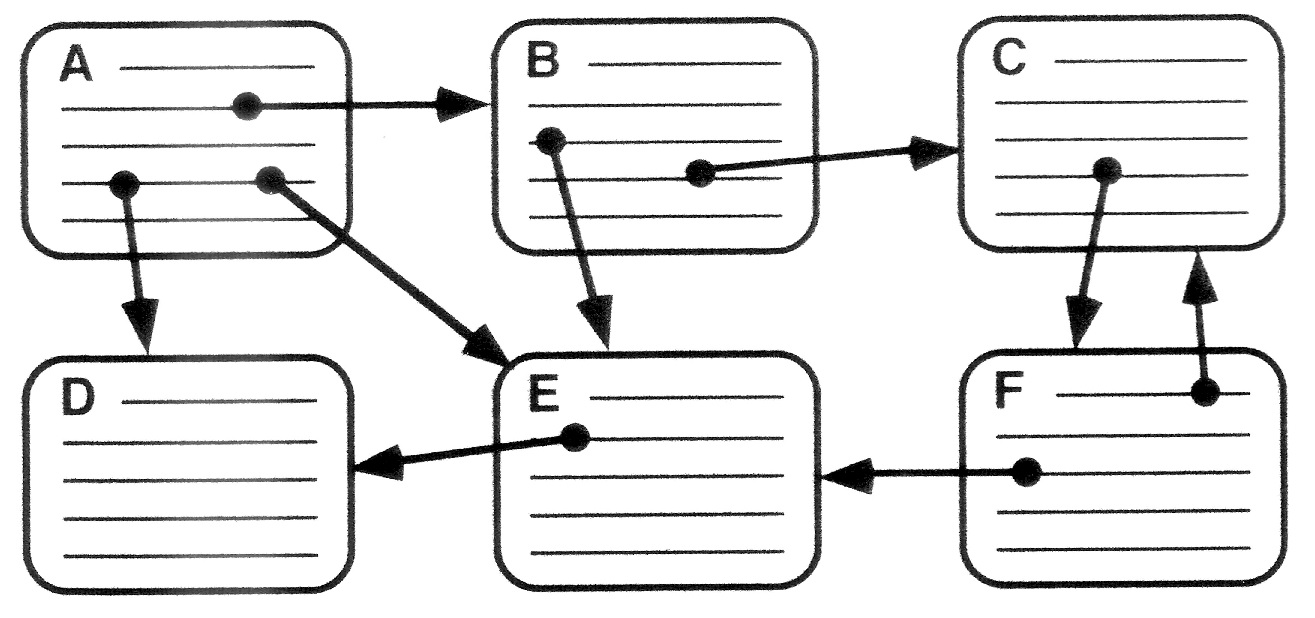
Hypertext

Name – Jheel Barad

Roll No.: 12

Enrollment No.: 4069206420210003

Paper no: 204

Paper code: 22409

Paper name: Contemporary Western Theories and Film Studies

Sem.: 3 (Batch 2021- 2023)

Submitted to: Smt S.B. Gardi Department of English, M.K. Bhavnagar University

E-mail- jheelbarad@gmail.com


Digital Humanities

Digital humanities promotes understanding of culture through digital technology. The perspective that stands out most prominently in digital Humanities is the interest of the theorist in hypertext. researchers have shown the convergence of hypertext and poststructuralist theories. For example; George P. Landow in the book ‘Hypertext;: the Convergence of Contemporary Critical Theory and Technology’ (1992) makes a very insightful and exhaustive study of this kind. it is therefore worth knowing the parallels between hypertext and postmodern/ poststructuralist ideas

Introduction to Stuart Moulthrop’s ‘You Say You Want a Revolution? Hypertext and the Laws of Media’


Stuart Moulthrop,  in his essay offers an insightful account of the history, nature and function of hypertext. He discusses the convergence of hypertext and contemporary critical theory in particular.

  • The first part of his present is the history of hypertext.

  • The second part of a balanced view of the role and utility of hypertext and 

  • The last part discusses the relation of hypertext to contemporary critical theory.

  • Unlike many supporters of hypertext and hypermedia, Mouthrop does not expect hypertext to bring any Revolutionary change in human culture. 


Origin of Hypertext:

The concept of hypertext originated with Vannevar Bush in 1945. He was science advisor to President Roosevelt and an Electrical engineer who designed an early computer. He wanted to build a machine called ‘Memex’ to help researchers organize disparate sources of knowledge. His project did not succeed but the appearance of electronic computers on the academic scene proved that his predictions were right and practically viable. The next development in this direction was the creation of an animation game called ‘Adventure’ by artificial intelligence researchers in the early 1960s. This was the first hypertextual narrative. Around this time, Theodor Holm Nelson, an American philosopher, sociologist and expert in information technology coined the term hypertext. His dream project was to create a worldwide network of information he called this project ‘Xanadu’. one of the noted computer scientists Douglas Engelbart, one of the pioneers of the user interface design, entered into the collaboration with Nelson. They prepared a hypertext system called FRESS (file retrieval and editing system) around University in the early 1970. Nelson saw hypertext as a dynamic computing system in which readers could both use and change the textual corpus.


Relation of Hypertext to Humanities:


"non-sequential writing -- text that branches and allows choices to the reader, best read at an interactive screen. As popularly conceived, this is a series of text chunks connected by links which offer the reader different pathways"  

-Ted Nelson


Moulthrop mentions some critics and their works that finally took note of hypertext and its utility in the study of humanities. Jay David Bolter’s  ‘Writing Space’ (1991) offers a historic view historical view of hypertext; Ted Nelson’s ‘Literary Machines’ presents for the first time the study of hypertext in hypertextual form; George Landow’s ‘Hypertext’ (1992) discusses the hypertext within the context of both the poststructuralist and postmodern theory. Moutthrop refers to the datedness of the technology that we use and the human tendency to look for the new. he agrees with objection that hypertext has not fully lived up to its promises in the sense that it has not caused the expected revolution to materialize by replacing the old information order with the new one. but he argues that such expectations in the postmodern context do not make much sense. 

  • Jean Baurillard proposed his theory of simulation. He argued that in the postmodern condition representation is replaced by simulation and therefore there is no reality but hyperreality. 

  • Jean- Francios Lyotard French philosopher and the literary theorist rejected all traditional literary and cultural narratives as a grand narrative and their consequent failure in explaining the complexity of the postmodern condition.

  • Donna Harraway, an American feminist critique has carried out interdisciplinary studies of technology and gender. Her approach to science, gender, nature and humanity has challenged the common sense and assumptions of and about this field. 

By referring to these theorists with many different pursuits, Mouthrop brings out the parallel between hypertext and electronic medium.


Necessity and distinctiveness of Hypertext:

Moulthrop Argues that it should not be dismissed as a local movement and as a preserve of a few in the technological elite.  In order to prove this he relates and compares hypertext to the postmodern notion of simulation. simulation is a postmodern Theory proposed by Baudrillard which states that there is nothing real and primary in the original and pure sense in the world. The other connection of hypertext is to the vision in a dream seen by S.T. Coleridge as described in his famous poem ‘Kubla Khan’. Moulthrop sees no problem with  revising Coleridge’s  dream in a new post modern context when the line of distinction between reality and dream is blurred and the concept of originality is complicated. Through computation this dream becomes a reconstruction of text not as a fixed series of symbols but a variable access database in which the reader/ writer can forge new links. Ted Nelson’s project xanadu is one such reconstruction of this dream. 

In his  discussion of the usefulness of hypertext more does not disregard the troubles that the concept of populism may cause,  he mentions two problems-

The first is that such social/ textual order will give benefits to only a few and that those benefited will not understand the responsibility of distributing accept Among many

The second problem is that information has virtually become equivalent to capital. textuality shapes information, but this could be appropriated by the capitalist system to their benefit. 


Moulthrop proceeds to explain the projected function or role of hypertext in creating a social/ cultural order based of populism. he offered his explanation in the framework of the four questions provided by Marshall Mcluhan in his work on media and Technology which word posthumously published as ‘The Laws of Media: The New Science’ in (1988), formulas four basic questions that can be asked about any invention. Moulthrop  applies these four questions and interprets hypertext accordingly.


Here are the four question and answers in brief:

McLuhan first question-  What does hypertext enhance or intensify? 

The answer: Hypertext enhances our sensitivity.


The second question- What does hypertext displays or render obsolete?

The answer: Hypertext displaces ‘post- literacy’ in the age of television and revives typographical culture.


The third question- What does hypertext retrieve that was previously Obsolete?

The answer: hypertext retrieves literacy 


The fourth question- What does hypertext become when taken to its limit?

The answer:  When taken to its limit hypertext becomes a new cultural space.


Features of Hypertext-

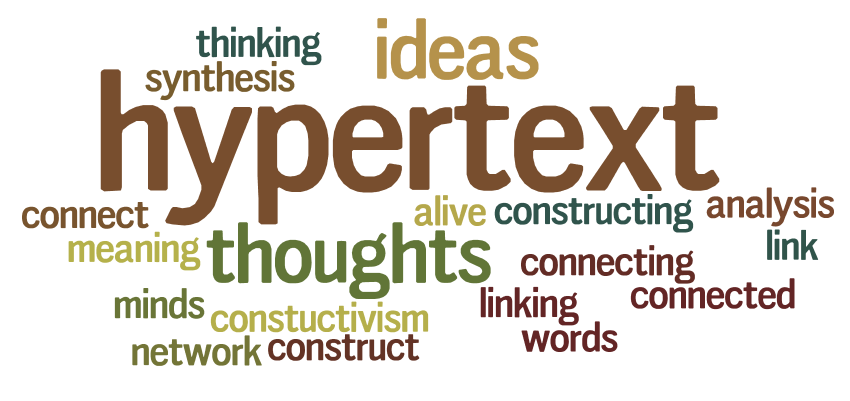
  • Hypertext is an electronic text that contains links to other texts. It is a form of textuality composed of blocks of words and links that opens several other reading links. it is not limited to text but includes Graphics, images, videos and sound. it is open to change and accessible to all. it is not based on any absolute and it remakes and is remade constantly. 

  • Hypertext is not linear and compact. It is multilinear in the sense that it draws from several discrete sources and actively encourages users/ researchers to explore other media and fields of thought by making several further other  links available within the body of the text.

  • Users/ readers can customize the hypertext to the form and appearance they find best suited to their utility, purpose and Desire.

  • Electronic links provided within the hypertext reconfigure text and create an ever- multiplying and ever- changing chain. This history of reconfiguration moves text, readers and writers into a new writing space.

  • The multiple reading links shift the power balance between reader and writer. Reconfiguration of the author and the authorial real property constantly takes place as the reader and the role of the author reconfigures his text.

  • Hypertext is a network of connection to other texts. thiscan as well be understood as connections of knowledge which are distributed throughout the network. it is neither localized nor restricted to a particular electronic space or memory.

  • Networking leads to democratization of the entire process of knowledge creation and distribution. Separations  like main text or original text at annotation create hierarchical distinctions. But hypertext removes such distinctions.

  • Moulthrop offers a balanced, impartial and insightful assessment of hypertext and convincingly claims that electronic media has the potential to create a new social cultural order. 


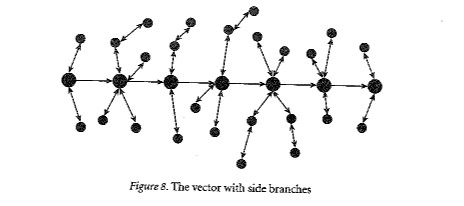
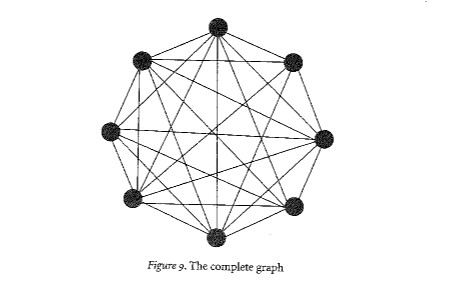
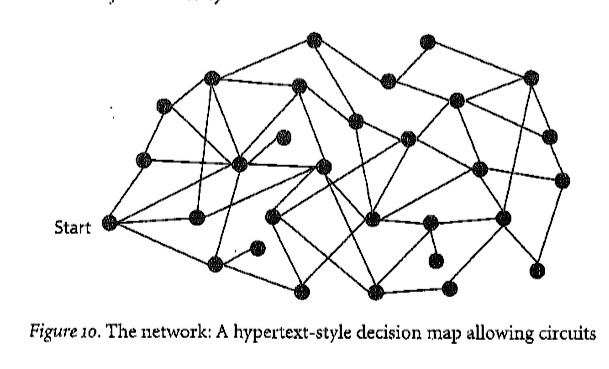
Patterns of Hypertext

Hypertext presents itself as a multi-dimensional cognitive environment where linguistic, graphic, visual and audio elements intersect in a network structure. Digital writing is transitory, changeable, open, infinitely reproducible, and mostly online.


The dimensions of the text are distributed from centralized to distributed.


Patterns of hypertext texts


  1. The vector with side branches


 E.g.: Inanimate Alice


  1. Complete Graph


  1. Network

E.g.: My Body - a Wunderkammer


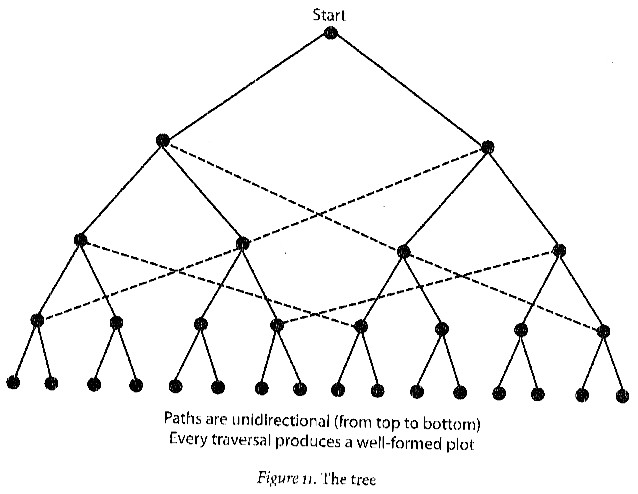
  1. Tree

E.g.: The Incipit


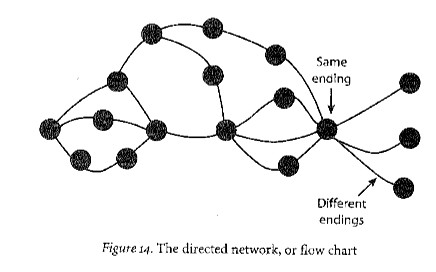
  1. Maze


  1. Flowchart


Works Cited

Inanimate Alice - Inanimate Alice, https://inanimatealice.com/. Accessed 5 November 2022.

“Come funziona.” THe iNCIPIT, https://theincipit.com/come-funziona/. Accessed 5 November 2022.

Kulkarni, Anand B. An Introduction to Literary Theory and Criticism. Orient BlackSwan, 2016.

McDaid, John, and Arthur Newkirk. “Bernstein: Patterns of Hypertext.” Eastgate Systems, https://www.eastgate.com/patterns/Print.html. Accessed 5 November 2022.

“'my body' - a Wunderkammer & (Shelley Jackson).” Electronic Literature Collection, https://collection.eliterature.org/1/works/jackson__my_body_a_wunderkammer/index.html. Accessed 5 November 2022.

Ryan, Marie-Laure. Narrative as Virtual Reality 2: Revisiting Immersion and Interactivity in Literature and Electronic Media. Johns Hopkins University Press, 2015.

My Learnings from the National Workshop on Academic Writing (2026)

The National Workshop on Academic Writing  I recently had the opportunity to participate in the National Workshop on Academic Writing (2026)...