Electronic Literature and Artificial Intelligence (AI): Theory and Practice of Digital Storytelling
Recently I attended an Online course on the Gian platform on ‘Electronic Literature and Artificial Intelligence (AI): Theory and Practice of Digital Storytelling’ hosted by Prof. M. Rizwan Khan, The Department of English Aligarh University, Aligrah, U.P. in a virtual mode. This blog deals with my learning out of attending this interesting course.

What is Gian?
Gian is Global Initiative of Academic Networks. It is Govt. of India’s approved new program in Higher Education aimed at tapping the talent pool of scientists and entrepreneurs, internationally to encourage their engagement with the institutes of Higher Education in India so as to augment the country's existing academic resources, accelerate the pace of quality reform, and elevate India's scientific and technological capacity to global excellence. [Visit GIAN website]
The basic knowledge I had about Digital Humanities and Electronic Literature.
The title, Digital Humanities contains two terms- digital and hiumanitites.it combines traditional and modern modes of critical understanding. Humanities in its traditional Avatar consists of various text-based disciplines which study classics, literature, philosophy, performing arts, media and communication and cultural studies. Digital Humanities is a new variant which uses informational Technology as a method of research in traditional human disciplines like literature and the performing arts.

Digitalising Humanities, Literature is always helpful for easy and fast reading and references along with digitizing text increases its availability. We know how tiring it is to go to the library and search for books. Ctrl F works as a magic wand to easily take the reference of what we want in a particular book if it's digitalised.
Today technology is also able to create literature, generate literature which has emerged as ‘generative Literature’.
Electronic Literature

There is no specific definition of E- Literature. Basically, Pdfs, Written and posted can not be considered E- literature. Electronic literature is coded literature.
N. Katherine Hayles defines electronic literature as "'digital born' (..) and (usually) meant to be read on a computer", clarifying that this does not include e-books and digitized print literature. A definition offered by the Electronic literature Organization (ELO) states electronic literature "refers to works with an important literary aspect that takes advantage of the capabilities and contexts provided by the stand-alone or networked computer".
This can include hypertext fiction, animated poetry (often called kinetic poetry) and other forms of digital poetry, literary chatbots, computer-generated narratives or poetry, art installations with significant literary aspects, interactive fiction and literary uses of social media.
E- literature has no specific author, it is collaborative (Reading + Writing). A reader itself can select what he/ she wants to read and after which chapter what to read. There is no continuation. Every reader forms his/ her own story. It’s a non- sequential reading, pioneer less narratology, multilinear, plotless, anti- novel, lack of particular meaning and interpretations keep on changing.
Digital humanities in a way saves our time of re- reading and helps us to come to our conclusion.
As an e- literature I have read Sultana’s Dream by Aphra Shafiq.
Further this blog will deal with blogger’s learning outcome from the online Gian course.


Day- 1
Lecture 1: Prof. Paola Carbone [Foreign faculty, Department of Humanities IULM University, Milan]- about ‘Definition of E-Literature
E-Lit was founded by the Electronic Literature Organization in 1999.
Elit- written with a digital device and need a digital device to be read/experienced.
Joseph Tabbi on Electronic Literature "an emerging cultural form" (2007). And here are various FOUR volumes of E- Lit: Electronic Literature Collections
Examples of E-Literature is ‘Love Letter’ (1952) by Chtistopher Strachey. One can generate a love letter, E- Love letter.
Techno-logique is the logical process determined by a technology.
Writing in a digital environment means designing narrative and reading processes. That is a network of possible readings and a human–machine interaction mediated by machine code


(Images are hyperlinked)
Digital writing: a non-linear type of writing.
Precursors- its roots in experimentalist writing and the work of European vanguards such as Laurence Sterne, Stephane Mallarmé, Tristan Tzara, T.S. Eliot, William Burroughs, Julio Cortazar, Italo Calvino, George Perec, and Marc Saporta, as well as OULIPO, Futurism, and Dadaism.
Formal ideas crucial to digital communication, such as abandonment of linearity, narrative fragmentation, montage, and multimedia convergence.


(Images are hyperlinked)
Philippe Bootz:
[In eLit it] is not only (or no longer) the product of a process that is represented but the process itself.
Process
- The process is written in the algorithm.
- The poetics of the work is enshrined in the
- algorithm
- The human-machine interaction defined by
- the process is called cyber-feedback-loop
Rosemarie Waldrop:
“We do not usually see words, we read them, which is to say we look through them at their significance, their contents. Concrete poetry is first of all a revolt against this transparency of the word (…). Concrete poetry makes the sound and shape of words its explicit field of investigation (…). Further, it stresses the visual side which is neglected even in the ‘sound and sense’ awareness of ordinary poetry
Concrete Poetry- “the new poem is simple and can be perceived visually as a whole as well as in its parts. It becomes an object to be both seen and used; an object containing thought but made concrete through play-activity,


Text rain- https://youtu.be/f_u3sSffS78
Lecture 2: Prof. Mohd. Rizwan Khan [Host Faculty, Department of English Aligarh Muslim University, Aligarh. U.P., India] - ‘Digital Humanities’.
What is Digital Humanities?
Use of Digital tools in the analysis of language, literature, visual and performing arts. Use of computer- related technologies in analysis, research, production and publication.
First work relating DH in the 1940s by Father Busa Index Thomisticus.
DH involves collaborative, transdisciplinary and computationally engaged research, teaching and publishing.
Features- Accessibility, Malleability and Interdisciplinary.
Two waves of Digital Humanities. First wave work was quantitative; second wave work is qualitative, interpretive, experimental, emotive, generative in character.

Examples:
Day-2
Lecture 3: Prof. Paola Carbone [Foreign faculty, Department of Humanities IULM University, Milan] on Definition of Digital Storytelling: Difference between 'telling a story' and 'creating storytelling
“Storytelling” is considered the realm of those who work in communication. For them rhetoric, for example, does not seem to have anything to do with literature. Not even narratology! It is not unusual to hear 'communicators' take on the authorship of things already said by, for example, Aristotle.
Digital Storytelling
Storytelling does not mean 'telling stories', it is more like “talking through stories”
“Telling a story” does not mean to create a story. Storytelling consists in 'creating' representations' (textual, visual, acoustic, perceptive) made in order to move, to touch, and to establish a relationship with the audience.
Storytelling is the shaping of a reality in order to connect people/readership to it, shaping an experience for the audience.
eLIT is made of process + experience
Digital + storytelling = digital media and narration
Narration/Literature: content + form + medium
Digital Media: different technologies + reading/writing surfaces/interfaces + interaction
Create emotions in the audience!
Stories are used to inspire, to persuade.
The one who writes for a digital environment is an experience designer
Types of stories:
Sequential: the different dramaturgical lines of the story follow each other without overlapping
Parallel: the different dramaturgical lines of the story run side by side without ever clashing in the different platforms
Simultaneous: multiple lines begin and end by sharing the same portion of the story across multiple media
Non-linear: storylines are fragmented and reconstructed in deliberately disjointed sequences
Example of Digital stories:
- Stories on Instagram
- Short videos used both for advertisements (Patagonia) or to activate social campaigns [Little lobbyst]
- Cultural communication [Library of the congress using story maps; The PALABRA Archive from the Hispanic Reading Room]
- VR/metaverses: characters, environments, themes, coherent creative and narrative universes, conflicts, identification and personification >> metaverses are creative universes to build

Case Study:
- Telling stories of victims or cases through the website of the organization for redemption, change and hope
- Little Lobbyists- Little Lobbyists seek to protect and expand the rights of children who have complex medical needs and disabilities through advocacy, education, and outreach.
- Scott Harrison, charity: water
- Every Australian Counts
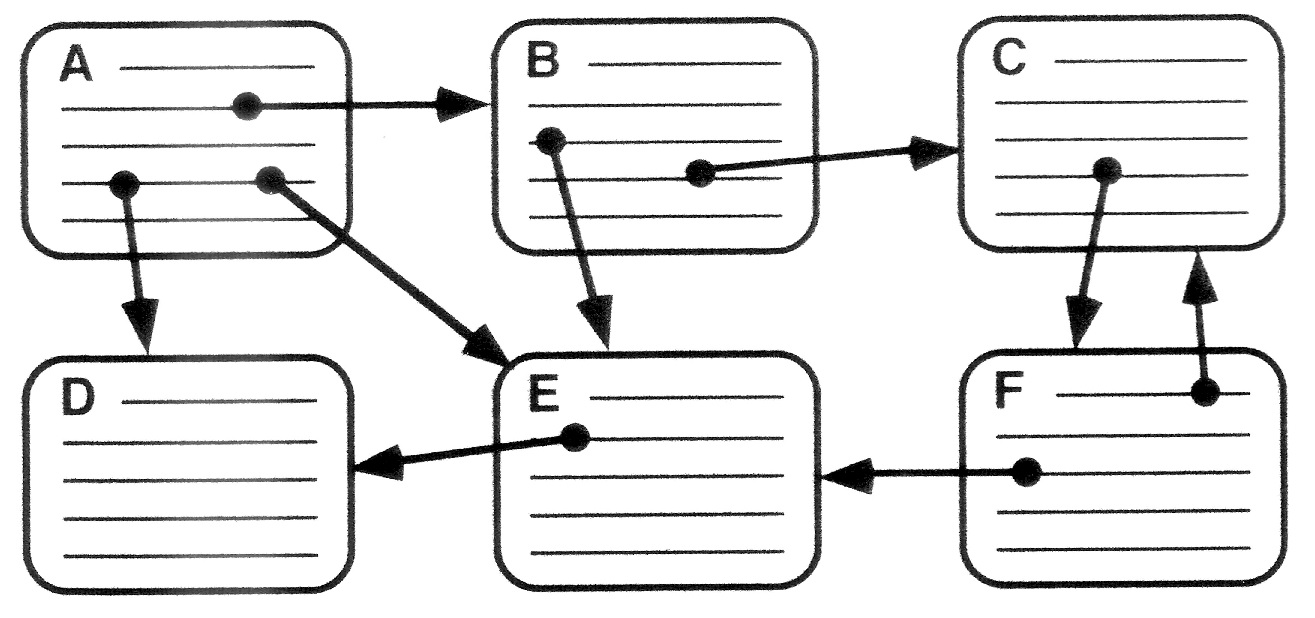
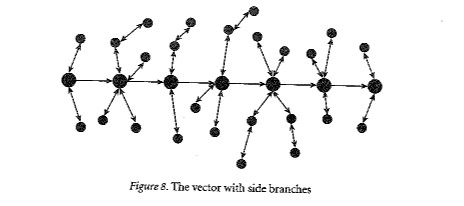
Definition of Hypertext as a Topographic form of writing; Peculiarities of a Non-Linear writing; Flowcharts; Hypertext; Flowcharts and Hyperlinks.
While writing digital media, we have to keep in mind the process of reading.
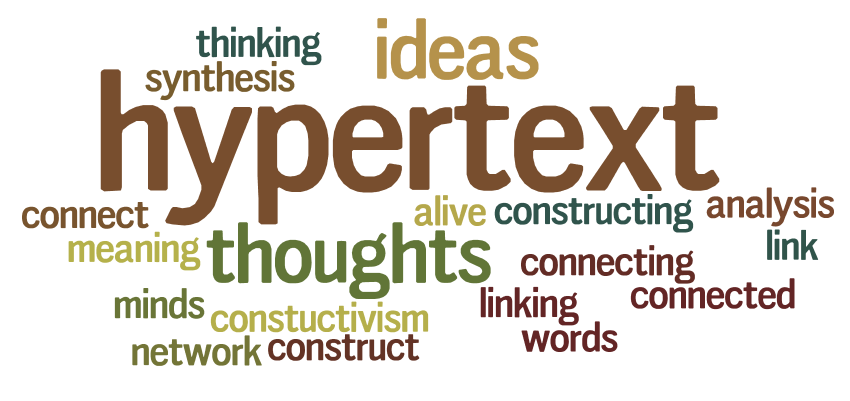
A book is organized linearly and hierarchically (in chapters; you read one page after the other); a digital textuality is not! Instead of linearity we talk about non-linear storytelling, even if the reading process is sequential (that is one Lexia after the other). This form of writing is called “hypertext”. The term was coined in 1965 by Ted Nelson
"non-sequential writing -- text that branches and allows choices to the reader, best read at an interactive screen. As popularly conceived, this is a series of text chunks connected by links which offer the reader different pathways"

Non-sequential reading
(user chooses where to start and how to continue browsing)
No fixed reading time
(the reading ends when the user is satisfied)
Links can be internal
(within the same website)
or external (to other websites)
The main feature that distinguishes hypertext from other literary works is, what Jay Bolter calls, the space of writing.
Michael Joyce, Of two Minds, states:
“Electronic writing is both a visual and verbal description”, says Bolter, “not the writing of a place, but rather a writing with places, spatially realized topics […] signs and structures on the computer screen that have no easy equivalent in speech.” For Bolter, hypertext’s “electronic symbols […] seem to be an extension of a network of ideas in the mind itself.”
Lecture 4: Prof. Mohd. Rizwan Khan [Host Faculty, Department of English Aligarh Muslim University, Aligarh. U.P., India] on AI and Employability
Career opportunity in AI is directly proportional to Advancement. Employability skills can be defined as the Transferable skills needed by an individual to make them employable. Communication and interpersonal problem solving skills, organizational skills, team working etc.
What is AI?
Artificial intelligence is a field that combines computer science and robust datasets to enable problem solving, a human human cognitive capabilities such as reasoning, recognizing patterns, categorizing objects and similar, identify images and so on, it's an interdisciplinary enterprise.

How does the AI system work?
Machine learning algorithms are the heart of AI.

It is a structured training set carefully curated by humans.
AI is widespread. It is an integral part of everyday life and culture Smart home, devices, E-mail filtering, product recommendation, etc. marketing and e-commerce, Healthcare, Automotive hiring and education.
AI will lead to a decline in jobs for humans but it is an emerging discipline with the new demand in the workforce. Challenges in the AI implementation is the need for more AI skills and training. We need to invest more in AI courses. This discipline prefers a dynamic job profile that requires interdisciplinary knowledge and has a Digital participation.
AI Is to support human work instead of the replacement. human beings and machines need to work together in partnership, the triangle of Technology, human and Organization. human creativity, nonlinear thinking, common sense, the ability to make decisions, emotional intelligence and communicative and special abilities cannot be replaced.
AI in the future will be integrated into all disciplines including music, literature, etc. humanities discipline not only Engineering courses. Which will increase the scope of employability.
I hope this blog is useful. Thanks for visiting.