Saturday, 14 January 2023

Ministry of Utmost Happiness- Arundhati Roy [1]

Hello! This blog is assigned by Dr. Dilip barad sir. It deals with Arundhati Roy’s second novel ‘The Ministry of Utmost Happiness’. As a task, we are assigned three questions and from them, this blog deals with Characters, Narrative plot, and facts and fiction from the novel.

MINISTRY OF UTMOST HAPPINESS
Arundhati Roy

Points to ponder while writing a blog -
2) Three points: Characters, fact and fiction, and narrative. [The blog itself] 

-In brief About Arundhati Roy and The Novel:


Arundhati Roy is an Indian author and political activist, best known for her debut novel "The God of Small Things" which won the 1997 Man Booker Prize. Roy is also a vocal critic of Indian government policies and has been actively involved in various social and political issues in India, including human rights, nuclear weapons, and the treatment of marginalized communities. She also has been involved in environmental issues and anti-development movements. Roy's writing often addresses the complexities of Indian politics, history, and society, and she is considered one of the most significant voices in Indian literature. She is known for her powerful, evocative writing style and her ability to bring attention to important social and political issues.


The novel "The Ministry of Utmost Happiness" by Arundhati Roy is a work of fiction. The novel is set in India and touches on themes and issues that have affected the country in the past and present, such as political corruption, the caste system, and the ongoing conflict in Kashmir. Additionally, it covers the human rights and social issues of marginalized communities such as transgenders, hijras, and lower castes.

-Characters

Jahanara Begum- mother of anjum

Malakat Ali- father of Aftab

Anjum/ Aftab

Man who knew English

Ziauddin- Blind Imam

Ahlam baiji- midwife

Bombay Silk

Mary- the only Cristian

Gudiya and Bulbul (Hindu)

Razia

Nimmo Gorakhpuri

Begum- Kulsoombi (Leader od Khwabgah Haveli)

King Aurangzeb

Abhaychand

Harat Sarmad

Barte Khatum

Changez Khan

Zainab

Saeeda

Sakim (Anjum's brother)

Sadam Hussain/ Dayachand

Sangeeta Madam

Shehrawat

Tubby old Gandhian (Anna Hazare)

Mr. Agarwal (Kejriwal) 

Dr. Azad

Gujarat ka Lalla (Narendra Modi)

Manmohan Singh (Trapped rabbit)

Biplav Das Gupta

Chtrarupa (Biplav’s wife)

Rabia and Ania (Biplav’s daughters)

Hariharan Nagarjun- journalist

S. Tillotama (Tillo)- Ustaniji

Maryam Ipe (Tillo’s mother)

Musa Yeswi- terrorist

Arifa (Musa’s wife)

Jebeen (Musa and Arifa’s Daughter)

First Jebeen)

Baby- Jebeen, The second Udaya- Udaya Jebeen (baby found at Jantar Mantar)

Caption Amrik Singh

Lavleen Singh (Amrik’s wife)

Acp Pinky Sodhi

Balbir Sodhi(Pinky’s brother)

Khadijah (Musa appointed her with Tillo in Kashmir)

Aijaz (terrorist; has an interview encounter with Magarjun)

Jalil Qadri (Human right activist)

Revathy- Comrade Maase


-The Narrative Plot

The novel begins in Jannat Graveyard with a surreal image. “She lived in a graveyard like a tree..” This turns out to be an Anjum as we move in the story.
One of his clients who used to speak English said Anjum’s name is opposite to ‘Majnu’ but He was wrong Anjum means ‘Mehfil’. Ziauddin- The blind man comes to meet Anjum.

In the second chapter, we enter Khwabgah. (back story of Anjum) Anjum was born as Aftab to Jahanahar begum and Mulakat Ali, Aftab had born with the genitals of both male and female. Ahlam Baiji, a midwife announced that a boy child was born everyone was happy but the mother was not. But she thought that female genitals will seal with time and he will grow like a boy and so hid this fact from everybody. Jahanara had a series of reactions along with dying and killing a child also. And then the word ‘Hijra’, Kinnar’ was there in the world for the people like this child but this word didn't form a language. There comes a wonderful concept of the World outside the Khwabgah is Duniya- ‘Duniya wale’, The world of Khwabgah is introduced, and other characters living there.

Back life of Aftab. Aftab in the market saw a beautiful lady and followed him and reached Khwabgah later on we come to know that she was Bombay Silk. Kulsoombi was the leader of this Khwabgah haveli and she was very proud of the Hijra community, this haveli was built by the Mughal emperor and a special place and respect were given to Hijras in the Mughal empire. Kulsoombi used to take all these Hijras to Red fort where there was a light and sound show that used to show the history of Mughal emperors as it also reflected the special place of Hijras who used to take care of Mughal emperor wives. Here Roy signifies that is erasing the story of the Mughals and writing about the Rajput kings we are somewhere easing the story of Hijras also. in rewriting history, we erase many identities.

Jahanara Begum realizes the female genitals in Afatab are not vanishing and so she takes her to the Dargah of Hazrat Sarmad. there comes a consequence story of Sarmad. He came from the Iranian reign/ Argentinian to Delhi in the love with Abhaychand. He adopts Islam and also disowns it after some time. He used to road naked in the time of King Aurangzeb. He was caught and was asked to recite the whole ‘Kalima’ but he recite only ‘Laa Illaha’ which means there is no god and he was beheaded on the steps of Jama Masjid. Roy compares it with a post-modern element with a motorist, as a motorist is picking up his helmet, Sarmad is picked up his head and went to heaven.

Jahanhara had to talk about Aftab's reality to Mulakat Ali, He is an Hakim who makes medicine and he tells that he would have been told earlier they might have done some medicine but now it is too late. Mulakat Ali is not happy to live with a third-gender child. There comes a backstory of Mulakat Ali. there comes a reference to Changez khan- he was anti-Islam and considered a sky god. But one of his children after winning the Arabic world, came in contact with Islam and adopted Islam religion and spread it wide. On the other side, there comes a story of Changez Khan as a lover, His wife was Borte Khartum; he fought for his wife. There is a reference to Ramayan also where Rama goes for 14 long years canvas everyone cam to give him farewell, he addressed male and female and asked to return but forgot to address the third gender and they stood there for fourteen long years as they were not asked to return.

Aftab at the age of 14- 15 decides to live in Khwabgah as it's near to their house so he could be easily taken care of. Anjum starts her own life. Suddenly on the day she went out and visited Jama Masjid and there they found a child of around three years, Zainab, and they brought her to Khwabgah. She always had a cry for motherhood but medication didn't help. Anjum becomes the mother of Zainab. There comes the character of Saeed who is seen as Anti- anjum. Anjum was demanded at a young age her interviews were taken, and she was a hot favorite of Hijra. But Saeeda takes that place. Anjum feels Saeeda did black magic on Zainab and takes her to Ajemre Sharif with Zakir Mian. Zakir had relatives in Gujarat and they come to Gujarat. It was the period of 2002 and there comes the scene of Godhra kand. The riots were going on in response to it. Suddenly the connection was lost back is homeland, Sakim goes to find them and he finds the completely changed and new Anjum. She has lost her charm and connection with Zainab also. She starts dressing Zainab in a boy's dress, and the trauma of the riots changed her. On asking she says Zakir Mian was terribly killed there but she was spared as she was Hijra. She started flaunting himself as a man and started going against Kulsoombi’s rules. She left the Khwabgah and moves to Graveyard/ Jannat.

Anjum constructs them one by one room with help of Gupta in the graveyard and creates a Janat guesthouse. Here the story comes back to the beginning where Anjum is talking with Ziaudding- Blind Imam.

Further, Jannat Guesthouse gets one permanent guest Sadam Hussein (Muslim). He introduces himself as working in a government hospital near the graveyard and there comes satire of doctors who instruct the lower caste people to do works like postmortem and they are disgusted. Sadam has left his job and is working as a security guard with an agency handled by Sangeeta madam and presents the corruption of all these private agencies. Sadam was caught lying that he is Muslim which was caught by Anjum. Then comes a back story of Sadam, His real name was Dayachand, a Chamar from Haryana. In his childhood, his father used to do a job of skinning the skin of dead animals. It refers to the leaching of Dalits in Una, Gujarat which has happened in Haryana in the Novel. His father was caught by Shehrawat, he was standing outside the police station as his father went for negotiation. But then suddenly there was a group of people coming after the Dusshera celebration with slogans like ‘ jai Shree Ram’. Shehrawat called people that he has caught one who kills cows and Dayachand’s father was hitten and killed by a group of people. He says that when he came to Delhi, he saw America was hanging Sadam Hussein which was coming on tv, even when he was being hanged there was a sense of dignity on his face. So he adopted his name thinking one day he will also take revenge on Shehrawat and will be confident like Sadam.

Moving to Jantar Mantar/ protest site in New Delhi scene. A group from Jannat Guest house decides to go to Jantar Mantar as there was a lot of news about protests and people gathering. Reaching there they raised that it was not only one protest but many. The list of protests is-
  • Tubby Old Gandhian and supporters.
  • Mothers of Disappeared- Kashmiri mothers
  • Manipur nationalist; women against ARSPA
  • Delhi Kabadiwala
  • Bhopalis- against union carbide [gas kand]
  • One who wanted Hindi as the national language.
There also comes a reference to Irom Chanu Sharmila who was on the longest fast and story about it. The prominent figure Dr. Azad Bharti was protesting at Jantar Mantar for the last 11 years, he has adopted the name ‘Azad’. On the footpaths a small baby was found, Anjum decides to take the baby but others defended themselves as they were hijras, and there come Mr. Agarwal who fights with Anjum, and the police were called. Suddenly the baby was lost. Here the episode of Jantar Mantar ends.

The world of Kashmir. The novel is in the third person but here suddenly in the Chapter named ‘Landlord’ the narration changes to the First person, narrated by BiplavDas Gupta, He is in I.B. (Intelligence Bureau). S. Tillotama, is working in an architectural program in Delhi. They both were studying in the same college and were working on the same drama. Nagaraj Hariharan and Musa Yeswi, all these four characters are four friends in College. Musa becomes a terrorist, Hariharan Journalist, S. Tillotama is found in Kashmir around Musa. Tillo was non- Kashmir lady caught in Kashmir, she referred Biplav and was saved by Nagarjuna, Later after living together for fourteen years with Nagarjuna they got married. After many years she is found in Delhi, living in a rented room given by Biplav. When he is introduced he has just returned from Kabul and is visiting a rehabilitation center as he has turned Drunkard. His wife is Chitrarupa and his two daughters Rabia and Ania. The baby which was lost from Jantar Mantar was taken by Tillo. Dr. Azad suggests she keep/ give the baby in Jannat's guesthouse and this way they all get connected. The baby is known as Jebeen (later, Jebeen, the second). Musa, his wife Arifa, and their daughter lived in Kashmir. Accidentally Musa’s wife and daughter were killed in an encounter by security forces. And this caused Musa to be a terrorist. All this has a wonderful description in the novel.

Cap Amrik Singh was one who believed violence is necessary and many times killed many without any strong grounds. Once Jalil Qadri (famous among Kashmiri) was caught in simple checking by Amrik Singh and Later Qadri’s dead body was found in river Jehlum. People were angry and even team members of Amrik were against him, so Amrik and Lavllen left Kashmir and went to Jammu. But still, as they didn't feel safe there they went to Canada and from there to America and were living in California. There came the news of Amrik Singh killing his family and did suicide. The doubt arose that there must be some terrorists, might be Musa who went to California and killed them. It remains the secret in the novel, along with whose Jebeen first. Tillo was found missing so Baiplav went to her apartment, he found many documents and photos which made Bipav realize that Tillo knows a lot of behind things. Nagaraj Harihar who is a Journalist, and terrorist felt he is writing for them but he was the handler of the government. IB used to give him information that was to be leaked and it seemed as if a journalist has done an investigation. Nagaraj was also unaware that he was being used. Nagraj with an interview with Aijaz gets to know how terrorist groups work.

By the time, Sadam proposed to marry Zainab, they were married a month later. Dr. Azad came with a letter written to him at Jannat guesthouse by Revathy, she is the mother of Udaya (the baby found at Jantar Mantar) who was named Jebben, the second by Tio in memory of his friend Musa and his wife Arifa. Later the baby was known as Udaya Jebeen.

[in the last 20 pages there is a long letter written by Revathy of 9 pages]

The letter brings a tragic story of tribal people who saved the forest. Revathy was raped by six police officers and Udaya was the daughter of this rape. She is the daughter of 6 fathers and 3 mothers (Tillo, Revathy, Anjum). Udaya connects the whole story.

There again comes the first-person narration by Biplav, he is looking in all the files at Tillo’s place. There suddenly someone came and was Musa and they had a talk. Biplav asks the question ‘Did you kill Amrik Singh?’ Biplav argues that your passport says you were in California and there are tickets for your travel. Musa explains that he hasn’t killed them but they all together created an environment through which Amrik Singh and his all family lived a frightful life, which made them take their own life. Musa says, “ one day Kashmir will make India self-destruct the way terrorists have killed Amrik Singh.”

In the last chapter, Guih Khom- Dung Beetle
Musa is reading something written by Tillo. And Tillo, she sussed to teach in the graveyard, shares a couplet that she wants to write on her tomb. Musa reads a poem written on Tillo’s page which turns a theme of the novel ‘shattered poem.’ This new home, Jannat, Musa remembers the story of Mumtaz Afal Malikh’ a young taxi driver who was killed by Amrik Singh. Musa was killed in one of the encounters later.

Last scene of the novel (last two paras). Anjum was restless at night and talked about her first sight of Bombay sim to Uadaya Jebeen. Anjum and Uadaya went for a walk. Returning to House back everyone was asleep except Dung beetle- Guih Khom who was working hard. It was on its back like it will safeguard the earth when heaven will fall. It seemed that he also knew that everything will end beautifully and happily as now Uadaya Jebeen has come. Jebeen is seen as the hope. The novel ends hopefully.

-Fact vs fiction

FACT FICTION

2002 Godhra riots- Gujarat

Trauma to Anjum; their visit to Gujarat

Leaching of Dalits (lower class) in Una Gujarat

Dayachand’s father’s killing in Haryana for taking a dead animal’s skin

Gulf war between Iraq and America

Hanging of Sadam Hussein by America

Inspiration for Dayachand to adopt the name, Sadam Hussein

Anna Hazare movement 2011-12

Tubby Gandhian at Jantar Mantar in TV and news

All the Jantar Mantar protests

A group from Jantar Mantar guest house visit Jantar Mantar

The madness of adopting names

Dr. Azad Bharti

Naxalite Maoist movement

Letter from Revathy

Sanjay Gandhi and Emergency


Narendra Modi and his case of suit

Gujarat ka Lalla


For the purpose of authoring this blog, Dr. Diip Barad sir's YouTube videos are referred to. CLICK HERE.

Despite the blog's length, I tried to cover the entire storyline. Due to the complexity of the book, I might have missed something. Please use the comment section to let know if there is anything we missed. Thank you.

[Words- 2750
Images- 3
Videos- 1]

Thursday, 12 January 2023

Class Presentation/ Learning Outcome - Gun Island by Amitav Ghosh

GUN ISLAND
Amitav Ghosh

As a group assignment for a classroom presentation, we (Emisha Ravani, Divya Parmar, Himanshi Parmar, Dhruvita Dhameliya, and myself) discussed Gun Island (2019), a book by Amitav Ghosh. The novel is a modern retelling of a Bengali myth about Manasa Devi and The Gun Merchant that focuses mostly on mass migration and climate change. I finished reading the entire thing, and it was a very fantastic experience. This presentation deals with Amitav Ghosh's Cli-fi novel Gun Island. It was a group presentation presented in M.A. sem 4 in the Department of English, MKBU. It deals with crucial facts, about the text and author, characters, plot overview, themes, and Articles related to the novel.


Here is our video recording


Here is our presentation 


Here are a few lines from the novel that I found to be insightful and provided me a deeper understanding of life (learning outcome from the novel).

‘Don’t set yourself up to fail, yet again.’
‘Do you think that people elsewhere don’t believe in such things?’
‘People think that knowing the future can help you prepare for what is to come – but often it only makes you powerless’
‘It’s always a mistake, to do the easy thing, just out of habit.’
‘Impossible is nothing’ – ‘Just do it!’
‘Time itself is in ecstasy.’


I hope this is useful. Thank you.

Sunday, 8 January 2023

Petals of Blood- Ngugi wa Thiong'o

Hello! This blog is a response to a task assigned by Yesha Bhatt ma’am. This blog deals with Ngugi wa Thiong’o’s novel Petals of Blood, we are assigned a few questions, and among them, this blog will talk about the first chapter of the novel which deals with the Interrogation of all characters.

PETALS OF BLOOD
Ngugi Wa Thiong’o

The birth name of Ngugi wa Thiong’o was James Ngugi. He is primarily a Kenyan Author. He writes in the Gikuyu language and formally in English. He has been described as having been "considered East Africa’s leading novelist". He is the founder and editor of the Gikuyu-language journal MÅ©tÄ©iri. His debut novel was the first novel in English to be published by a writer from East Africa. Ngugi wa Thiong’o is a Kenyan writer, scholar, and social activist who has written numerous novels, plays, and non-fiction works.


In the 1970s, Ngũgĩ became involved in the struggle for democracy in Kenya and was imprisoned for his political activism. After his release, he went into exile in the United States, where he taught at universities and continued to write and publish.

Ngũgĩ's works as "Decolonising the Mind" and "Petals of Blood," address issues of cultural imperialism and the importance of African languages and traditions. He has received numerous awards and accolades for his contributions to literature and social justice, and his work has been translated into numerous languages.

Ngugi was criticized however for his stylistic form in Petals of Blood. It was suggested that the social realism of the novel did not accurately represent or complement the socialist ideals put forth.

His important work
In English
  • Weep Not, Child (1964) is the first novel in English to be published by a writer from East Africa.
  • The River Between (1965)
  • The Grain of Wheat (1967)
  • Petals of Blood (1977) his last novel in English
Written in Gikuyu and translated into English
  • Devils on the Cross (1980) 
  • Matigari (1986)
  • Wizard of the Crow (2006)
His essays
  • Homecoming (1972)
  • Decolonizing the mind (1986)
  • Moving the Centre (1993)
  • Detained (1981)
  • One the Abolishment of the English Department (1968/ 1972)
  • The Asmara Declaration on African languages and Literature (2000)
Plays (three most important)
  • His play was published before the novel.
  • The Black hermit (1963)
  • The Trial Of Dedan Kimathi (1976)
  • I will Marry When I Want (1977)

About The novel- Petals of Blood

The novel Petals of Blood was published in 1977 and is set in Kenya’s fictional village Ilmorog. The bog begins in the present and moves twelve years in flashback. It deals with the four characters Munira, Wanja, Abdulla, and Karega whose lives are intertwined due to the Mau Mau rebellion. All four characters have come to Ilmorog to escape from city life. The novel explores corruption, social inequality, and the betrayal of the ideals of the independence movement. "Petals of Blood" was highly critical of the post-colonial government of Kenya and was banned in the country upon its release. However, it has since become a classic of African literature and has been widely translated and studied.


The novel has a reference to the Mau Mau revolution at various times and also its political background of it. Watch this video to understand the Mau Mau rebellion.


Title
The title Petals of Blood is derived from a line of Derek Walcott’s poem 'The Swamp'. The poem suggests that there is a deadly power within nature that must be respected despite attempts to suggest by humans that they live harmoniously with it.

…Conceals within its clutch the mossbacked toad,
Toadstools, the potent ginger-lily,
Petals of blood…

Originally called 'Ballad of a Barmaid', it is unclear why Ngugi changed the title before release. We assume that he changed the title because the Barmaids suggest the character of Wanja and he believed that individual character and qualities should not overtake community action. So the Title ‘ballad of barmaid’ might highlight the individual character rather than the collective consciousness of people.


Chapter one- Interrogation of suspected characters.
The primary four characters of the book, Karega, Munira, Wanja, and Abdullah, are detained by Inspector Godfrey as suspects in the murders of three individuals, two businessmen, and one educator at the beginning of the novel (Kimeria, Migo, Chui).


“They came for him on Sunday”. On Sunday, when the book begins, the cops are there at Munira’s door. Murina was reading from the Book of Revelation in Bible while taking a break after spending the previous night keeping vigil on the mountain. His name and occupation were verified when the two police officers knocked on the door. Readers learn something about Murina, a teacher at the new Ilmorog Primary School. Munira accepted the police's cool treatment, put on his coat, and accompanied them to the station. We learned from their conversation that Munira is a Christian who's really looking forward to Christ's second coming in this violent, bloody, and murderous world. Ilmorog had been residing in the wasteland for twelve years.

Next, the police were visiting, Abdullah was sitting on the chair outside his hovel in the section of Ilmorog called the new Jerusalem he was looking at the bandage on his left hand and feeling strangely at peace considering the events of the previous night. However, he was unable to comprehend what had actually occurred. He questions himself "would he ever be able to explain this fulfillment of what had only been a wish and intention? how far had he willed it?" When a policeman approached him and requested him to accompany him to the police station, he said that it was only to ask him a few questions for the record. However, when he arrived there and was put in a cell, Abdullah protested and the policeman slapped him.

Nextly police officer went to arrest Wanja but Wanja was in the hospital and the doctor didn't allow the police to meet her because she was not in a position to answer questions. according to Doctor she was in delirium and kept shouting “Fire… Fire… my mother's sister… my dear aunt… put off the fire, put off the fire!” She was not in a critical condition but in shock and hallucinations. the police guided the doctor to record her words as a clue for the case.

Lastly, the police visited Karega. He was asleep after all night executive meeting of the Theng’eta Breweries union. with a knock on the door, he leaped out of the bed in his pajamas and found an Armed Police at the door he changed his clothes And joined the policeman he wondered how he would contact others. he had heard the 6 o'clock news and so he knew that the strike had been banned but hoped that even if he was arrested the strike was would go on.

Soon the news was spread about Karega’s imprisonment the workers in a hostile mood marched towards the police station demanding his release. the police officer requested them to disband peacefully and say that Karega was there only for a routing questioning about the murder in Ilmorog. The crowd was getting into an angry and threatening mood toward the police. Police with guns and arms chased the protesting worker right to the center of Ilmorog. one or two workers sustained serious injuries and were taken to hospitals. such a definition of confrontation with authority had never happened in Ilmorog.

And one newspaper The Daily Mouthpiece bought out the special issue with the banner headline: MZIGO, CHUI, KIMERIA MURDERED. with this the novel opens up and gives a brief introduction to all three murdered.


In brief:
One of the main conflicts that Wanja faces is the tension between her desire for personal freedom and her sense of duty to her community. Wanja is involved in an affair with Kimeria, a wealthy businessman, and she becomes pregnant with his child. However, Wanja is also engaged to Mzigo, a poor farmer, and feels a sense of obligation to marry him and provide for his family.

As a result of these conflicting desires, Wanja becomes deeply conflicted and begins to feel trapped by her circumstances. In an act of desperation, she decides to kill Kimeria, Mzigo, and Chui, a wealthy landowner who has also been pursuing her.

Ultimately, Wanja's actions are driven by her feelings of frustration and desperation, as she feels that she has no other options available to her. The novel explores the consequences of Wanja's actions and the impact they have on her and the people around her.

At the end of the novel, Munira, Ngotho, Wanja, and Abdulla come together to form the "people's gang," a group dedicated to overthrowing the colonial government and fighting for the rights of the oppressed. Despite their efforts, the gang is unsuccessful in their uprising, and Munira is killed in the process. In the aftermath of the failed rebellion, the remaining members of the gang are arrested and imprisoned. Despite the setbacks they have faced, they remain committed to their cause and continue to fight for their beliefs. The novel ends with the implication that the struggle for independence and justice will continue, even in the face of hardship and defeat.


I hope this blog is useful. Thank you.

[words-1520
Images- 4
Videos- 3]

Thursday, 5 January 2023

Mechanis in Writing

Hello! This blog is a response to an assigned task by Megha Trivedi ma’am. It deals with the Mechanics of Writing. This blog is based on the recorded video lectures by Dr. Kalyan Chattopadhyay and Prof. Atanu Bhattacharya. It deals with my learning from the videos. 

 MECHANICS OF WRITING

What is the mechanics of writing?
Writing is the process of creating written communication using a writing implement, such as a pen or pencil, and a writing surface, such as paper or a computer screen. The mechanism of writing involves the physical movements of the hand and fingers to form letters, symbols, and words on the writing surface. There is also a cognitive aspect to the mechanism of writing, which involves generating ideas, organizing them in a logical order, and expressing them in language.

The difference in academic and non-academic writing skills
1. Academic Writing:
Academic writing refers to a piece of writing which focuses on a specific academic subject/topic. Through academic writing, the writer intends to prove a theory or viewpoint in one way or the other. Mainly academic writings are based on academic findings and academic research and is intended for a scholarly audience. The writer can explain a specific subject matter by providing his/her own point of view. It includes scholarly essays, research papers, dissertations, etc.

2. Non-Academic Writing:
Non-Academic writing refers to a piece of writing which focuses on a general topic rather than any academic topic. It is not intended for an academic audience. It is intended for a lay audience or the mass public. Nonacademic writing focuses on lay audiences or the mass public. These types of articles are mostly personal, impressionistic, emotional, or subjective in nature. It includes magazine articles, personal or business letters, novels, websites, text messages, etc. are some examples of nonacademic writing.


Dr. Kalyan Chattopadhyay talked in the Ph.D. coursework session on Academic Writing. He talked about the importance of linguistic markers to identify formal and informal writing and shared his views on Critical Writing.


One can easily understand the difference between formal and informal language by comparing the Language used in text messages in everyday life and the organized language in the book. Basically, to know whether the write-up is formal or informal we need to know the pitches of the write-up. A story pitch is a succinct way of explaining what your story is about, what makes it right for the person you are pitching it to, and why it will sell.

Features of academic/ formal writing:
  • Formal vocabulary
  • Cautious language- not stating clearly
  • Objective language
  • More use of passive voice
  • Use of questions
  • references/ citations
  • Objective, formal- Your research will be assessed by professors like me
  • Subjective, informal- I will assess your research.
Academic writing is divided into paragraphs that are hooked with each other, the paras are divided into topical sentences, supporting sentences, and concluding para/ sentences; does not have topic sentences but concludes everything.

Academic writing uses signaling expressions/ linguistic markers which are True, as a result, however, although, because of, etc. it needs to be used significantly and cautiously because it gives a turn to the arguments.

Academic writing is writing critically. Writing critically means making the best use of the material one has consulted, it involves careful thinking, analysis, comparison, and decision-making. It involves questioning the arguments done by the seminal critics. Research writing is establishing one’s own idea otherwise it is a jumble of ideas.


A talk by Prof. Atanu Bhattacharya was delivered in Ph.D. Coursework is divided into two parts. In this first part, he talked about the basics of Academic Writing for the specific purpose of Research in English Studies.


A basic principle of the way of writing is to question and understand What not to do? What can be done? What are the useful Web tools and the case study?
One can create a paper full of formal writing, and Jargon. Alan Sokal showed that people are writing extremely theoretically using a lot of jargon and they don't read a lot because of difficult language. He published a paper Transgressing the boundaries: Towards a Transformative Hermeneutics which was only a meaningless combination of jargon and was accepted and peer-reviewed. The same was repeated in Serbia; they made a source of false arguments with Ron Jeremy and Michae Jackson.

The picture of academic writing we see is extremely complex, and formalized, and uses jargon and technical terms. It has its own structure but it does not necessarily mean that it should be understandable only to academicians.

The publication Scale: Not so harmless
Siddharth Mukherjee in The Emperor of the Maladies claims that the first cure for breast cancer came from South Africa. The Doctor gave a surgery that claimed to cure more than 20 patients. Later the doubts were raised and realized that in most cases it relapsed. It was later known that it was fake and in meantime, many women lost their lives. Academic writing can have great consequences, especially in the case of data forging and imagining data, making arguments about what does not exist.

Few takeaways-
  • Writing has material effects: Data forging can lead to loss
  • Avoid massive jargonization
  • Research and publication ethics
  • Carefully choose topic

Writing tips:
  • Writing an introduction of at least
  • Create an indexed literature review: whether you use it in your work or not
  • Be sure of the triangulated methods (looking at the same sets of data from various approaches)
  • Do not repeat the same arguments
  • Use available digital tools
  • Follow the literature: do an act of writing something new
Making a choice in selecting authentic journals for publication. Web of Science and Scopus are the good ones and one can check out the authentic journals at the UGC Care website, and one can get the Journal rank in it.

Some digital tools for reference management
  • Zotero
  • Mendeley
  • MS Word
  • Language help
  • Grammarly
  • OWL (Online Writing Lab)
  • Reverso
  • Excelsior Online writing lab

Plagiarism

Types
  • Verbatim or rephrasing without acknowledgments
  • Inappropriate collaboration
  • Other assistance with acknowledgments
  • Cheating
  • Duplication
  • Research fabrication and falsification
  • Using computer networks for false attribution

In this second part, he talked about the mechanics of Academic Writing for the specific purpose of Research in English Studies.


Formulating propositions/ Defining- stating or defining some things and on it, the whole thesis/ dissertation is based. Its linguistic structure in

Key term + verb (be)/ is defined as/ Can be defined/ may be defined as/ is often defined as + [in] which/ that/ where/ when + Defining features.

We are not stating the truth we always state what we think is true. We should write in a way that we are not claiming anything. It's an important framework that guides us through our write-up.

Genre: classification (Swales’ CARS model)


Definition
↓
Purpose
↓
Justification
↓
Literature Review
↓
Method
↓
Argument
↓
Conclusion
Classification of academic writing is a very important step.

Organizing ideas


Paraphrasing
  • It's really important in academic writing.
  • Avoid repeating yourself. words/ ideas/sentences.
  • Avoid quoting someone else exactly
  • Change your vocabulary
  • Develop Your own ‘Voice’ in your writing
Introduction
The rational points- why are doing this research? Why this literature is important? how are you interested in that research? What is your position in that research? What is a personal point of interest?

  • The thesis statement/ the topic sentence- what the research is about supported by other evidence. The sentence provides an idea of what research is about.
  • Contextualizing material- what is another kind of research done around this area?
  • A statement to gain the reader's interest.
  • A basic definition.
Noun Phrases and nominalizations

Defining the noun which we have used in spite of it can be said in the simplest language.

In 1835, Lod Macaulay who was an essayist, historian, and colonial administrator, produced his ‘Minute on Education’.

In 1835, Lod Macaulay produced his ‘Minute on Education’.

This report focuses on countries that have high birth rates.

It focuses on Africa and India but in the academic form, it generalized the countries by giving a specific idea (high birth rates).

In Britain, in 1807 a bill was defeated which would have brought elementary education to everyone.

In Britain bill was defeated for elementary education.


Noun phrases help you to expand your ideas.

Stance
  • Our personal point of view. Try to provide a point of view in a sentence.
  • The internet and the WWW have provided a new medium of culture, generally labeled cyberculture, because it exists in cyberspace.
  • Generally- I think it is a general acceptance and there might be other points also. One clears their points that he agrees on the major definitions but also agrees that there are other points.
  • Apparently- it creates a point of view that at least from literature this is the aids.
  • It may be argued/ Arguably.- one completely agrees with
Hedging language
The phenomenon of keeping the window open for other possibilities, ideas, and instances is called hedging. Modal verbs like can, may, and verbs like seem, appear, etc helps not to give absolute facts and keep the voice uncertain.
My way of classifying- This way of classifying

Passivization
The process of changing a verb or sentence into the passive: The subject of the sentence is hard to identify because of passivization. The research included transitive verbs that allow the passivization

Structure of arguments.


I hope this blog is useful. Thanks for visiting

[words- 1559
Images- 4
Videos- 3]

Wednesday, 4 January 2023

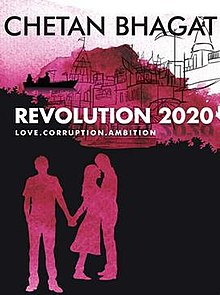
Revolution 2020- Chetan Bhagat

Hello! This blog is a response to a task assigned by Dr. Dilip Barad sir. In the paper Contemporary English Literature, we studied Chetan Bhagat as a part of Popular Literature. This blog deals the Chetan Bhagat’s 5th Novel Revolution 2020 which was Published in 2011. This blog deals with the tile significance and social realism in Revolution 2020 (R2020) and a creative insight about How it would be better if it were narrated from Raghav or Aarti's perspective.

Revolution 2020
Chetan Bhagat

Chetan Bhagat 

Chetan Bhagat is an Indian author, Columnist, Youtube, and motivational speaker. He was included in Time magazine's list of the World's 100 Most Influential People in 2010. Bhagat completed his B.Tech in Mechanical Engineering from IIT Delhi in 1995 and completed his MBA in IIM, Ahmedabad in 1997. IIMA awarded him the "Young Alumni Achiever's Awards 2018" in the Art & Entertainment category. He got campus placement in Canada, but the company closed and he joined as an investment banker with Goldman Sachs at their Hong Kong office. He left his work and began his writing career as a full-time job in 2009 and he is also famous as a motivational speaker.


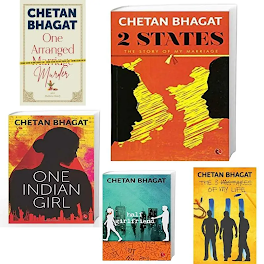
His novels and the Bollywood movies inspired by it.
  • Five points Someone- 3 Idiots (Rajkumar Hirani)
  • One Night at The Call Centre (2005) - Hello (Atul Agnihotri)
  • The 3 Mistakes of my Life (2008) - Kai Po Che (Abhishek Kapoor)
  • 2 States (2009) - Two States (Abhishek Verma)
  • Revolution 2020 (2011)
  • Half Girlfriend (2014)- Half Girlfriend (Mohit Suri)
  • One Indian Girl (2016)
  • The Girl in Room 105 (2018)
  • One Arranged Murder (2020)
  • 400 Days (2021)


Writing style
Chetan Bhagat’s writing style is very different from the other prominent authors and he deals with the ideas and lives of the Indian youth that's what resists him from being a highbrow writer. He uses simple language which doesn't even need a dictionary to be referred to. The audience also finds it easier to relate to his books as the context of his books is usually based on actual events from their lives. The target audience of Bhagat is youth and the characters he creates are also similar to targetted audience. His stories usually have an Indian touch to them which makes them even more interesting. With his vivid and humorous way of depicting stories, he has inspired reading habits in many young Indians.

The reason Chetan Bhagat is read a lot is his use of simple language, and a conversational, youth-friendly style and he has proved himself to be a great storyteller. His books are affordable price and the length of the narrative is like a short novella that can be completed in a single sitting. It doesn't need to think deeply or it doesn’t disturb the reader's sentiment or thought process.

Chetan Bhagat is considered a popular writer of today’s time but perhaps he might survive the exam of time and can be known as a prominent writer of the time. We have an example of Shakespeare and Wordsworth who were considered popular and criticized for their way of writing but have survived their time and are the prominent writer of their time. CLICK HERE to read an article- Chetan Bhagat: the paperback king of India by Robert McCrum

Revolution 2020 (R2020)


Revolution 2020: Love, Corruption, Ambition story is concerned with a love triangle, corruption, and a journey of self-discovery. R2020 has addressed the issue of how private coaching institutions exploit aspiring engineering students and how parents put their lifetime earnings at stake for these classes so that their children can crack engineering exams and change the fortune of the family. While a handful accomplishes their dreams, others sink into disaster. The novel is based on the "rampant corruption" apparent in the Indian educational system.


Social realism in the novel
Social Realism is the realistic depiction in art of contemporary life, as a means of social or political comment. Revolution 2020: Love. Corruption. Ambition deals with the most prevailing social turmoil such as corruption in education, politics, business, economy. The whole novel revolves around the three main characters Gopal, Aarti, and Raghav all of three were school friends and IIT aspirants. Raghav’s father of engineer (educated), Aarti’s father was an Ias officer and Gopal’s father was a school teacher and farmer. All three had different family backgrounds, Raghav could crack the AIEEE/ JEE exam with a good rank and got admission to BHU-IT while Gopal cracked the exam but couldn't score well. So, he was sent to Kota the preparation for the exam. Aarti’s character keeps on oscillating between her love interest Raghav and Gopal.

Aforementioned, this novel deals with the concerns in the life of youth. Raghav got admission to BHU- IT but he wished to be a social reformer and after his education, he began a newspaper named Revolution 2020 in which he used to write the social and political realities of the societies. Gopal met MA Shuklaji when he was very young and without having finished his schooling. He then started a private college, and the entire institution is built on corruption and bribery, beginning with the purchase of land. Gopal saw everything in terms of money, and he spoke in constant monetary terms. Bhagat portrays the privatization of education through the character of Gopal and his institution. When educated people sell degrees, degrees have a higher value than knowledge and education. Gopal visits Raghav in his black Mercedes to demonstrate to him where he has come despite not having any formal education, while Raghav writes in the small garage and makes an effort to demonstrate his superiority.

Gopal (wealth) > Raghav (knowledge/ ethics)

In addition to showing the deplorable side of the private education system, Bhagat also depicts the scenarios of Kota, Rajasthan, which has developed into a coaching school hub and is still present in 2023. It also depicts the incident involving Manoj Dutta, the former PG in Gopal's room, who hanged himself. Gopal's father wanted him to become an engineer, which is the genuine tale in the lives of many children, thus he was compelled to attend school in Kota.


‘Kota now had small coaching shops 
to coach you to get into the top 
coaching classes, From there, you would 
be coached to get into an engineering college.’


It also demonstrates Indian students' desire to take competitive exams, and online series like Kota Factory and Aspirants provide excellent illustrations of the daily struggles and pressures these students face.

As a politician, MLA Shuklaji portrays corruption in an appropriate light because he was the only one who helped Gopal find his private institution and taught him how to pay people. Raghav, a journalist, wrote an article about the Ganga Action Plan fraud that resulted in Shuklaji's imprisonment. The Ganga Action Plan is a true account of India, not a fictional scene from a book. The Ganga action plan was launched in 1986 with the goal of reducing pollution in the Ganga river. The downfall of the Ganga Action plan was that it was a wholly bureaucratic effort with top-down, end-of-the-pipe interventions—Corruption in the Ganga Action plan. GAP is a 100% state-supported scheme. In 2019, the Ganga Action Plan was re-announced, although the pollution and filth levels in the Ganga remain the same.

Another issue in the book is the erosion of moral and ethical standards. how educational institutions are transformed into corporate hubs. He has seen unethical behavior throughout the entire land purchase process, including when the building was constructed and the admittance quota was met. How pointless schooling has become?


Significance of the title 'Revolution Twenty20'

There are about 27 instances of the word 'revolution' in the book (estimate).

The Indian Revolution of 2020 was predicted in the 2011 book Revolution Twenty20. After earning his engineering degree, Raghav pursues his career as a writer in order to pursue his desire for social change. He lost his job as a result of his unrestrained journalism, at which point he started his own printing press in a small garage called ‘Revolution 2020’.

Raghav ‘believes there will be a real people's revolution in India one day.’

Revolution 2020. That's his goal. That India 
must have a full-blown revolution by 2020. 
Power will be with the youth. We will dismantle 
the old corrupt system and put a new one in place.

The Revolution 2020 write-up was presented on a fluorescent pink A3-sized sheet with the headline "Because Enough is Enough" and the words Revolution 2020 in large, bold type. ‘We have to start a revolution, a revolution that resets our corrupt system.’ Four passionate people worked for a small journal called Revolution2020.
  • The word Love is included in this Revolutionary narrative through artful title writing. The title implies that the emphasis on the theme of revolution is weighing down on the theme of love.
  • The love -story has the canvas story of revolution or vice-versa.
  • The theme of revolution is covered in the theme of love.


The IPL, a Twenty20 cricket league, served as the inspiration for the book's title. The first thing that springs to me when I read the title Twenty20 is IPL cricket. The author of this book utilized the term twenty20 in his title, which we interpret to refer to the cricket frenzy that year because it was published in 2011. This is a lacuna in the title's explanation that we are attempting to fill. The author has never explicitly explained anything in this area.


Do you think that an opportunity for a good novel is wasted because the story is told from Gopal's perspective? Can it be better if narrated from Raghav or Aarti's perspective? How would it be better if it was narrated from Raghav or Aarti's perspective?

The narration of a novel can change significantly when the narrator changes, as the perspective and voice of the narrator can have a significant impact on the way a story is told. It is subjective to determine what makes a novel "good." Different people have different tastes and preferences. But in terms of literature, good or Highbrow literature is one which raises the abstract question and deals with abstract problems; novels such as Waiting for Godot, Oedipus Rex, and Hamlet. While R2020 comes under the classification of popular culture as it lacks high seriousness and sincerity.

The whole novel is narrated from Gopal Mishra’s point of view, he is sharing his life story with Chetan Bhagat, who is present as a character in the novel. If the novel was narrated from Raghav Kashyap’s point of view it might have gotten a chance to be a better novel. How?

Raghav Kashyap belonged to an upper-class family. His father was an IITian, and an engineer at BHEL. Raghav himself cracked JEE exam and graduated from BHU- IT. but then he followed his passion of being a social reformer and became a journalist. He became a fearless journalist who went against authority/ power which lead him to lose his job and so he began his private small printing press where he tried to bring the real face of authority and real news to society. In this run of following his passion, he didn't give time to Aarti which created distance in their relationship. He also went against his family for his passion.

‘…his parents are okay with it?' 'No way! 
They went ballistic when he told them, it isn't 
just about the money, he isn't using his engineering 
degree. They are still upset.’

‘He feels the revolution begins at home. 
Society changes only when an individual 
family norms are challenged.’

'Raghav’s expose has created complete chaos.
Even my family has been affected,' she said


The dialogues by Aarti that depict the challenges Raghav experienced in pursuing his passion are seen above. It demonstrates how challenging his life was at the time he decided to join a political party for social reformation after marrying Aarti.

Considering Raghav's life I believe that the concept of revolution would have been appropriately conveyed in the book if Raghav Kashyap had recounted it instead of Gopal Mishra, whose narration is overshadowed by the theme of love. Despite being an educated scholar and coming from an upper-class, conventional household, it can be challenging to follow your passion. Aarti abandons her goals to become a regular girlfriend or bride in today's environment when students like Gopal look for life's shortcuts. For young people trying to navigate the challenging questions of life, Raghav's narrative may have been motivational.

And we are all aware of the challenges posed by being a true journalist, defying the establishment, and exposing people for who they really are. Not just the journalist but also his family is in danger as a result.


Although Gopal R2020's tale teaches readers what kind of person they shouldn't be, it also makes it clearer what they should do.


I hope this blog is useful. Thanks for visiting.
[words- 2208
images- 6
video- 1]

My Learnings from the National Workshop on Academic Writing (2026)

The National Workshop on Academic Writing  I recently had the opportunity to participate in the National Workshop on Academic Writing (2026)...