Showing posts with label Title. Show all posts

Sunday, 8 January 2023

Petals of Blood- Ngugi wa Thiong'o

Hello! This blog is a response to a task assigned by Yesha Bhatt ma’am. This blog deals with Ngugi wa Thiong’o’s novel Petals of Blood, we are assigned a few questions, and among them, this blog will talk about the first chapter of the novel which deals with the Interrogation of all characters.

PETALS OF BLOOD
Ngugi Wa Thiong’o

The birth name of Ngugi wa Thiong’o was James Ngugi. He is primarily a Kenyan Author. He writes in the Gikuyu language and formally in English. He has been described as having been "considered East Africa’s leading novelist". He is the founder and editor of the Gikuyu-language journal Mũtĩiri. His debut novel was the first novel in English to be published by a writer from East Africa. Ngugi wa Thiong’o is a Kenyan writer, scholar, and social activist who has written numerous novels, plays, and non-fiction works.


In the 1970s, Ngũgĩ became involved in the struggle for democracy in Kenya and was imprisoned for his political activism. After his release, he went into exile in the United States, where he taught at universities and continued to write and publish.

Ngũgĩ's works as "Decolonising the Mind" and "Petals of Blood," address issues of cultural imperialism and the importance of African languages and traditions. He has received numerous awards and accolades for his contributions to literature and social justice, and his work has been translated into numerous languages.

Ngugi was criticized however for his stylistic form in Petals of Blood. It was suggested that the social realism of the novel did not accurately represent or complement the socialist ideals put forth.

His important work
In English
  • Weep Not, Child (1964) is the first novel in English to be published by a writer from East Africa.
  • The River Between (1965)
  • The Grain of Wheat (1967)
  • Petals of Blood (1977) his last novel in English
Written in Gikuyu and translated into English
  • Devils on the Cross (1980) 
  • Matigari (1986)
  • Wizard of the Crow (2006)
His essays
  • Homecoming (1972)
  • Decolonizing the mind (1986)
  • Moving the Centre (1993)
  • Detained (1981)
  • One the Abolishment of the English Department (1968/ 1972)
  • The Asmara Declaration on African languages and Literature (2000)
Plays (three most important)
  • His play was published before the novel.
  • The Black hermit (1963)
  • The Trial Of Dedan Kimathi (1976)
  • I will Marry When I Want (1977)

About The novel- Petals of Blood

The novel Petals of Blood was published in 1977 and is set in Kenya’s fictional village Ilmorog. The bog begins in the present and moves twelve years in flashback. It deals with the four characters Munira, Wanja, Abdulla, and Karega whose lives are intertwined due to the Mau Mau rebellion. All four characters have come to Ilmorog to escape from city life. The novel explores corruption, social inequality, and the betrayal of the ideals of the independence movement. "Petals of Blood" was highly critical of the post-colonial government of Kenya and was banned in the country upon its release. However, it has since become a classic of African literature and has been widely translated and studied.


The novel has a reference to the Mau Mau revolution at various times and also its political background of it. Watch this video to understand the Mau Mau rebellion.


Title
The title Petals of Blood is derived from a line of Derek Walcott’s poem 'The Swamp'. The poem suggests that there is a deadly power within nature that must be respected despite attempts to suggest by humans that they live harmoniously with it.

…Conceals within its clutch the mossbacked toad,
Toadstools, the potent ginger-lily,
Petals of blood…

Originally called 'Ballad of a Barmaid', it is unclear why Ngugi changed the title before release. We assume that he changed the title because the Barmaids suggest the character of Wanja and he believed that individual character and qualities should not overtake community action. So the Title ‘ballad of barmaid’ might highlight the individual character rather than the collective consciousness of people.


Chapter one- Interrogation of suspected characters.
The primary four characters of the book, Karega, Munira, Wanja, and Abdullah, are detained by Inspector Godfrey as suspects in the murders of three individuals, two businessmen, and one educator at the beginning of the novel (Kimeria, Migo, Chui).
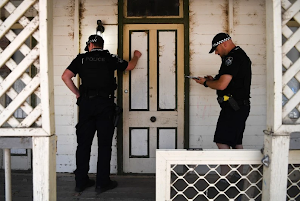

“They came for him on Sunday”. On Sunday, when the book begins, the cops are there at Munira’s door. Murina was reading from the Book of Revelation in Bible while taking a break after spending the previous night keeping vigil on the mountain. His name and occupation were verified when the two police officers knocked on the door. Readers learn something about Murina, a teacher at the new Ilmorog Primary School. Munira accepted the police's cool treatment, put on his coat, and accompanied them to the station. We learned from their conversation that Munira is a Christian who's really looking forward to Christ's second coming in this violent, bloody, and murderous world. Ilmorog had been residing in the wasteland for twelve years.

Next, the police were visiting, Abdullah was sitting on the chair outside his hovel in the section of Ilmorog called the new Jerusalem he was looking at the bandage on his left hand and feeling strangely at peace considering the events of the previous night. However, he was unable to comprehend what had actually occurred. He questions himself "would he ever be able to explain this fulfillment of what had only been a wish and intention? how far had he willed it?" When a policeman approached him and requested him to accompany him to the police station, he said that it was only to ask him a few questions for the record. However, when he arrived there and was put in a cell, Abdullah protested and the policeman slapped him.

Nextly police officer went to arrest Wanja but Wanja was in the hospital and the doctor didn't allow the police to meet her because she was not in a position to answer questions. according to Doctor she was in delirium and kept shouting “Fire… Fire… my mother's sister… my dear aunt… put off the fire, put off the fire!” She was not in a critical condition but in shock and hallucinations. the police guided the doctor to record her words as a clue for the case.

Lastly, the police visited Karega. He was asleep after all night executive meeting of the Theng’eta Breweries union. with a knock on the door, he leaped out of the bed in his pajamas and found an Armed Police at the door he changed his clothes And joined the policeman he wondered how he would contact others. he had heard the 6 o'clock news and so he knew that the strike had been banned but hoped that even if he was arrested the strike was would go on.

Soon the news was spread about Karega’s imprisonment the workers in a hostile mood marched towards the police station demanding his release. the police officer requested them to disband peacefully and say that Karega was there only for a routing questioning about the murder in Ilmorog. The crowd was getting into an angry and threatening mood toward the police. Police with guns and arms chased the protesting worker right to the center of Ilmorog. one or two workers sustained serious injuries and were taken to hospitals. such a definition of confrontation with authority had never happened in Ilmorog.

And one newspaper The Daily Mouthpiece bought out the special issue with the banner headline: MZIGO, CHUI, KIMERIA MURDERED. with this the novel opens up and gives a brief introduction to all three murdered.


In brief:
One of the main conflicts that Wanja faces is the tension between her desire for personal freedom and her sense of duty to her community. Wanja is involved in an affair with Kimeria, a wealthy businessman, and she becomes pregnant with his child. However, Wanja is also engaged to Mzigo, a poor farmer, and feels a sense of obligation to marry him and provide for his family.

As a result of these conflicting desires, Wanja becomes deeply conflicted and begins to feel trapped by her circumstances. In an act of desperation, she decides to kill Kimeria, Mzigo, and Chui, a wealthy landowner who has also been pursuing her.

Ultimately, Wanja's actions are driven by her feelings of frustration and desperation, as she feels that she has no other options available to her. The novel explores the consequences of Wanja's actions and the impact they have on her and the people around her.

At the end of the novel, Munira, Ngotho, Wanja, and Abdulla come together to form the "people's gang," a group dedicated to overthrowing the colonial government and fighting for the rights of the oppressed. Despite their efforts, the gang is unsuccessful in their uprising, and Munira is killed in the process. In the aftermath of the failed rebellion, the remaining members of the gang are arrested and imprisoned. Despite the setbacks they have faced, they remain committed to their cause and continue to fight for their beliefs. The novel ends with the implication that the struggle for independence and justice will continue, even in the face of hardship and defeat.


I hope this blog is useful. Thank you.

[words-1520
Images- 4
Videos- 3]

Monday, 22 August 2022

Mahesh Dattani's Final Solution

Hello readers, this blog is an assigned task by Vaidehi Hariyani Ma’am. This deals with Mahesh Dattani’s play and a movie ‘Final Solutions’, it answers the various assigned questions.

FINAL SOLUTIONS (1993)

Mahesh Dattani


Mahesh Dattani, born on 7 August 1958 is an Indian director, actor, playwright and writer. He was born in Bangalore to Gujarati Parents. He is the forest Indian playwright in English to be awarded the Sahitya Akademi Award for his remarkable contribution to the world of drama and is also awarded for his book of plays, Finals solution and other plays.

His various Works are-
Where There's a Will (1988)
Dance Like a Man (1989)
Bravely Fought the Queen (1991)
Final Solutions (1993)
Do The Needful
On a Muggy Night in Mumbai (1998)
Seven Circles Round The Fire (Radio play for BBC) (Seven Steps around the Fire) (1998)
30 Days in September (2001)
The Girl Who Touched the Stars (2007)
Brief Candle (2009)
Where Did I Leave My Purdah (2012)
The Big Fat City (2012)

His critically acclaimed works include Where There’s a Will, Dance Like a Man, Tara, Bravely fought the Queen, Final Solutions, Night Queen, and Thirty Days in September.

Dattani's approach is not only to just raise questions that exist in contemporary Indian society but to think about the best possible solution for these problems and try to recognize the identity of the marginalized class in society.


Final Solution

बटने का दर्द कहने से कम हो ता है क्या? 
फर्क रंगों में तलाशो तो अच्छा है, पैदाइशी में फर्क होता है क्या?
-Final Solutions (Zee5 2019)


The play Final Solutions, written by Mahesh K. Dattani discusses the theme of communal riots, hatred and bitterness of Hindus and Muslims against each other, social vision, social exclusion. The plot is set in Gujarat (after the 2002 Riots). The communal hatred is at peak. problems of communalism and gender, class and caste discrimination found everywhere and every time in the contemporary Indian society.

Final Solutions revolves around a Hindu family that gives refuge to two Muslim boys during a communal riots. Hardika, Ramnik Gandhi, Bobby and Javed are important characters in the play, In this play Two Muslim boys, Javed and Bobby (Babban) take refuge in the house of a Hindu businessman, Ramnik Gandhi while a Communal riots rage outside.


What is the significance of the title ‘Final Solutions’?
Final Solutions talks about the communal riots of Hindu and Muslim community. The play aptly shows the Hindu family which is trying to help Muslim boys but they are afraid of their community. Ramnik, calling himself a liberal tries to help Muslim boys but in the raged conversation between them we realize that somewhere Ramnik is trying to wash or balance his or his family’s mistake done in past where because of him a Muslim family had to suffer and face loss. Ramnik knew that Muslims are not bad while the female of the family felt that unpleasant happened in the past was because of Muslims and so they couldn't trust the Muslim boys but later in the end truth was revealed. We realize that here no one is the be blamed. There is always a powerful person who is benefited by this type of riots. And today all this has reached a level where we don't have a solution to stop it. The title can be said to be reversible or communal. Reading the title one might think it will give a solution, a Final Solution but we realize there is no Final Solution to the various communal riots in this world.

Do you think Mahesh Dattani’s ‘Final Solutions’ makes any significant changes in society?


The theme of the play Final Solutions is to highlight human weaknesses, selfishness, avarice and opportunism. Woven into the play are the issues of class and communities and the clashes between traditional and modern life style and value systems. I cannot surely say if Mahesh Dattani's' ‘Final Solutions' have made or is making any significant changes or not because even today we are seeing the riots in the society and various issues based on Hindu- Muslim Community issues. We can assume that perhaps in subsequent times readers will grasp its morals and will understand the real reason and story behind the communal riots in society and it will bring significant changes in society.

How are the beginning and the end of the movie? Do you feel the effect of communal disturbance in the movie?
The narration in the movie oscillates between past and present. The movie begins with female protagonist Daksha (whose name is changed after marriage to Hardika) reading her diary at an older age. She is confused about what to write and comes to a point to write something which is big and notable for the world. And she begins with August when the nation got its independence and this brought her to the remembrance of communal riots in the nation that happened because of partition. And in this partition she lost her father. She recollected how she and her mother were holding the Krishna murti and hoping for her father to return but he didn't return.

Moving towards the end of the movie, the truth gets revealed to Hardika/ Daksha that Zarina’s Family (Muslim Community) was not at fault. It was her father- in - law and husband who tried to destroy Zarin’s father’s shop and bought it at half price. The root cause of all this happening and lack of friendship from Zarin’s side was also the Hindu- Muslim Communal riots.

Here we can see the effect of communal riots in the beginning and ending of the movie.

The movie comes up with many different symbols and colors. Write about any two symbols which caught your attention. What does it signify?
Mahesh Dattani’s film ‘Final Solutions', latest adaptation on ZEE5 platform of his 1993 work ‘Final Solutions’ has one of the best cinematography. It has wonderfully used the colors, chorus and symbols in the movie. There are various symbols like, Chair, Photo frame, saffron, green and white color, diary, Pooja bell, Taqiyah (Muslim cap), Krishna, singers and songs, and fire. According to question we will discuss to symbols-

1. Photo in Hardika’s room- The photo was of her favorite singer who was Pakistani, Noor Jahan. And the song she sang mostly was

Jawan hai mohabbat
Haseen hai zamana
Lutaya hai dil ne
khushi Ka khazana

This frame of Muslim singer in Hindu house suggest that how the nation was one before partition. Everyone used to celebrate each other’s art and enjoy it but with the time and because of partition the differences began. The frame also symbolized the deep love of Hardika/ Daksha for music and her dream of being a singer.

2. Diary- diary comes as a symbol of past and present. It also suggests an ambition of women to make her voice reach to everyone. Hardika began to write a diary with an idea of how larger society will read and what type things should be shared with them. Diary also came out as a friend and a secret keeper for Daksha/ Hardika. In the movie and also in the novel diary is a vehicle which takes us to the past and the present.

3. Colors- the Movie makes use of colors very aptly it is a play performed in a traditional light with the use of modern techniques and method. Chorus is wonderfully used in the play as an observer, narrator, voice of conscience and in times of blood-lust, participants. Dattani uses the chorus to directly address the audience and help them visualize the action. And the lights on chorus and the props color used by the chorus without the use of words clearly suggest whose ideas are shared or displayed by them. It can also be a satire on owning a color in the name of religion. Saffron- Hindu, Muslim- Green.

Is Ramnik a liberal thinker? If yes then why? If not then why?


Literal meaning of liberal is willing to respect or accept behavior or opinions different from one's own; open to new ideas. Here in the movie various times we see that Ramnik Gandhi is trying to be a liberal thinker and wants to help Javed and Bobby. He gives them shelter in his house, safeguarding from the mob instead of his conservation wife, Aruna. Ramnik’s character grows as a sympathetic person and as a viewer we also love him, thinking him to be rational. But when the arguments begin between Javed and Ramnik we realize that somewhere Javed is having a strong point like when he said u r helping cause you are in majority and you have power to help us we (Muslims) are ‘bichara’ poor and disabled. And later when Javed’s character grows we realize that it was his childhood trauma who constructed him to be a part of riots and we as a community are to be blamed for the happenings with Javed. After knowing about Javed, Ramnik forcibly wanted to give him a job. In between he also says, “yahi to ek liberal person karta hai na”. Which shows he was trying to be good and act like a liberal. Also when Javed says something Ramnik directly points out about the whole Muslim community which shows that in his mind there difference between both te communities and he hasn't accepted the community but is trying to balance his sins, what was done by his father and grand father. So after reading Ramnik's fully grown character of Ramnik we cannot consider him to be a Liberal thinker.

Does education make any difference? Comment with the reference to the women characters.
In this movie we have four women. Daksha (young Hardika) and Zarine, Hardika (grandmother), Aruna and Smita (Tasneem). This work has a wonderful symbol or diary writing which directly suggests the level of education in women in that period. Daksha/ Hardika was a literate and that character was really indulges in Muslim community which an be seen through her song and singer interest and also his love for Zarine. She was hugely interested in having friendship with Zarine and the same things are seen in Smita, her granddaughter. But as the society has moved further by two generations we find that she has a Muslim best- friend. Smita is studying in college but unlike Hardika she didn't had to go against family to have friendship with Muslim girl. And she could also take her own stand. The difference grew in society can be clearly seen in these two characters. On the other hand, Aruna is a so-called ideal Hindu woman. We don't see glimpses of education in her character. Majority of the time she is seen doing pooja or veneration of Lord Krishna. And she is the one who feels touchable towards Muslims and these types of character traits are also noted in Gajju’s Hardika's Mother- in -law's description by Hardika herself. So here we can conclude that yes education does make a difference in the way of looking towards society.


I hope my Blog was useful. thanks for visiting.

Saturday, 4 December 2021

Importance for Being Ernest- Oscar Wilde

IMPORTANCE OF BEING EARNEST
This blog is in response to the blog task given to us by Dr. Dilip Barad sir based on the classical play The Importance of Being Earnest. In this blog I am going to discuss Wilde's changed subtitle of the play and one of the female characters from the play.

Brief about the play:


The importance of being Earnest, A trivial comedy of serious play was first performed on 14 February 1895 at the St. James Theatre in London. This play is a farcical/ absurd/ laughable comedy. Genre of this play is Social comedy; comedy of manners; satire; intellectual farce. It is set in the 1890s in London (Act I) and Hertfordshire, a rural county not far from London (Acts II and III). In this play the characters maintain imaginary personae to escape from the burdensome social obligations.

Characters of the play:
Jack Worthing (Ernest)- a young gentleman from the country, in love with Gwendolen Fairfax.
Algernon Moncrieff- a young gentleman from London, the nephew of Lady Bracknell, in love with Cecily Cardew.
Gwendolen Fairfax- a young lady, loved by Jack Worthing.
Lady Bracknell- a society lady, Gwendolen's mother.
Cecily Cardew- a young lady, the ward of Jack Worthing.
Miss Prism- Cecily's governess.
The Reverend Canon Chasuble- the priest of Jack's parish.
Lane- Algernon's butler.
Merriman- Jack's servant.

In brief the central act of play:
In the play we see that the protagonist named Jack Worthing maintains a fake person named Ernest in the town as a younger brother who always creates some troubles and because of that he has to visit the town from the countryside again and again. The main aim to visit town was to meet his beloved. Along with, he was a guardian in the town, he was a responsible person, an authority in town so to get out of that authority mark and have a burden less time he used to visit town. Same was with another protagonist Algernon Moncrieff, he also maintained a fake person named Bunbury to rest out from his burdensome life. Once Algernon surprisingly visited the country house of John when he was going to end the story of Ernest. Going there he lies that he is Ernest and falls in love with Cecily, ward of John. where Cecily was already in love and engaged to the person named Earnest, who in front of her is Algernon. Gwendolen, beloved of John, was in love with John but only if he had the name Earnest. Gwendolen and Cecily met and in conversation realized that they both were in love with a person named Earnest but there was no one with real name Earnest. And to fulfill the wish of their beloved both male protagonists were going to christened with the name Earnest. Moving towards the end of the play the mystery comes out that John was the lost child of Mrs. Bracknell’s poor sister, he was brother of Algernon Moncrieff and his name was baptized from the first name of his father and that was Earnest.

Title and Subtitle explanation:
Looking at all these incidents of the play somewhere inside we realize how can someone be so insane. How can any female demand such things like name or how can anyone think to maintain fake persons to move out of their burdensome life. But this play is satire and criticism of the society of the Victorian era. Now it would be easier for us to understand the title and why Wilde is putting such words like trivial and serious in the title. The importance of being earnest: after reading the central act of the play we realize how important it was for the male protagonist to have a name Earnest. They required the name Earnest to marry their beloved. If we look at the literal meaning of the word earnest then it means showing sincere and intense conviction; serious minded. And somewhere in the male protagonists we lack the literal meaning of that word because if they would have been serious minded they would have never done such a trivial act of making an imaginary person to get away from regular life and also the decision to change their names to Earnest.

We notice that Wilde has originally subtitled the play 'A Serious Comedy for Trivial People' but then changed it to 'A Trivial Comedy for Serious People.' We already know that the play was a farcical play, it is a comedy of manners. The play is fun and a comedy of triviality. The literal meaning of the word ‘trivial’ is something of less importance, cheap. if we look the meaning in Guajarati language then it is તુચ્છ,મામૂલી. If the subtitle was ‘a serious comedy of the trivial people’ then the audience would have self- prejudiced that they are already being judged and are given no importance and no audience would gather to watch the play. Comedy is for fun and people are an important part of society and in comparison of these two things if more importance would have been given to comedy by telling it to be serious and people to be trivial, the audience would not accept it. The importance of being earnest is a satire to the people of Victorian age. The satire is to ridicule ideas, conditions, or social conventions with which the audience is familiar (or even practices and supports) without making the audience feel estranged. If Wilde openly and publicly insulted them by referring to them as 'trivial people,' they would not attend. Perhaps, so Wilde interchanged the words and subtitled as ‘A trivial comedy of serious people’ and gave importance to people and named comedy to be trivial. This is my one interpretation.

This change of subtitle can also be interpreted keeping the characters of the play in the center. We already read about the insane actions of the male protagonist and the insane need of the female protagonist in their husbands. The actions are completely trivial. Whenever we are watching a movie or a play we always compare ourselves with the protagonist of the play. At the very first watching of the play we just compare ourselves with them; we do not or cannot find the flaws or cannot criticize them. We get connected to them. If the direct subtitle indicates that the characters and their actions are trivial, people after feeling connected to them will realize that the writer is calling them trivial and on the spot they will start criticizing the writer and would not accept any argument of the writer. So instead of telling characters to be insane and trivial, the writer himself is telling comedy means his own writing to be trivial and makes people feel that it is only for fun. The subtitle ‘a trivial comedy of the serious people’ shows that characters are serious and good enough but the comedy the fun they are making is trivial, characters are correct at their place.

Further in this blog I am going to discuss the female character Miss Prism as I personally found her attractive.
Miss Prism is Cecily's governess at Jack's house in the country. As such, her position is that of a social anomaly in that her status is greater than that of an ordinary servant, but less than that of a member of her employer's family.

Miss Prism was an independent woman. She's the character of the Victorian era novel where marriage was very strongly prevailing. In that era she was a strong independent woman who was earning on her own instead of being dependent on any male figure like father or husband. On the other hand, working as a governess in a private home was a low-paid occupation, it was at least respectable.

Also, Miss Prism was an intellectual woman, that too in a literary way. She is a creative writer. We get to know this when she brings out the truth of Jack. She is working as a governess and guardian of Cecily. She is guardian of Cecily's education and her virtue. She was the one to inspire Cecily to write a diary which can be published later as a novel. Perhaps it was a dream of Miss Prism which didn't come true. She makes constant moral judgments. We can know this through Her reaction on the news of dead Ernest "As a man sows, so shall he reap."


Miss Prism is an appropriate character to uncover Jack's true history. When Mrs. Bracknell visited Jack's country behind her daughter who was in love with Jack. She met Miss prism; everyone was shocked at how they knew each other. Mrs. Bracknell showers questions on Miss Prism.

“Prism! Where is that baby? Twenty-eight years ago, Prism, you left Lord Bracknell’s house, Number 104, Upper Grosvenor Street, in charge of a perambulator that contained a baby of the male sex. You never returned. A few weeks later, through the elaborate investigations of the Metropolitan police, the perambulator was discovered at midnight, standing by itself in a remote corner of Bayswater. It contained the manuscript of a three-volume novel of more than usually revolting sentimentality. But the baby was not there!”

To this Miss prism answered- “ admit with shame that I do not know. I only wish I did. The plain facts of the case are these. On the morning of the day you mention, a day that is for ever branded on my memory, I prepared as usual to take the baby out in its perambulator. I had also with me a somewhat old, but capacious hand-bag in which I had intended to place the manuscript of a work of fiction that I had written during my few unoccupied hours. In a moment of mental abstraction, for which I never can forgive myself, I deposited the manuscript in the bassinette, and placed the baby in the hand-bag.”


Here we see that Miss prism was writing a novel of her own. And we can interpret that she was so much lost in the writing and reading of the novel that she didn't realize about the baby to not be there in the perambulator and when she realized she had already lost the baby. Later, the story opens in a way that Jack was the same baby who was lost. Jack is discovered as the elder brother of Algernon with the baptized name Ernest. He was discovered in a handbag in the cloakroom of Victoria Station by an old man who adopted him and subsequently made Jack guardian to his granddaughter, Cecily Cardew.

I found Miss Prism an attractive character because the Victorian era was the time when women were not given independence of reading and writing, they didn't have equal opportunities as men in the literary writing space. Instead women were asked and forced to concentrate on family and children thinking that if she also starts writing and reading every woman would make mistakes like Miss Prism as they will stay lost in their own world but Miss Prism is being a women representative in the novel who is writing her own novel. And today women are having equal opportunities in the literary and education world.

Comparing it in the contemporary time. Today women and girls are stopped from using mobiles and getting off social media accounts. Here also they have the same argument that if women will start spending time on mobile phones their children and family will fall. These all incidents are also taking place in real life which we keep on reading in newspapers. But we foresee that as women have made their place in the education world they will also make equal space in the digital world.


[words- 1944]

My Learnings from the National Workshop on Academic Writing (2026)

The National Workshop on Academic Writing  I recently had the opportunity to participate in the National Workshop on Academic Writing (2026)...