Thursday, 18 August 2022

Thinking Activity- selected Poems- An Introduction- Kamala Das

Hello readers! This blog is a response to a task assigned by Yesha Bhatt ma’am based on the poem ‘An Introduction” by Kamala Das. The assignment is to Pick any one line/ word/ phrase/ thought/ idea from the poem, Writing our own version of it in the form of poetry, excerpt, paragraph (prose), story, or any literary piece.

AN INTRODUCTION
Kamala Das

Feminism is a range of socio-political movements and ideologies that aim to define and establish the political, economic, personal, and social equality of the sexes. Feminism incorporates the position that society prioritizes the male point of view and that women are treated unjustly in these societies. Efforts to change this include fighting against gender stereotypes and establishing educational, professional, and interpersonal opportunities and outcomes for women that are equal to those for men.

“I hate to hear you talk about all women as if they were fine ladies instead of rational creatures. None of us want to be in calm waters all our lives.”
― Jane Austen, Persuasion


About Kamala Das


Kamala Surayya is an Indian Author from Kerala, born on 31 March 1934 and died on 31 May 2009. She was popularly known by her one-time pen name Madhavikutty and married name Kamala Das. She is an Indian poet in English as well as an author in Malayalam, India. At the age of 15, she married bank officer Madhav Das, who encouraged her writing interests, and she started writing and publishing both in English and in Malayalam.

She has wrote a Novel Alphabet of Lust (1976); Autobiography My Story (1976); Short stories A Doll for the Child Prostitute (1977), Padmavati the Harlot and Other Stories (1992) in English and various poems in English and Malayalam.


About the poem ‘ An Introduction’


"An Introduction" is a very bold poem, published in Calcutta in 1965, in which Das expresses her femininity, individuality, and true feelings about men. This autobiographical poem is written in the colloquial style. She presents her feelings and thoughts in a bold manner. She realizes her identity and understands that it is the need of every woman to raise a voice in this male-dominated society. The poet longs for love that is the result of her loneliness and frustration.

The Poem ‘An Introduction’ is written in two stanzas, 37 and 22 lines respectively and in total it is 59 lines. Das explores powerful themes of feminism/equal rights, freedom, and marriage in 'An Introduction'. This poem is a very clear feminist statement that advocates for free choice for all women. The major theme of most of her poems are the quest for love and her failure to find fulfillment of love in life.

In the poem Kamala Das is sharing her personal life and her time when the world was all about patriarchy. The poem is a mixture of history and memory. She begins with how politics and positions were decided. She personally was not interested in politics but she knew all the politicians who ruled in sequence beginning with Nehru. Symbolically she presented the place of women in this patriarchal world. Even after independence women were/ are not independent as men were/ are. Absence of women politicians in the history of India till the time of Kamala Das.

Further, in the poem Das talks about her multi-linguistic . Das already had to face various oppositions being a female writer but above all she also had to justify her language of writing. Society forced her to write in her mother tongue and to leave English. But she claimed that whichever language she/ one uses turns to be one's own. Its distortions are not its flaw but its uniqueness.

Das was married at a very early age. She was always forced to ‘fit-in’ in the womanliness of the society and perform her duties in the patriarchal world. But yet in all this she fights and finds her own way and writes this wonderful poem which inspires other women also to be what they are and to search for self.

Das brings the poem to an end on the exact same notes that the beginning and the center of her poem explicitly stress, i.e., “I.” The struggle between herself and the world at large heightens towards the end, eventually blurring the lines between where her original self begins and ends.


I would like to quote Simon de Beauvoir's statement from The Second Sex-

"Man is defined as a human being and woman as a female – whenever she behaves as a human being she is said to imitate the male." "One is not born, but rather becomes a woman."


This is a prose– poem of my own version from this poem. This is the first time I am trying my hands on creative writing. I apologize for the mistakes or any incompleteness found in it. I might make corrections or add in the poem later. The line I chose from the poem is Who are you, I ask each and everyone, The answer is, it is I.

Who are you, I ask each and everyone,
The answer is, it is I.
Who are you, I was asked by each and everyone,
The answer is, it is I.
I, trying to paint my world
I, trying to read the unsaid
I, trying to play with books;
Growing to what are you from who are you.
What are you? A woman, a girl
Made to play with kitchen set
Dressing Barbies, broom and mop;
No, a disordered girl
No more domicile as Sita
But fiery as Draupadi,
Escaping Austen’s world
Getting in Woolf’s world;
Growing to what are you from who are you.

Explanation of my poem
The above poem is my first experiment of creative writing. Borrowing the first line from Das’s poem ‘An Introduction’ I have tried to write a few lines continuing it. In this poem I have explained ‘I’, who is ‘I’ and what is ‘I’ which is used for self- identity. ‘I’ is the one who is building her own world and trying to change the question from who are you to what are you. Which means not asking who you are but how come you did this what are you? What is answered as you can be simply a woman who is always taught to be a girl. But now women will not be domicile or controllable as Sita but will fight challenges and be fierce like mythical character Draupadi. Today women is/ will try to escape Jane Austen’s world, world of marriage and womanliness and is/ will enter the world of Virginia Woolf, where women stood for themselves, fought for their place in the patriarchal society.


I have painted this painting based on a few lines of the poetry. Lines of the poetry are also written below.


I speak three languages, write in
Two, dream in one.


It is half English, halfIndian, funny perhaps, but it is honest,


Then … I wore a shirt and my
Brother's trousers, cut my hair short and ignored
My womanliness. Dress in sarees, be girl
Be wife, they said. Be embroiderer, be cook,
Be a quarreller with servants. Fit in.


There is also a Hindi feminist song ‘Rupaiyya’ from Album ‘Super 8 womaniya Special’ released in 2017 by Sona Mohapatra. It was presented on ‘Satyamev Jayate’ Star Plus program on Women’s Day special program.


As in ‘An Introduction’ in this song a girl is requesting her parents that she is not a burden for anyone so they do not sell her. Sell her in the sense not to make her marriage and pay dowry for it. She will and can fight with all the troubles of life and society, she cannot be contemplated with money. She leant walking with fathers support and will turn to his father’s support. She is also a part of the family not a ‘paraya dhan’ she will definitely bring food, earnings to the family. This song strongly suggests the answer ‘No’. A girl has a right on herself, on the family she is born in. She can make her own decisions. 

Here we see the poem was published in 1965 yet there is no great change in society which can be easily read from the very recent Hindi song released in 2017. Perhaps women have to start their own new world, new life, new language to get free from this patriarchal society. As we have a short story ‘Sultana’s Dream’ by Begum Rokeya. The land of women, first published in 1905 in a Madras English newspaper, is a witty feminist utopia—a tale of reverse purdah that posits a world in which men are confined indoors and women have taken over the public sphere, ending a war nonviolently and restoring health and beauty to the world.

I hope my blog is useful to you. Thanks for visiting.

Sunday, 14 August 2022

Workshop- Thinking

THINKING SKILLS
Critical and Creative Thinking 

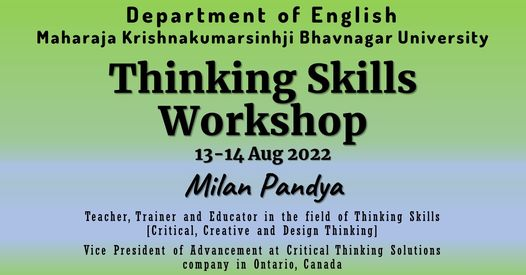
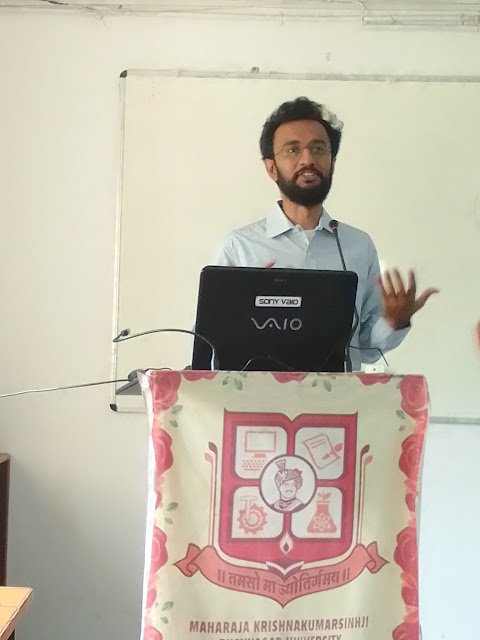
The Department of English, MK Bhavnagar University had a two- Day ‘Thinking Skills Workshop’, 13- 14 August 2022 by Prof. Milan Pandya.

Milan Pandya is a teacher, trainer and educator in the field of Thinking Skills i.e. Critical, Creative and Design Thinking, English Language Teaching & Communication Skills. With more than 12 years of teaching experience, Mr. Pandya has authored 02 books, and presented and published a number of research papers in national and international conferences and journals. Mr. Pandya has BA & MA in English Literature, M.Phil in English Language Teaching (ELT) & his Ph.D involves study into Online Teaching, Communicative Competence & Critical Thinking. He currently holds a position of Vice President of Advancement at Critical Thinking Solutions company in Ontario, Canada, and teaches at multiple colleges such as Conestoga and Sheridan college in Ontario, Canada.

This blog deals with the learning outcome of this two- day Thinking skills workshop.


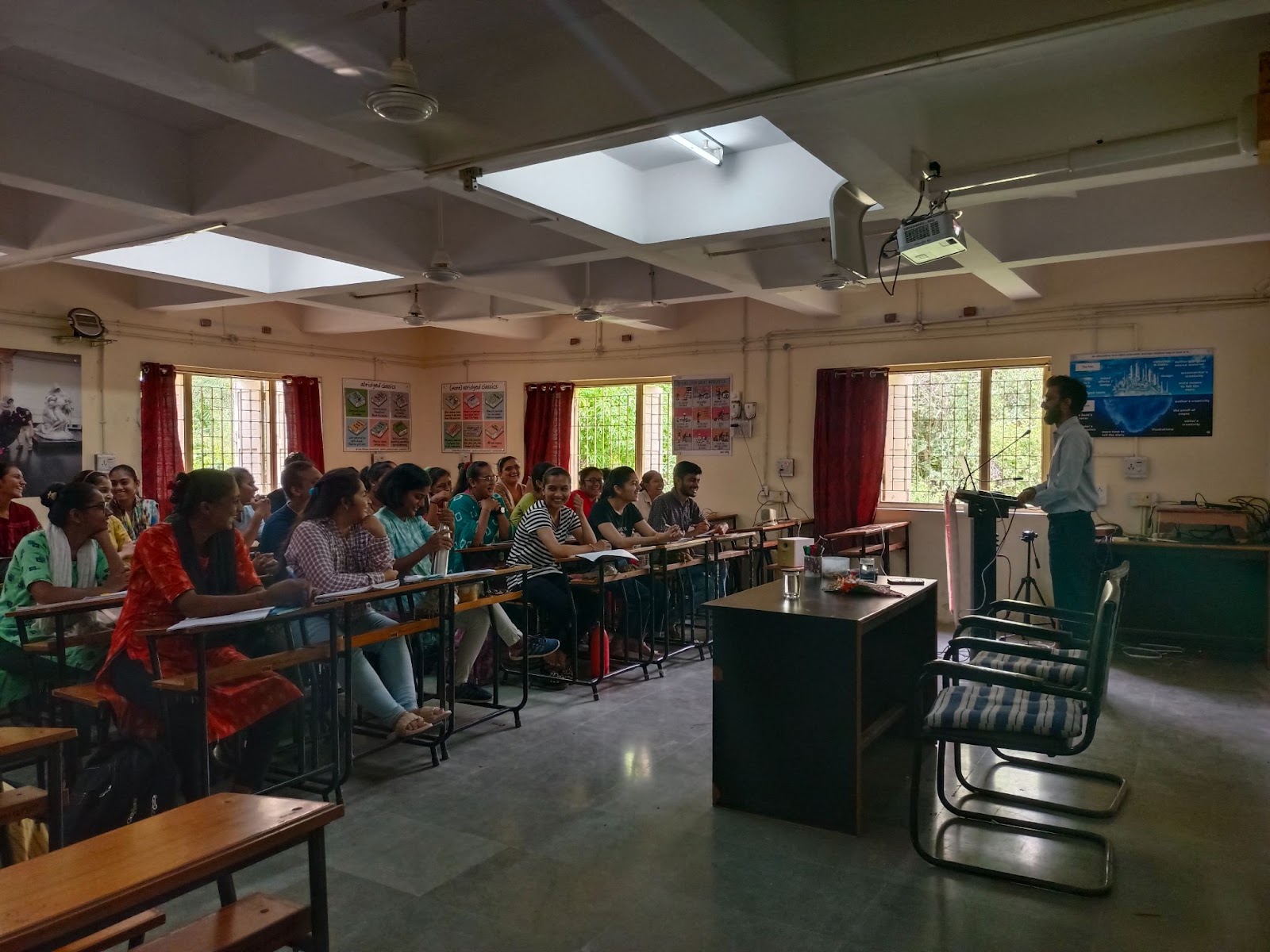
This workshop was wonderful beyond imagination, in the Socratic method of class (question- answer, interactive class) . Thinking is distinguished as Critical, Creative and Design Thinking and our workshop majorly focused on critical and creative thinking process.

What is critical thinking? (classroom discussion)
Critical thinking is not accepting anything of a face value, thinking over it giving it our own personal opinion and reflection. Being skeptical, questioning our own thoughts or ideas.

The basic way to have critical thinking is having logical, Rational and Scientific Thinking. Critical thinking is not just a way of being thoughtful but It's a way of life. Milan Pandya sir gave a wonderful statement, a definition of critical thinking-

 “Thinking about thinking in order to improve thinking.”

All human beings, Homo sapiens on this world are identical, two legs, two hands, language, ability to speak etc. yes the deformity is an exceptional case. But what makes human beings different from each other is their own mental capacity, thinking power. Thinking skills are necessary in life. Everyday, every minute we need to plan for ourselves, make a variety of decisions, small or big. Human being is also an animal, a social animal and its thinking capacity makes it different from other living beings. Humans are rational animals, along with being social, our whole life depends on thinking.

The most important thing to remember is CONTEXT. Context is a must in critical thinking and also in life. If we don't know the context we might miss the truth or get a wrong answer, outcome.

E.g.: if we take a number 2. Someone wins two Nobel prizes, then two is a great number in context to Nobel prize, there are rare cases of winning two Nobel prizes. And if we take two in the context of marks. Gaining 2/20 is too low. Then here two is lesser in value.

In class we practiced some lighter examples of critical thinking. Here I will discuss the same and will also add a few new examples.

1. Here is an ad on Glori soap featured by Akshay Kumar. Today we rarely find this soap. Do you really think a Big star and a citizen of Canada will be using this soap? A soap of around 20-25 rupees.


Also we have an ad for lux soap by various Bollywood actresses and they enthusiastically share its discount’s news. Does 3-4% of discount even matter to the Crore earners? It's all to influence society. A critical insight helps us to read what is not said.


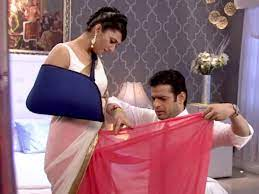
2. Look at this image. Do you find something fishy?


Yes, this is an image from a popular serial ‘Yeh Hai Mohabbatein’. What do you find? Female protagonist’s hand is fractured and so male protagonist is helping her to drape a saree. But how could she do a flawless make and hairstyle on her own!

This is critical insight. Question everything and everywhere

Milan sir gave us a wonderful mantra which would help us to think, criticize and lead us to read absence. “If something is true what else has to be true within.”


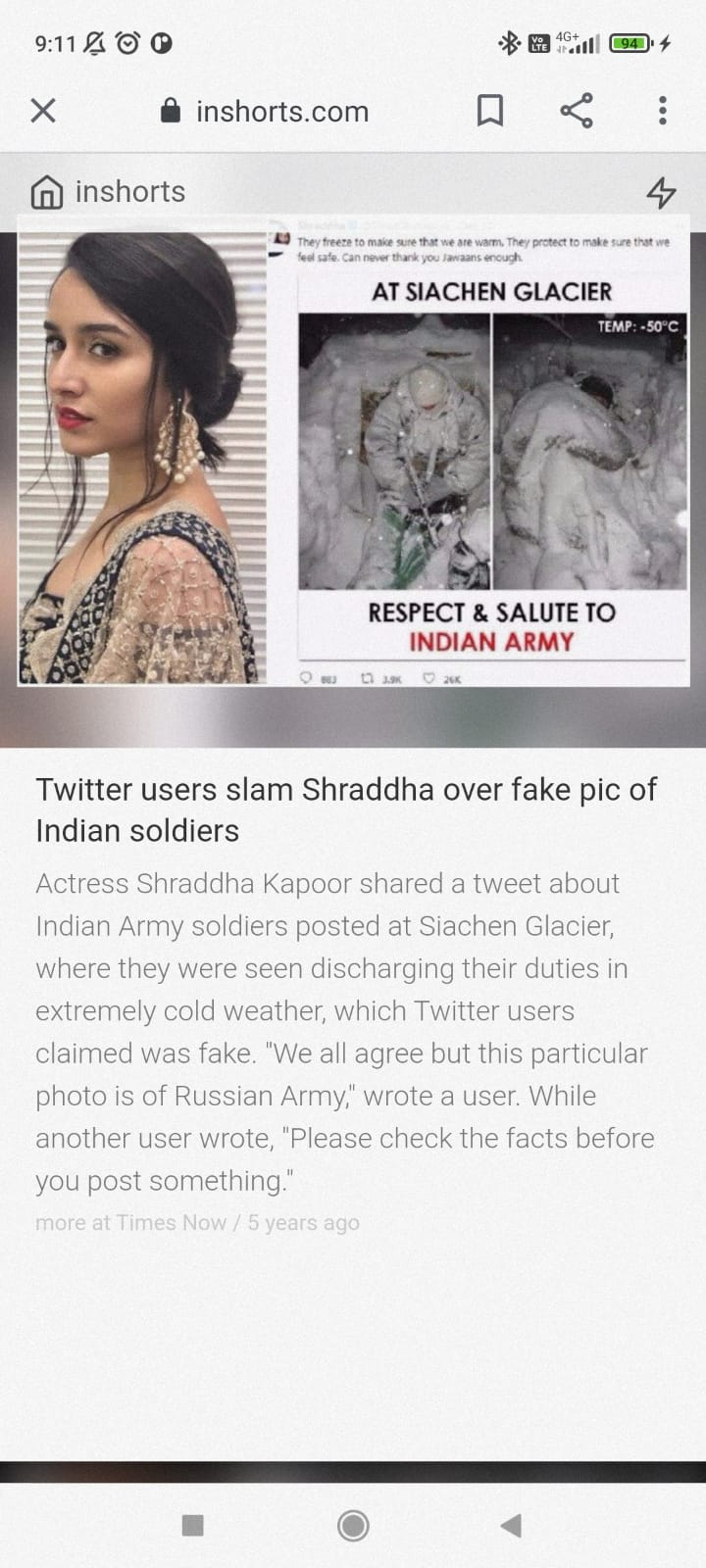
Here’s a tweet by Shraddha Kapoor for which she was trolled a lot, she shared this image talking about Indian soldiers and later came to know that the place is not Siachen and also these are not Indian soldiers but Russian Soldiers.


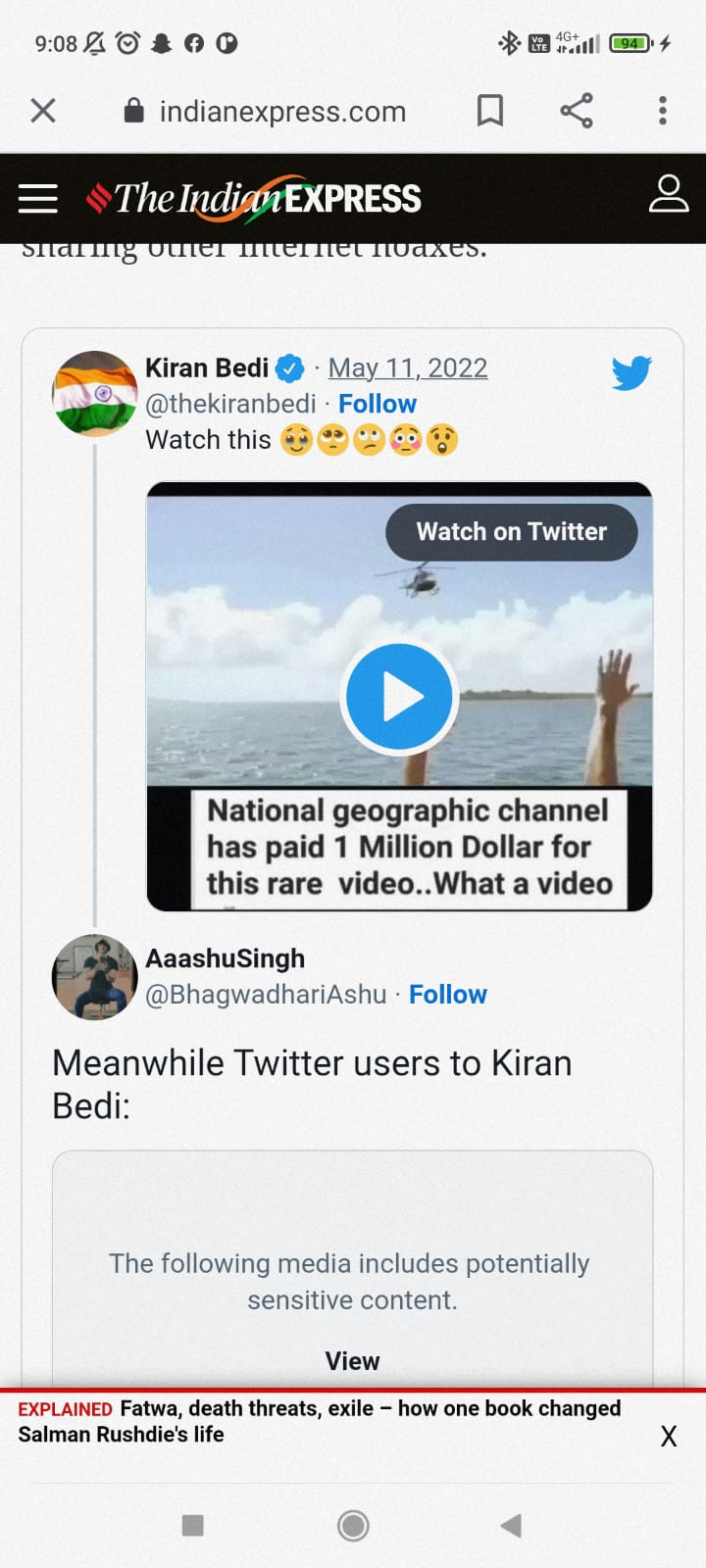
This was the Tweet by Kiran Bedi (the first female IPS ) and it was really funny to know that he video she shared was an edited video not a real one.


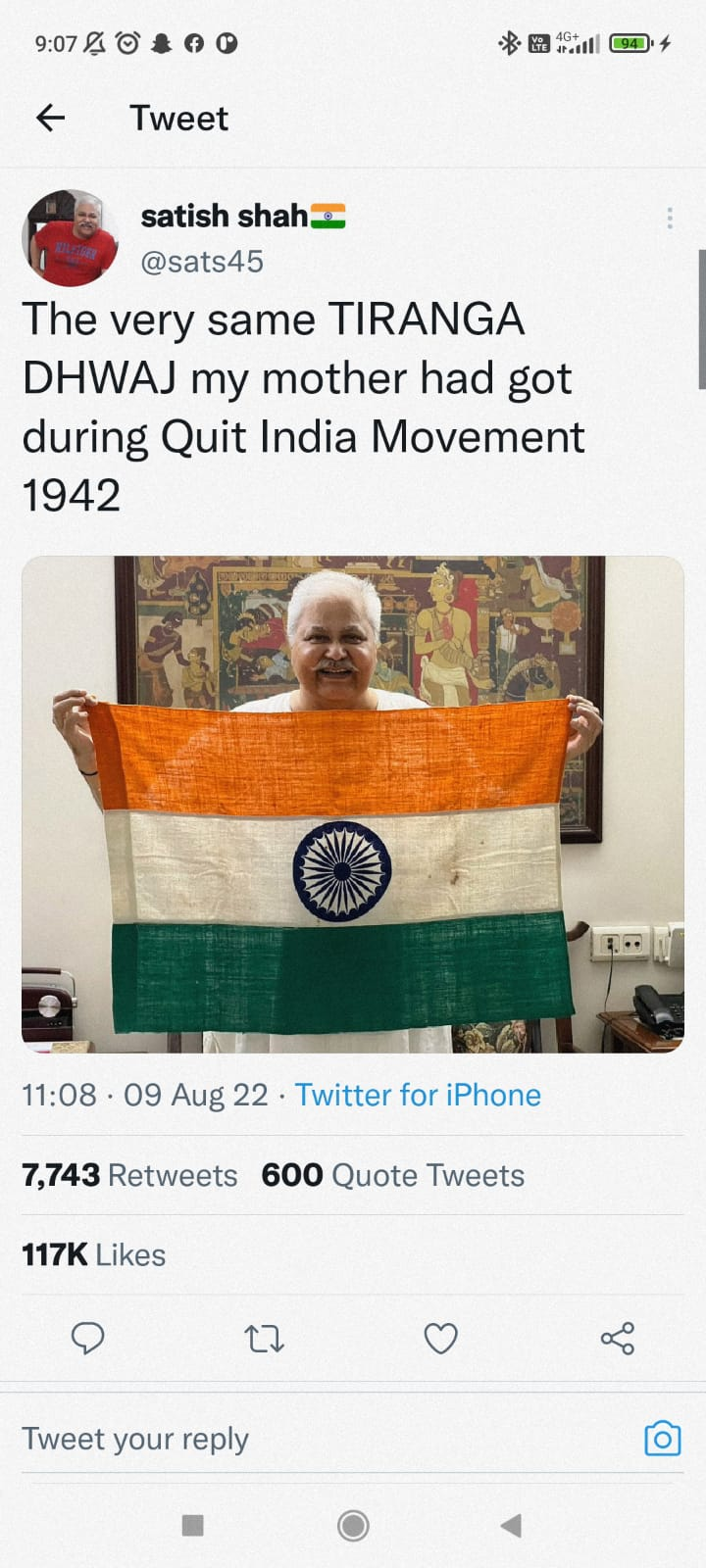
This is the recent tweet by Satish Shah, Indian flag of 1942. If we know the history we realize that this flag was selected as national flag after independence.


This was the national flag during 1942, Quit India movement.


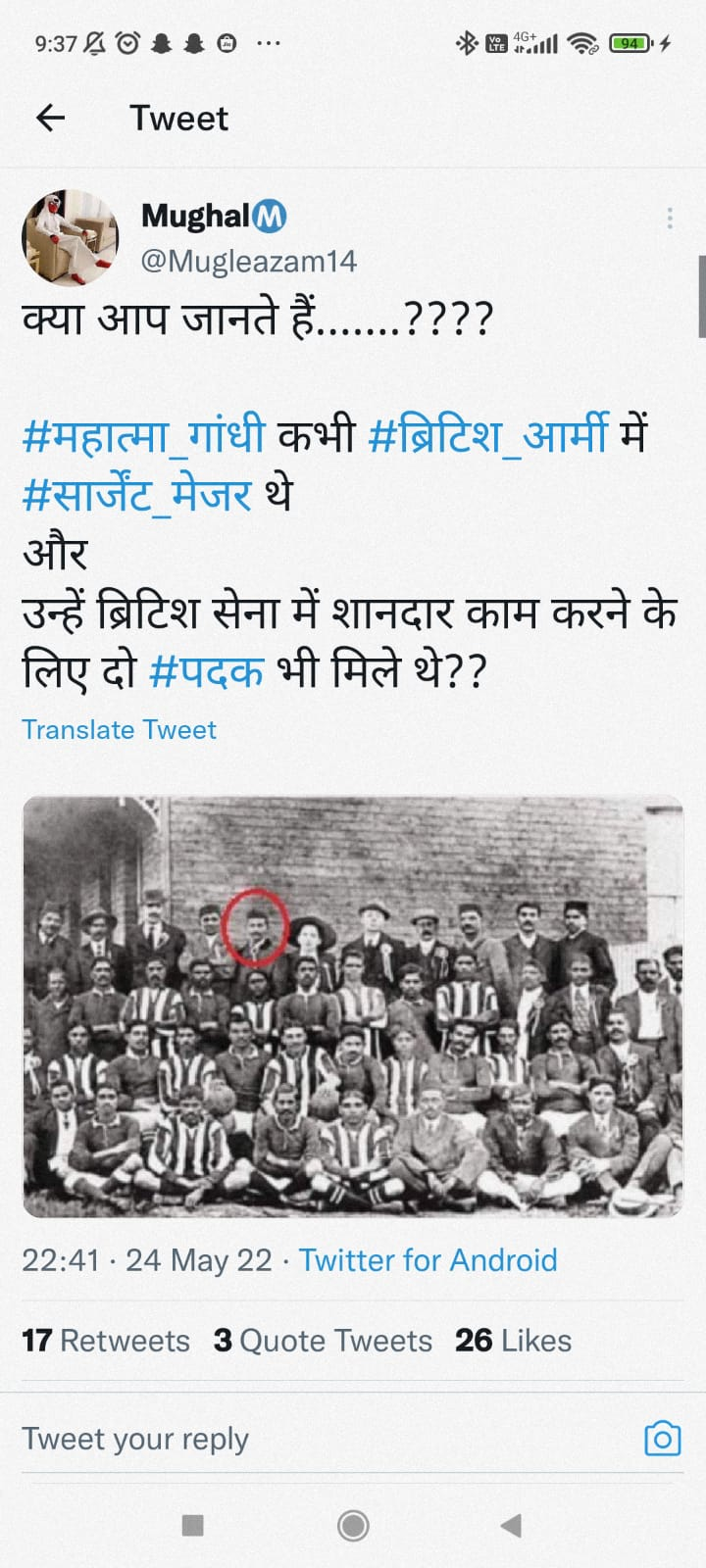
This tweet also went viral saying that Gandhi was a part of the British Military, pre- independence but after fact checking news came that Mahatma Gandhi formed two football clubs in Johannesburg and Pretoria. This image was that of the team, taken circa 1913 in South Africa.


Looking at all this scenario we realize that critical thinking is very necessary. If we start believing in any of this without thinking perhaps we will start living in a fake, imaginary world built by social media. Also Amitabh Bachchan, Shradddha Kapoor all big stars have a great fan following and some also consider them to be their ideal and so they will always believe everything said or posted by them without even cross- checking or knowing the truth. It doesn't mean to not love, like or follow anyone but the most important is to have your own individual thinking.

In earlier periods also this type of stupid talks were happening but all that was limited to group of people but today due to social media stupidity is not limits to oneself.

“Man is the Storytelling Animal, and that in stories are his identity, his meaning, and his lifeblood.” -Salman Rushdie ( Luka and the fire of Like)

There are stories everywhere but it's necessary to identify what is fact, belief, opinion and truth.

The teacher might be wrong. Learn to think for yourself. A student always believes what is said by a teacher but one should not rely on even a teacher to think for themselves. Be individual, be oneself.
ખેડ, ખાતરી ને ખંજવાળ જાતે કરવી સારી.

Developing an ability to think is equal to developing a good physical strength, gym process.
Thinking process = Gym process.

In the beginning you might think that humans are rational animals but modifying it we can say humans have a capacity to be rational. To be rational a mind is trained or is needed to be trained in a particular way.
E.g: players of any sport get trained to be perfect in that.

Similarly, critical and creative thinkers are not born thinkers, they go through a thinking process every time and train their mind to think.
One might feel that question is a way of thinking and contracts wh idea of training a mind to think because infants keep on questioning. But it is to be understood that asking questions doesn't mean that one is a critical thinker. Choice of question and arising to right question at a right time and place is important.

Beginning with creative thinking, look at an image, is this creative?


Perhaps it's unsafe! Harmful. Technomodication by the collective of bicycle and sewing machines. This image can be conceived in various ways. It's 'The Family Bicycle,' with a sewing machine included for dear old Mom. Invented by Charles Steinlauf in 1939 so the whole family can get out and enjoy some family exercise and catch up on some sewing, too.

Its difficult to call it a creative because to be creative two are compulsory characteristics- To be original, Creation must be of some value.
It's an original idea but it's not adding a complete value to life or anything.

Next we had a wonderful activity to know whether we are creative or not.


We had to make a category in which at least two items from the image can be considered.

Various categories popped up like toys, sports equipment, food, garden, religion, occupations, etc but important is how one can, you can look at things differently, how creative you are. Some of the best categories popped up in the class were
  • Shakespeare’s tragedy- hamlet, Macbeth
  • Books- gun island, home and the world, great Gatsby, Frankenstein
  • Proverbs- apple of my eye, pen is mightier than sword
  • Things associated with apple- Adam eve story, MacBook
  • Metaphor in literature- axe, painting plate
  • Quotes- Abdul Kalam on Pizza, today is a present
  • Bollywood songs
  • LGBTQ- color plate, no gender of robot
  • Movie names
  • Phallocentric
  • Current news, on Salman Rushdie- a book, fatva, being stabbed.

If you find any new category write in the comment.

Training the mind to be creative is being able to see what others cannot see. Change the way of looking.

We also had another activity in which we were shown a picture and had to give its unobvious uses, for example of brush- painting, cleaning comb, scratching; of Gogals to hold your hairs; it was a practice to see things beyond its purpose and try to be creative.

Patience is necessary to be creative, as physique can be made with patience in the training. Abstract thinking is not at all an easy task.

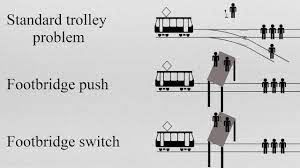
Further we had a thought experiment, which brushed our brains to a great extent. Milan sir gave us trolley -ology questions to apply our mind in a creative and critical way.


It was really a great exercise. This exercise had no right or wrong answer. It was a test of an ethical dilemma. here giving answer isn't important an argument behind  the answer is important. 

Learning outcome:
This workshop gave me a way or clear insight into how to start thinking. when to think? Thinking is perhaps the most difficult process. we have a habit of accepting what news reaches us and even we might lack information where to fact check but the idea of what else is true helps to doubt what is said and then we can go for the real, correct news. Its not necessary that thinking will always give us answer or solution, it might confuse us more but it develops an ability which differentiates us from other. constructing an argument is important. learnt to be skeptical, rational and look at the plausibility. 


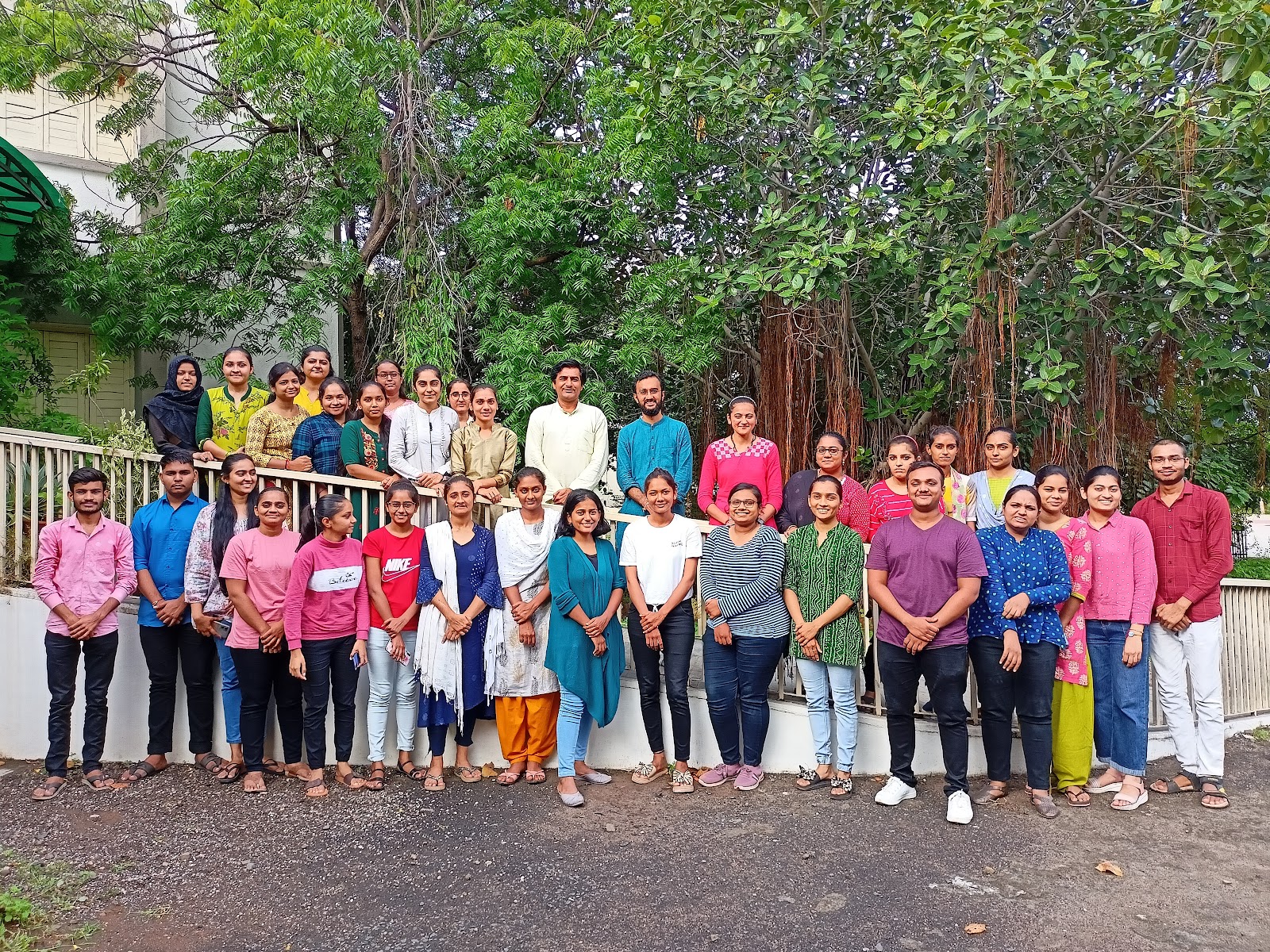
Our workshop ended with the feedback and vote of thanks by the students and the group photo with sir.


These two days were really a worthy weekend full of fun and knowledge. Attending this workshop was truly enjoyable Thank to Dr. Dilip Barad sir and Prof. Milan Pandya Sir.

Tuesday, 26 July 2022

Welcome Function 2022

WELCOME FUNCTION


Our decoration had a combination of technology and literary books because The Department of English MKBU wonderfully combines Literature and technology. Technology is a vehicle which helps us to achieve our literary knowledge/ Literary sensibility and as we know digitalization of education is very much necessary and is important for future teacher teachers to be familiar to it. 

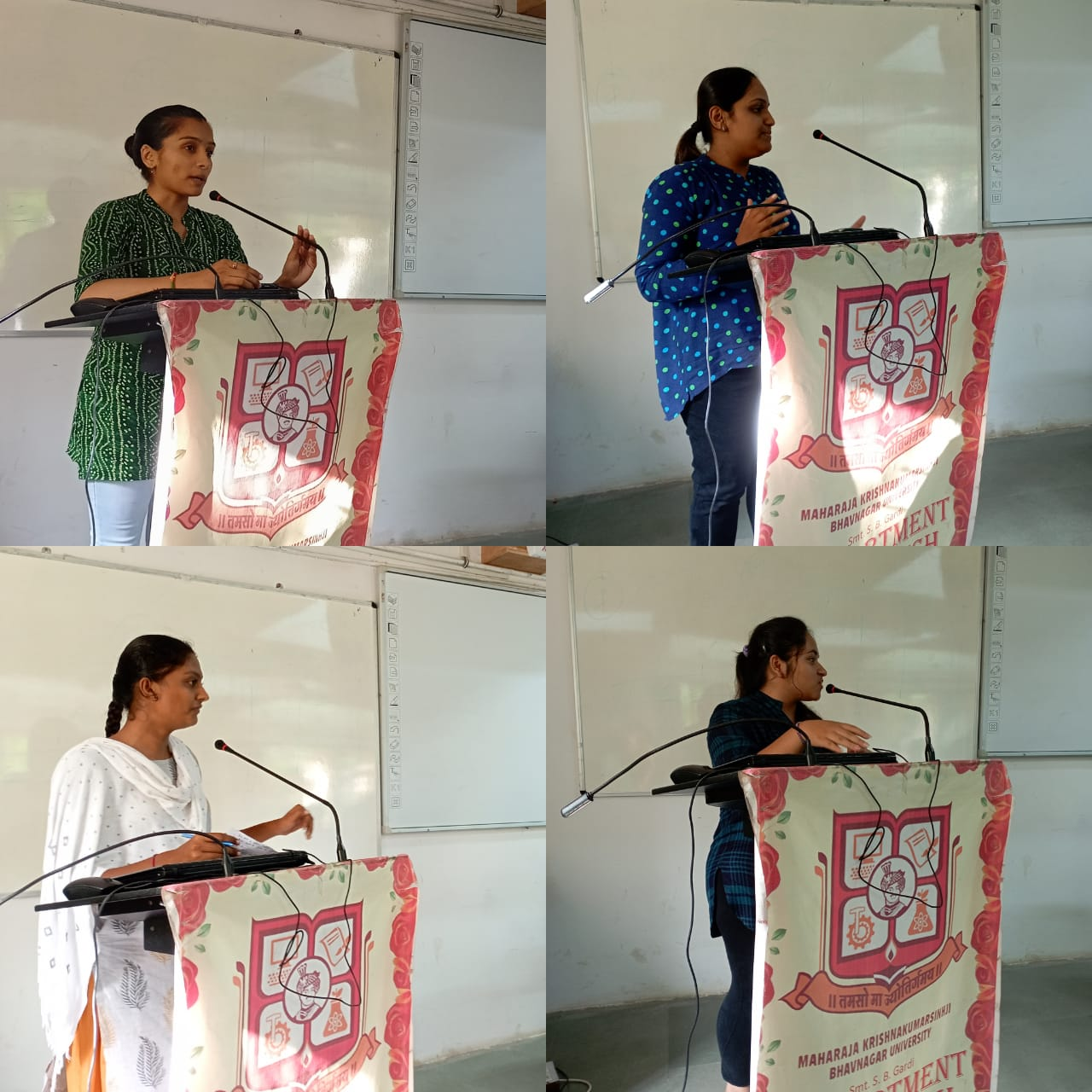
on 24 July 2022, Sunday we students of semester 3 (Batch 2021-23) organized a welcome function for the newly enrolled students of semester 1 (Batch 2022-24). As per the Department’s tradition, all the leaders of various committees introduced their respective committees to the juniors and tried to introduce the work culture of The Department of English.  


This function was hosted by Dhruvita Dhameliya and me. 


Students of Semester 1 also enthusiastically participated in this function Drashti Joshi performed a wonderful dance of Nagada Song, Akshat Banerjee Presented a song in a tribute to great singer KK and a lovely Guajarati folk song was sang by Prabhat Gohil. My classmate Himanshi Parmar engaged our juniors in wonderful spinner wheel game. It was great that we were able to modify the chit game into spinner wheel. And there was a wonderful group dance by semester 3 students in connection to the theme of existentialism. 


All The leaders wonderfully presented there committees to the Juniors. Presentation of The Committees are embedded below.


Lastly, the function ended with the golden words by our faculties
Kavisha Alagiya ma’am gave us her example of error as a student and taught us to learn from mistakes ‘trial and error’ is a key to success and to always stay curious. 
Yesha Bhatt ma'am guided us to be real, be enthusiastic and to gain courage to face stage fear. 
Vaidehi Hariyani  ma’am gave us a wonderful idea to always be a green fruit (kachcha fal) because once a fruit ripe it loses all its capacity to handle pressure and to grow more and to be open to grasp and learn new things.

In the concluding words by Dilip Barad sir, sir gave us insight into the teaching profession after masters degree. He discussed the objectives of the Department's work culture to increase literary sensibility, to observe the world through literature; making students ready with digital skills to make them ready for the future work culture. Teaching is the mother of all professions, talent is necessary to be a teacher. Be a multitasker. After being a teacher, the most important thing is to groom students.


Here is the recording of our function


Wednesday, 20 July 2022

Daily Assembly- Exploring Bogger- ICT

Exploring Blogger

Hello! I presented this presentation in Daily assembly for introducing blogger to our juniors (sem 1 Department of English , MKBU) as we are assigned a our thinking activities in form of Blog.


This presentation teaches to create a account on a blogger and introducing layout and themes and various aspects of bogger to make your blogs look attractive for readers.


A blog is a a regularly updated website or web page, typically one run by an individual or small group, that is written in an informal or conversational style.
In 1994, when blogs began, a blog was more of a personal diary that people shared online. In this online journal, you could talk about your daily life or share about things that you were doing. Then, people saw an opportunity to communicate information in a new way online. Thus began the beautiful world of blogging.
the main purpose of a blog is to connect you to the relevant audience. Another one is to boost your traffic and send quality leads to your website.

Keep exploring.

Tuesday, 19 July 2022

Daily Assembly- Guru Purnima

GURU PURNIMA

Hello Readers! This blog deals with basic information of Guru Purnima and a presentation which was presented in a Daily Assembly.


Guru Purnima (Poornima) is a tradition dedicated to all the spiritual and academic Gurus, who are evolved or enlightened humans, ready to share their wisdom, based on Karma Yoga. It is celebrated as a festival in India, Nepal and Bhutan by Hindus, Jains and Buddhists . This festival is traditionally observed to honor one's chosen spiritual teachers or leaders. It is observed on the Full Moon day (Purnima) in the Hindu month of Ashadha (June–July) as it is known in the Hindu Calendar. The festival was revived by Gandhi to pay tribute to his spiritual guru, Shrimad Rajchandra. It is also known as Vyasa Purnima, for it marks the birthday of Veda Vyas , the sage who authored the Mahabharata and compiled the Vedas.


This presentation talks about how this auspicious day is celebrated in various ways in different religions. 

On this auspicious day in daily assembly we discussed about Dattatreya, who is famous or known for Self Education, he declared nature as his Guru and gave 24 elements of nature. Today is also an era where self- education is possible and is done through internet. There seems no need of spiritual or academic Guru for education. Also a veer like Eklavya who only with the idol's help became a great archer.


This was the article on Guru Purnima 2022 in 'Shatdal' weekly paper of Gujarat Samachar said that all the wars and violence in this 21st century is result of Technology. While this can be criticised by saying that in the periods of wars like Kurukshetra, WWI and WWII there was no technology no internet. This article was also discussed in class.

We also came across an article of Martin Haigh 'Sri Dattatreya’s 24 Gurus: Learning from the World in Hindu Tradition' CLICK HERE TO READ IT


This is a wonderful Bollywood song which was also discussed in the class criticizing the idea of India as a 'Vishwa Guru'. Humne Suna Tha Ek Hai Bharat Hindi Lyrics from movie Didi (1959) sung by Mohammed Rafi, Asha Bhosle, lyrics writing by Sahir Ludhianvi, music composed by N. Dutta. Starring Sunil Dutt, Feroz Khan, Lalita Pawar, Shubha Khote.

Monday, 18 July 2022

Derrida and deconstruction; Deconstruction in practice

Hello! This blog is in response to a task assigned by Dr. Dilip Barad sir. In this Blog I am going to deal with my own understanding of deconstruction and going to elaborate deconstruction with examples. Derrida and Deconstruction, we learnt this topic in Flipped learning, to read my learning outcome CLICK HERE.

Derrida and Deconstruction


What is deconstruction?
It is a form of textual analysis. The theory of Deconstruction was introduced by the French Philosopher Jacques Derrida along with Paul de Man and his fellow Yale Deconstructionists; Harold Bloom, Geoffrey Hartman and J. Hillis Miller. Deconstruction is one of the important strings in Post Structuralism. Deconstruction had an immense influence on Literary studies (though this is more marked in the English- speaking world than in France) philosophy and Historiography. Gayatri Chakravarty Spivak was Derrida’s translator and had a major impact on Postcolonial theory and also became important element in Queer theory.

Deconstruction is a very difficult term to be defined; many of its practitioners insist that it is not a theory or philosophy that can be applied or can be defined in a set of propositions But its number of general principles can be identified.

Deconstruction relies upon extremely close reading of the texts under analysis and tends to refrain from introducing external evaluative criteria. Deconstruction can be called as an extreme form of Immanent critique. De Man states that it is not something that is added to the text.


Derrida says,
“Language bears within itself the necessity of its own critique.”


A literary text deconstructs itself because it simultaneously asserts and denies the authority of its own rhetoric.

Derrida was not the initiator of this theory but it is ancestry is traced in Friedrich Nietzsche that there are no facts, only interpretations and Marti Heidegger’s critique of the priority that is traditionally given to the present tense in attempts to discuss the nature of being. While Derrida’s one of the constant concerns is with ‘Metaphysics of Presence’; to read the absence in the present of presence. Also can be said that the ‘subject’ can be self- understanding and can express itself fully in speech. Derrida also criticizes logocentrism or phono centrism which says that speech exists prior to writing. Logocentrism emphasizes the privileged role that logos, or speech, has been accorded in the Western tradition.

He claims that speech is the primal and the full form of expression. Logocentrism ignores or conceals the fact that if writing is a supplement to speech then definitely something must be absent in the speech that has to be supplemented. Speech does not have a point of origin but it arises from an ordinary lack. Following Saussure, Derrida describes language as a series of supplements and substitutions But he argues that the theory of the sign is itself an instance of logocentrism.


While in the critic of the sign Derrida introduce a new word ‘Differance’

Difference= differ + defer

This demonstrates that language has one point of origin and on end. The ‘meaning’ of the word is always a product of the difference between signs and it is always ‘deferred’ by a temporal structure that never comes to end.

For e.g.: It is a tree because it's not a plant
It's dark due to absence of light
Women due to absence of masculinity

So, there is never a final reading of the text, every reading infuses a supplementary reading.

The universalist ambition of structuralism is also challenged by deconstruction’s emphasis on undecidable apereas which cannot be described in terms of sets of binary oppositions. E.G. Plato’s ‘PHARMAKON’ which means both poison and antidote.

Derrida’s Grammatology which in detail studies Saussure exemplifies deconstruction’s insistence on unraveling the logic and contradictions of the text itself. Derrida explains deconstructing a philosophical text means working through its concepts and logic in such a way as to discover and determine what it cannot describe, what its history has excluded in order to constitute it as what it is.

Paul de Man makes a similar point in his argument that if they are to be coherent and self- consistent, Literary texts must of necessity be blind to the ‘metaphors’ and other figures of rhetoric that constitute them as texts. Deconstruction’s rigorous examination of those figures reveals the weakness of the links that hold them together.

Deconstruction is a poststructuralist theory, based largely but not exclusively on the writings of Derrida. It is in the first instance a philosophical theory and a theory directed towards the (re)reading of philosophical writings.

This is my basic understanding about deconstruction. Further in the blog I am going to deconstruct some ads and some Bollywood songs

This is Dr. Dilip Bard sir's presentation which instructs ‘How to Deconstruct a Text?’

Language bears within itself the necessity of its own critique

Deconstruction insists not that truth is illusory but that truth is institutional.


पैरों में पायल की बेड़ी से बंध के मैं ना रहने वाली
मैं अल्हड़ पुरवा के जैसी हूँ, परदेसों तक बहने वाली
मुझे गहनों से बढ़ के सपनों की चाहत है
जिन सपनों को सच हो जाने की आदत है
कट्टी है मेरी मर्दों से, यारी फ़िल्मों के पर्दों से

The above lines is from the Bollywood song “Param Sundari” from 2021 Laxman Utekar’s movie ‘Mimi’. Movie is about young ambitious woman who wants to be a actress and for money she opts to be a Surrogate mother for a foreign couple.

This is a stanza from the song sung by the female protagonist, the four lines of the song are very appealing that a woman is trying to come out from the traditional female role and loves her dreams. But the last line of the stanza again takes us back to the idea of limitations of women’s dreams. Dreams of beautifying themselves, dreams of being admired. In Contrast , dreams of male Bollywood characters are like ideal, sophisticated dreams. For example ‘Kabir Singh’ is a love story, male protagonist is toxic, still he is a top surgeon and is honest to his work, no image damage as a doctor, and lives his dream. . While the female protagonist dreams to have a happy life, being admired, money and to be beautiful. Another instant example is also a ‘Fashion’ movie.


Tarak Mehta ka Ooltah chashmah is a Hindi sitcom based on the weekly column "Duniya Ne Undha Chasma" by Taarak Mehta in Chitralekha magazine. It is produced by Asit Modi. This serial focuses on the members of Gokuldham Society who come from different backgrounds, It attempts to deliver a beautiful notion of India which believes in Unity in Diversity. .Gokuldham is also referred to as "Mini India" in the show. But, deconstruction is always about finding loops. Perhaps it shares the unspoken socio- political condition of India. The Serial has one ‘Muslim” character Abdul. And he has no place in Gokuldham society, he owns a shop outside the society. He is part of every occasion but not of society. The society which is called Mini India perhaps really tries to bring a critic of India’s religious (Hindu- Muslim) biases. Or perhaps it is speaking the language of authority and trying to set viewers mentally.


Fairness cream ads are majorly problematic. It prioritizes fairness, white skin for being a leading personality in any field. It downgrades the talent, and beauty is prioritized. Here is the series of ads for ‘Ponds white cream’ . It's a storyline in which a boy breaks up with his beloved and falls for a white girl. But comes back to the girl once she starts looking fair. This brushes the racist ideology in the human mind. If a girl wants love or a job she needs to be fair. This ad also brings out the idea of colonizers and colonized. Still the colonizers are colonizing us, this ad makes us feel beneath them. Especially to women, there are white skinned people who won't let have a dreamt or happy life. Continuous telecast of this type of ads boosts this ideology in the culture.


Even the taglines of beauty products are like; Fair and lovely taglines- “Badal do apni kahani” and “Guaranteed Fairness. Guaranteed Fame.” To change life, to have fame one has to be fair.

Even our Bollywood songs praising the white skin “गोरे गोरे मुखड़े पे, काला काला चस्मा”


सुन्दर हो और सुशील
रंग चांदी सा चमकीला
डिग्री भी हो फैशन भी जाने सोनिये
हो सीता जैसे नारि और जाने दुनिया दारी
पिया को सब कुछ ही वो माने
दिल से दिल्ली हो वो धड़कन से हो लंदन
ढूंडू में ढूंडू
मेरे ब्रदर की दुल्हन

मोहब्बत की हो वो गूगल
जो देदे हर क्वेश्चन का हल
नज़र के एक ही क्लिक से सोनिये
वाक पे सुनती हो जाने
ब्रदर को खुश करना जाने
जो सबके दिल में दुआ सी बस्से
मॉडल हो वर्ल्ड बेस्ट पर मिटटी हो इंडियन
ढूंडू में ढूंडू
मेरे ब्रदर की दुल्हन


Mere Brother Ki Dulhan (translation. My Brother's Bride) is a 2011 Indian Hindi -language Romantic comedy film written and directed by Ali Abbas Zafar. The above lines are from its titular song. In this line a male protagonist is singing the characteristics he wants in his sister-in-law (Bhabhi). It suggest he want a hi-fi women who is capable to stand in this hi-fi world but should not leave her traditional values like husband is everything “pati Parmeshwar” idea पिया को सब कुछ ही वो माने. He demands a beautiful lady shining like a diamond, knowing fashion along with education but she should also be like SITA (mythical character from Ramayana). Should be loving, responsible, modern and could also make or keep his brother happy. She should be all rounder but traditional ideal Indian lady characteristics should be there.

Here we can see the demanding society, a woman should be more than 100% no guarantee about the men.

The same film also has a dialogue.


So here I end my blog, I have tried my best to make deconstruction easier for the readers. I hope it was useful to you. Thanks for visiting.

[words 1650]

My Learnings from the National Workshop on Academic Writing (2026)

The National Workshop on Academic Writing  I recently had the opportunity to participate in the National Workshop on Academic Writing (2026)...