Showing posts with label environment. Show all posts

Wednesday, 24 July 2024

Environmental Studies 3- Environment

 ENVIRONMENT


The word ‘environment’ is derived from the French word 'environ', meaning to encompass or encircle. It refers to ‘entoure’, or that which surrounds us. The human environment includes biotic (living), abiotic (nonliving), and socioeconomic factors, all of which interact to shape our surroundings and influence our lives.


Various Spheres of Earth

1. Lithosphere:

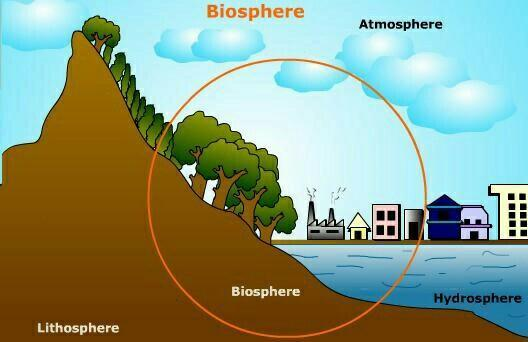
The lithosphere is the solid outer layer of the Earth, encompassing the crust and the uppermost part of the mantle. It is composed of rocks and minerals and is where we find landforms like mountains, valleys, and plains. This layer is crucial for providing natural resources such as minerals and fossil fuels, and it supports terrestrial life.


2. Atmosphere:

The atmosphere is the layer of gases surrounding Earth, extending from the surface into space. It is composed mainly of nitrogen and oxygen, with traces of other gases. The atmosphere is vital for life, providing the air we breathe, protecting us from harmful solar radiation, and regulating the planet's climate through the greenhouse effect.


3. Hydrosphere:

The hydrosphere includes all the water on Earth's surface, such as oceans, lakes, rivers, and glaciers, as well as groundwater. Water in the hydrosphere is essential for all living organisms and plays a key role in weather patterns and climate regulation. It is also crucial for various human activities, including agriculture, industry, and recreation.


4. Biosphere:

The biosphere encompasses all living organisms on Earth, from the deepest ocean trenches to the highest mountain peaks. It includes all ecosystems and the interactions between different forms of life and their environments. The biosphere is the global sum of all ecosystems and is essential for maintaining the balance and sustainability of life on the planet.


5. Cryosphere:

The cryosphere consists of all the frozen water on Earth, including ice caps, glaciers, sea ice, and permafrost. This sphere is crucial for regulating the Earth's climate by reflecting solar radiation and influencing ocean currents. The cryosphere also plays a significant role in the global water cycle and provides habitats for specialized forms of life.


6. Anthroposphere:

The anthroposphere, or technosphere, includes all human made structures and activities, such as cities, infrastructure, and technology. This sphere represents the human impact on the Earth and its systems. It is closely linked with the biosphere, lithosphere, atmosphere, and hydrosphere, as human activities significantly influence and are influenced by these natural systems.


Various Spheres of the Atmosphere

1. Troposphere:

The troposphere is the lowest layer of Earth's atmosphere, extending from the surface up to about 815 kilometers (59 miles) high. This is where most weather events occur, and it contains the air we breathe. Temperature decreases with altitude in this layer, which holds about 75% of the atmosphere's mass.


2. Stratosphere:

The stratosphere lies above the troposphere, reaching up to about 50 kilometers (31 miles) high. This layer contains the ozone layer, which absorbs harmful UV radiation and causes temperatures to rise with altitude. The stratosphere is stable and free of weather disturbances, making it ideal for high altitude flights.


3. Mesosphere:

The mesosphere extends from 50 kilometers (31 miles) to 85 kilometers (53 miles) above Earth. It is the coldest atmospheric layer, with temperatures decreasing with altitude. This layer is where meteors burn up upon entering the atmosphere, creating bright trails.


4. Thermosphere:

The thermosphere ranges from 85 kilometers (53 miles) to 600 kilometers (373 miles) high. Temperatures increase significantly with altitude due to the absorption of high-energy radiation. The thermosphere includes the ionosphere, important for radio communication and satellite operations, and is the site of the auroras.


5. Exosphere:

The exosphere is the outermost layer, starting around 600 kilometers (373 miles) above Earth and extending into space. It has very low density, with particles so sparse they rarely collide. The exosphere gradually fades into the vacuum of space and is where many satellites orbit.


Read in detail about

Thanks for visiting. I hope this blog was useful. Keep Learning.

Environmental Studies 1- Introduction

INTRODUCTION 


What is Environmental Studies?

  • Environmental studies is an interdisciplinary academic field that studies human interaction with the environment to solve complex problems. 

  • Interdisciplinary study of how we humans interact with the living and nonliving parts of the natural world.


Environment

The surroundings or conditions in which a person, animal, or plant lives or operates.
the natural world, as a whole or in a particular geographical area, especially as affected by human activity.


Environmental Science

  • An interdisciplinary field that integrates physical, biological, and information sciences to study the environment and find solutions to environmental problems.

Environmental Engineering

  • A branch of engineering focused on protecting human health and the environment by developing technologies and processes to manage natural resources and mitigate pollution.

  • Application of engineering principals, under constraints to the protection and enhancement of the quality of the environment, public health, and public welfare

Environmental Studies

  • A multidisciplinary academic field that examines human interaction with the environment to promote sustainability and conservation.


Differences

Ecology and Environment

Environment

Ecology

Environment refers to the interaction between the physical, chemical and biological components.

Ecology is the study of the relationship between organisms and their environment.

The environmental issues include pollution, deforestation, global warming, and other broader issues.

The ecological issues include population size, diversity, distribution of organisms, and competition between them.

Studies the internal and external factors affecting the environment.

Aims to understand life processes, distribution, adaptation and biodiversity.


Ecosystem and Environment

Environment

Ecosystem

It is the surroundings where organisms live.

It is the community where the biotic and abiotic components interact with each other.

It comprises physical components.

It comprises biological components.

It provides a living space for the elements

It provides interaction between the elements

It provides the condition to live.

It provides the relation between components to live.

Environment can be macro or micro.

Ecosystems can be aquatic or terrestrial.

An organism’s environment changes as it moves from one place to another.

The ecosystem remains the same no matter where the organism travels.

Environment is just a place in time.

Ecosystem depends upon all the essential life processes such as photosynthesis.


Ecology and Ecosystem

Ecology

Ecosystem

The interaction between the environment and living beings is the focus of ecology.

The study of various places and environments, such as streams, still water, desert, river, grassland, and woodland, is fundamental to the study of ecosystems.

Ecology is the study of the natural environment and its various ecosystems.

In general, the ecosystem is a subset of the larger ecology.

When it comes to ecology, there is no broad categorization.

The ecosystem, on the other hand, can be of several forms, such as a marine ecosystem, a forest ecosystem, or a pond ecosystem.

Ecology is the study of living entities or organisms, as well as their interactions and relationships with their surroundings.

The ecosystem, on the other hand, is a subset of ecology that encompasses all of the complex interactions between living and nonliving organisms in a community or area.

Ecology encompasses a larger view of the environment.

Every biotic and abiotic aspect in the environment makes up an ecosystem.


Ecology is the study of ecosystems whereas ecosystems are units that are formed by the interaction of a community of organisms with the environment.


Read in detail about

Thanks for visiting. I hope this blog was useful. Keep Learning.

Thursday, 10 November 2022

CONCLUSION: THE FUTURE OF POSTCOLONIAL STUDIES

Hello! This blog is a response to the task assigned by Dr. Dilip Barad. In this blog I am going to summarize two articles from Ania Loomba's book "Colonialism and Postcolonialism" about postcolonial studies, Conclusion: Globalization and the future of postcolonial studies and Conclusion: The future of postcolonial studies.

Globalization, Environment and Postcolonialism

What is Post- Colonial Studies?
Postcolonial studies is the critical analysis of the history, culture, Literature and modes of discourse that are specific to the former colonies of England, France, Spain and other European imperial powers. Postcolonial studies have focused on the third world countries in Caribbean Islands, Asia, South America and Africa.

CONCLUSION: THE FUTURE OF POSTCOLONIAL STUDIES

Dipesh Chakrabarty finds that all his ‘reading in theories of globalization, Marxist analysis of capital, subaltern studies, and postcolonial criticism over the last twenty- five years’ have not prepared him for the task of analyzing the ‘planetary crisis of climate change’.

This video aptly shows how the human world is encroaching nature.


The environmental activist Vandana Shiva has exposed the connection between colonialism and the destruction of environmental diversity. She argues that growth of capitalism and today of trans- national corporations, exacerbated (make worse) the dynamic begun under colonialism which has destroyed sustainable local cultures.

Many feminist environmentalists agree that questions of ecology and human culture are intricately linked. Especially in third world countries, where saving the environment cannot be talked about while ignoring the needs of human lives and communities.

Rob Nixon further noting about the wilderness obsession of Americans celebrated in American literature as well as in natural history says-
'There is a durable tradition … of erasing the history of colonized peoples through the myth of the empty lands. … a prodigious amount of American environmental writing and criticism makes expansive gestures while remaining amnesiac towards non-American geographies that vanish over the intellectual skyline' (Nixon 2005: 236).

Nixon suggests such 'spatial amnesia' is one reason why 'postcolonial criticism' has been suspicious of earth-first 'green criticism' and therefore has not engaged with questions relating to the environment .

Such engagement is particularly necessary given the battles all over the third world between environmental activists and big multinational companies, acting in concert with the nation-state, despoiling land and destroying communities.

Jodi A. Byrd and Michael Rothberg suggest that this is the result of 'indigenous people's sense of living under ongoing colonial projects-and not just colonial legacies and from postcolonial studies' over-reliance on models of colonialism in South Asia and Africa that do not necessarily speak to the settler colonies of the Americas, Australia and New Zealand'.

The displacement of indigenous communities and the theft of their land are also defining features of many spaces that have been privileged in postcolonial studies, such as South Asia and Africa, as is evident from environmental struggles there.

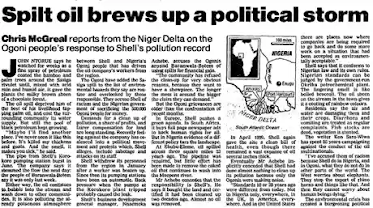
Ken Saro Wiwa led MOSOP, or the Movement for the Survival of the Ogoni People, an indigenous group in southeast Nigeria, whose oil-rich homelands were targeted for drilling by multinationals, leading to their large-scale displacement and to wide-scale environmental destruction.


Shell Oil finally admitted that it had collaborated with the Nigerian military dictatorship in the execution of Saro Wiwa in 1995.


In India, the Narmada Bachao Andolan (NBA; Save the Narmada River Movement) led widespread protests against a project, funded by multinational as well as indigenous capital, to build scores of large dams across central India. The protests highlighted not just the ecological damage but the displacement of thousands of tribal peoples all across the Narmada valley.


Chittaroopa Palit, one of the leaders of the NBA talking about her valuable lesson from this protest says,
Though international political factors, such as the character of the governments involved, the existence of able support groups in the North that play an important part, they cannot supplant the role of a mass movement struggling on the ground. Soon after the SPD government in Berlin refused a guarantee to Siemens, the German multinational, for building the dam in Maheshwar, it agreed to underwrite the company's involvement in the Tehri dam in the Himalayas and the catastrophic Three Gorges Dam in China-both just as destructive as the Narmada project; but in neither instance were there strong mass struggles on the ground.

In sharp contrast is the resistance to the plunder of the forests in Central India by iron and bauxite mining companies. The movement here is led by Maoist guerrillas who have taken control of large swathes of territory and are being hunted by the police and the army.

Roy writes that the constitution of free India 'ratified colonial policy and made the State custodian of tribal homelands. Overnight, it turned the entire tribal population into squatters on their own land. It denied them their traditional rights to forest produce, it criminalized a whole way of life'. Roy and many others have documented how the Indian State is acting in the interests of large iron and steel or bauxite and aluminum producing conglomerates, which are simultaneously national and global.

Karl Marx explained,
The enclosure of the commons was crucial to the birth of capitalism. He described the process in England: beginning at the end of the fifteenth century, the forcible usurpation of communal property occurred first 'by means of individual acts of violence and later through the Parliamentary Acts for Enclosures of the Commons. Along with slavery and colonialism, the takeover of the commons and the conversion of various forms of collective property rights into private property involved dis possessing large sections of the population, both in the colonising and colonised countries, so that wealth would be accumulated by a few. It also turned those dispossessed people into landless laborers and forced them into a cash economy; their work was thus 'commodified.

Luxemburg’s ideas which are important even today are- she alerts us to the deep historical connection between trade and colonialism. She reminds us that accumulation is a constant process rather than a past event.

Amitav Ghosh’s recent book, The River of Smoke offers a deeply compelling fictional account of this process by looking at the opium trade and wars in China.

David Harvey redefining Primitive accumulation points out that-
All the features of primitive accumulation that Marx mentions have remained powerfully present with capitalism's historical geography until now. Displacement of peasant populations and the formation of a landless proletariat has accelerated in countries such as Mexico and India in the last three decades, many formerly common property resources, such as water, have been privatized (often at World Bank insistence) alternative (indigenous and even, in the case of the United States, petty commodity) forms of production and consumption have been suppressed. Nationalized industries have been privatized. Family farming has been taken over by agribusiness. And slavery has not disappeared (particularly in the sex trade).

Water, land and air or 'the environmental commons' are now battlegrounds in many areas of the world.

Swapna Bannerjee-Guha argues that accumulation by dispossession is at the very heart of neoliberal development, concluding that it involves not just dispossession from land but 'losing rights over nature, livelihood practices, related knowledge,even culture-all that capital needs to appropriate for its expansion and increasing profit'. Such dispossession is widespread in Asia, Africa and Latin America, but it is also evident in Europe and North America.

Paula Chakravartty and Denise Ferreira da Silva asking who is the most vulnerable to dispossession, note that

the question [is one] that Harvey does not even consider, one that he also seems to see as already asked and answered by the subprime mortgages themselves and their securitization, which is: what is it about blackness and Latinidad that turns one's house (roof, protection, and aspiration) and shelter into a death trap?... How could anyone expect to profit from unpayable loans without debtors who were already marked by their racial/cultural difference ensuring that at least some among them would not be able to pay? This is precisely what makes 'high-risk' securities profitable.

Dipesh Chakrabarty writes that historians had previously assumed that the environment changed so slowly as to be a negligible factor in human history, we have now reached 'a tipping point' where it is clear that human beings have become 'geological agents' in a much more drastic and immediately palpable way.

He gave the word Anthropocene which denotes the current geological age, viewed as the period during which human activity has been the dominant influence on climate and the environment.

He conceded that-
Climate change, refracted through global capital, will no doubt accentuate the logic of inequality that runs through the rule of capital; some people will no doubt gain temporarily at the expense of others. But the whole crisis cannot be reduced to a story of capitalism. Unlike in the crises of capitalism, there are no lifeboats here for the rich and the privileged (witness the drought in Australia or recent fires in the wealthy neighborhoods of California).

In a response, Ian Baucom observes that a 'new universalism: the universalism of species thinking'. He rightly suggests that concern with our plantory condition must be less distanced, less empyrean and less stratospheric; having caught that catastrophic glimpse from above' we need not ask 'postcolonial studies to abandon recorded history' but to engage with key moments that help us understand 'this unfolding of catastrophes'.

For this, Baucom proposes that we return to
the history of the commonwealth... to that sixteenth and seventeenth century moment in which the political was separated out from the natural and set in conceptual opposition to it. And we need to do so not only in order to discover in this moment the deep origins of the Anthropocene, but as importantly, to find in our habits of critique, in our interpretative strategies, the ability to imagine a counter concept of the commons and of the commonwealth through which we might be able to find a way out of the anthropogenic catastrophe gathering around us.


As Susie O'Brien and Imre Szeman note,
'no other critical practice has foregrounded the links between cultural forms and geopolitics to the degree that postcolonial studies has over the past four decades'.

But postcolonial studies must engage more deeply in historical work in order to amplify these connections between culture and geopolitics; moreover, a narrow presentism obscures our view of the world we live in and postcolonial studies needs to understand pre-colonial histories precisely in order to approach the present with even greater sophistication).

Extending the time-frame of our self-understanding' as Baucom puts it, should lead, not to despair, which he detects in Chakrabarty's analysis, but to a deeper commitment to ‘enhancing conditions under which not just human life, but life itself can continue through the deep future of the planet'.

In the conclusion of the article Ania Loomba indicates new directions of post- colonial studies. The four areas: the environment; the history and present of indigenous peoples and societies; premodern histories and cultures; and the ongoing colonization of territories, labor and peoples by global capitalism. All of these demand fresh thinking about colonial history, the shape of freedom, racial hierarchies, gender dynamics, and community.

Many commentators have suggested that postcolonial studies should not be thought of as a discrete field so much as an approach that has been honed by work on colonial dynamics and legacies in several disciplines; nevertheless, it is also a formation within the academy, shaped largely within English departments.


SOME EXAMPLE OF ECOCRITICISM AND POSTCOLONIALISM
These examples explain in detail how globalization is affecting the environment and the new field of postcolonialism is emerging.

Real incidents

(Photo clicked by me)


Victoria park, Bhavnagar
(Photo by: Amul Parmar)


(Photo is hyperlinked)


(Photo is hyperlinked)

Shatrunjay Mountain range, Palitana


Examples from cinema


The movie has a fight for Jal, Jameen and Jungle. CLICK HERE

In this movie we see how the private company owners are happy and decide to let meteor fall as it may provide minerals.


The blog is quite lengthy, I have tried to give the overall idea presented in the essay. I hope it will be useful. Thank you.

[Words- 2045]

Friday, 11 March 2022

Research paper- Envirocentric Approach to Hard Times by Charles Dickens and William Wordsworth’s selected Poems

Research Felicitation Center of M. K. Bhavnagar University managed by prof. J.P Majmudar sir and Paras Sheth organised research paper competition for the first time to motivate and spread awareness among the students regarding research field. Various subjects were divided into four categories Language, Natural science, Social science and Medicine & ranks are to be announced differently for PG students and PhD scholars. In language category our department had highest number of participants in PG section. We submitted our research paper earlier and today we presented our paper. My topic for paper is 'Envirocentric Approach to Hard Times by Charles Dickens and William Wordsworth's selected Poems'.


Envirocentric Approach to Hard Times by Charles Dickens and William Wordsworth's selected Poems

Abstract:

This paper attempts to view the Environment in selected literary text. In recent years the human and environment connection has provided a vast area for research. Environment is an inseparable part of human’s world but personal greed has increased the depletion of nature. Dickens in Hard Times have done great service unknowingly by projecting imagery of industrial town and imparted serious teaching of Environment. William Wordsworth is nature poet and so in this paper also makes efforts to read his poems as envirocentric literature. Every literary work constitutes an environment in the background, reading it allows us to understand its problem in contemporary time. This paper attempts to read the environment in selected literary works.

Keywords: Envirocentrism, Hard Times, Charles Dickens, The Tables Turned, The
World is Too Much With Us, William Wordsworth, Eco criticism, Nature.

Discussion:

Literature has capabilities to influence readers and their minds. It ignites the capability to see the world with an entirely different perspective. In literary works, history plays an important role in shaping it; It brings the political and cultural reality of that period, and comes up with critical eyesight towards various social norms. Literature aims for social, political and cultural refinement along with expanding our field of vision towards the environment.


If one analyses several literary texts one finds numerous environmental concerns in it, it might not be the chief affair of the text but definitely the subordinate one. The text which deals with the environment is Envirocentric Literature and This multidisciplinary study of literature and environment is identified as Envirocentricism / Ecocriticism.

The concept of envirocentric literature/ ecocriticism was specified by Joseph Meeker as an idea called ‘Literary ecology’ in his ‘The Comedy of Survival: Studies in Literary Ecology’ (1972) and later the term ‘Ecocriticism’ was coined by William Rueckert in his essay ‘Literature and Ecology: An Experiment in Ecocriticism’ in 1978.

There was no specific organised movement to study ecocriticism/ envirocentric literature like we do have Romantic period in English Literature, was at its peak in 19th century in the span of 1800- 1850, began with publication of Lyrical Ballad (1798). It was disintegrated with various titles like Pastoralism, human ecology, regionalism etc.

Later in the 1980s, collective work began under this genre by the efforts of Western Literature Association. It set up ASLE at a Conference in Reno with a motive of "sharing of facts, ideas, and texts concerning the study of literature and the environment," in 1992 . Ecocriticism is associated with ‘Association for the study of Literature and Environment’ (ASLE- United States), founded in 1992 which organises a conference for the scholars of Environmental studies in literature and Environmental Humanities in general and later in publishes a journal, a quarterly published by Oxford University Press, ‘Interdisciplinary Studies in Literature and Environment’ (ISLE).

Cheryll Glotfelty defined Envirocentricism/ ecocriticism in ‘The Ecocriticism Reader’
(1996) "ecocriticism is the study of the relationship between literature and the physical environment".

The second wave of ecocriticism/ envirocentric literature turned up in the 2000s. Its
representative work is Environmental Justice Reader: Politics, Poetics, and Pedagogy (2002) by Joni Adamson, Mei Mei Evans, and Rachel Stein (Eds.). According to Lawrence Buell, promoter of ecocriticism expresses that the second wave envirocentric literature deals with public health environmentalism, considering
sociocentric point of view rather than ecocentric. It doesn't only think about rural landscapes but also started including Urban and industrial transformation which one can define as human wildness.

According to Simon Estok -
"ecocriticism has distinguished itself, debates notwithstanding, firstly by the ethical stand it takes, its commitment to the natural world as an important thing rather than simply as an object of thematic study, and, secondly, by its commitment to making connections".

Camilo Gomides offered a comprehensive definition in reply to the questions about What ecocriticism is or should be with his article "Putting a New Definition of Ecocriticism to the Test: The Case of The Burning Season, a Film (Mal)Adaptation" in 2006.

"The field of enquiry that analyses and promotes works of art which raise moral questions about human interactions with nature, while also motivating audiences to live within a limit that will be binding over generations".

The second wave envirocentric literature was inspired by the writers like Charles Dickens who wrote about society in the Victorian era and its concern with increasing industrialisation.

Let us see ‘Hard Times: For These Times’ (1854) by Charles Dickens as an Envirocentric Literature. What one generally sees is when we read any text from an environmental view one finds presence of environment in every text. The only muddle is one reads the environment as a background but for enviro- criticism the environment plays an active role.

Thematically ‘Hard Times’ portrays the reality of Victorian society. The harsh reality of its education system, money- minded society and futility in concern for humans, Dickens criticises the modernisation. All these social and economical areas play an active role in the novel ‘Hard Times’. Besides all this Dickens very prominently presents wilderness of humans towards nature.

In the Novel, the narrative of the Imaginary town Coketowm shows the immense disturbance in Dickens seeing the neglecting nature of humans towards the environment. The narrative of Mr. Gradgrind in the novel easily suggests that hard times have already begun.

Presenting the picture of Coketown which didn't look natural. “It was a town of red brick, or of brick that would have been red if the smoke and ashes had allowed it...”

The images like ‘savage’, ‘elephant’, and ‘serpents’ show the human attitude towards nature.

“ ...it was a town of unnatural red and black like the painted face of a savage. It was a town of machinery and tall chimneys, out of which interminable serpents of smoke trailed themselves...”

An imaginary town of Dickens is painted red and black which seems like ‘savage’ something which is violent or uncontrollable which aptly indicates that the town is developing hastily, it has lost its naturalness and now it cannot be controlled. ‘Serpents’ are poisonous and the smokes coming out of tall chimneys are visualized poisonous for humans. Through this one can suggest the atmosphere of Coketown is toxic.

“... the piston of the steam-engine worked monotonously up and down, like the head of an elephant in a state of melancholy madness.”

The imagery of ‘elephant’ is significant. As the mad elephant destroys its own living similarly here man who is acting like a machine ‘piston of steam- engine’ like a mad is destroying his own livelihood.

“...had a black canal in it, and a river that ran purple with ill-smelling dye....”

Water is life and the above indicates the containment of water. Industrialisation implanted its dirt in nature.

Along with all these features of Coketown putting forward envirocentrism in the ‘Hard Times’. The structure of the Novel is very significant, it is divided into three sections with agricultural titles “ Sowing,” “Reaping,” and “Garnering”. It is ironic as the novel’s overall focus is on industrialisation

Judging Hard Times with Envirocentric idea pushes us in wonders, How magnificently Dickens portrays Novel with its reading of Envirocentric Literature. William Wordsworth (1770- 1850) , a pioneer of romanticism, celebrated as a ‘poet of nature’, ‘worshiper of nature’. He supported the idea that nature and man are interconnected and both need to maintain their harmony. He always held up upon the idea of man’s dependence on nature. Bate, an eco- critic in his book ‘Romantic Ecology:

Wordsworth and the Environmental Imagination’ writes, romantics to be the ‘first ecologists’ as in a way they turned to be the prominent in challenging the idea of ‘capitalism’. He used simple language and described the nature/ landscape, he had his own nature, his world in his mind. He belonged to the middle class and studied in Cambridge and brought out new versions of nature poems. He was a pastoral person and so believed in the strong relation of nature and humans.

Bate is supporting the idea of Wordsworth but he doesn't mean to separate material and natural world, but both human and non- human world needs to walk hand-in-hand. Bate in his ‘Romantic Ecology: Wordsworth and the Environmental Imagination’ explains psychology of romantic poets, “a respect for the earth and scepticism as to the orthodoxy that economic growth and material production are the be-all and end-all of human society”

Above explanation of Bate can be aptly justifies by the Wordsworth's poem “The World is Too Much With Us”, written in 1802 and published in 1807

The world is too much with us; late and soon,
Getting and spending, we lay waste our powers:
Little we see in Nature that is ours;
We have given our hearts away, a sordid boon!

Wordsworth poem “The Tables Turned” (1798), is the best example of nature’s power. The poem has a prominent voice that the knowledge acquired from nature is more powerful than the knowledge acquired by books, human knowledge.

Up! up! my friend, and quit your books;
Or surely you’ll grow double:...

Books! ’tis a dull an endless strife:
Come, and hear the woodland linnet,
How sweet his music! on my life,
There’s more of wisdom in it

Not only for the knowledge, mental power but depicts nature to be the ultimate source of health, cheerfulness and wealth also i.e. physical power.

One impulse from a vernal wood
May teach you more of man,
Of moral evil and of good,
Than all the sages can.

Wordsworth always paid great attention to the physical world around him, ‘Nature is a teacher'. Somewhere we do find him subjective in his works but he also describes nature objectively. Reading Wordsworth’s poem as an envirocentric one can easily find Wordsworth's disappointment with the effect of industrialisation and one can easily find ecological and environmental concerns in his poems. Going through the poem we realise that it was an attempt done by the poet to awaken the society for the welfare of nature and the environment. we can interpret that the world was moving so fast towards the materialism and industrialisation that they were losing the physical world around them, they were not enjoying the nature on the other hand they were destroying the nature for their own benefits.

Every literary work portrays environment and every text seems to be envirocentric it depends on the reader how he reads it. The theory of ecocriticism is a recent theory of the 20th century but we find that the literary writers used to write about the environment in the past also. We have a habit of reading the work based on the current situation. For example, today we are reading various poems like Wasteland by T.S. Eliot with the pandemic lens. Similarly today when we are facing environmental problems like climate change, snow melting etc , we read various texts and poems from the environmental point of view. Sometimes we find that literary writers are also playing the role of historians. Whenever we read a literary text we get an idea of an historical event through it. so it is a duty of literary writers to portrait contemporary Society of their time in their work today we're facing use issue of Climate Change and the popular writer of today, Amitav Ghosh is writing his various text like The Hungry tide (2004), the Great Derangement (2016), Gun Island (2019) depict the environmental issue of contemporary time. In this paper I have dealt with one novel Hard Times by Charles Dickens and two poems of William Wordsworth through which we can identify the environment of their period and also understand how the society of that period was looking towards the environment.

Today, the ratio of envirocentric literature is greatly focused, as our current problem is climate change. Many novels very briefly illustrate the environment but those are the fresh images. After analysing the above envirocentric works we can trace human society’s role is depleting environment and environment’s superiority. It is necessary to portray the environment in works as it provides eyesight to the importance of human and nature relationship. And ecocriticism/ Envirocentric literature helps us to criticise the mannerism of society in treatment of nature.

Work Cited:

Barzinji, Mariwan. “Nature and Environment in William Wordsworth's Selected
Poems: An Eco-Critical Approach.” International Journal of Social and Educational Innovation (IJSEIro), January 1, 2020.
https://www.academia.edu/44009821/Nature_and_Environment_in_William_Wordsworths_Selected_Poems_An_Eco_critical_Approach.

Bate, Jonathan. “Romantic Ecology (Routledge Revivals): Wordsworth and the Environmental Tradition.” Routledge & CRC Press. Accessed February 21,2022.
https://www.routledge.com/Romantic-Ecology-Routledge-Revivals-Wordsworth-and-the-Environmental/Bate/p/book/9780415856652.

Batra, Jagdish. “Ecological Consciousness in Recent Indian English Fiction,” May 11, 2020.

Debrabant, Mary. “Smoke or No Smoke? Questions of Perspective in North and South.” Cahiers Victoriens et Édouardiens, no. 71 Printemps (June 18, 2010): 75–88. https://doi.org/10.4000/cve.2828.

Dickens, Charles. Hard Times. CreateSpace Independent Publishing Platform, 2017.

Estok, Simon. “Ecocriticism in an Age of Terror.” CLCWeb: Comparative Literature
and Culture 15, no. 1 (March 1, 2013). https://doi.org/10.7771/1481-4374.2182.

Faraday, Michael. “The Great Stink.” Accessed February 21, 2022.
http://www.choleraandthethames.co.uk/cholera-in-london/the-great-stink/.

Gladwin, Derek. “Ecocriticism.” obo. Accessed February 21, 2022.
https://www.oxfordbibliographies.com/view/document/obo-9780190221911/obo 9780190221911-0014.xml.

Glotfelty, Cheryll. “The Ecocriticism Reader.” Georgia Press (blog). Accessed February 21, 2022. https://ugapress.org/book/9780820317816/the-ecocriticism-reader.

Hall, Clark. “The Development of Leisure in Britain, 1700-1850.” Accessed February 21, 2022. https://victorianweb.org/history/leisure1.html.

meeker, Joseph. “Amazon.Com: The Comedy of Survival: Literary Ecology and a Play Ethic: 9780816516865: Meeker, Joseph W.: Books.” Accessed February 21, 2022.
https://www.amazon.com/Comedy-Survival-Literary-Ecology-Ethic/dp/0816516863.

Ramazani, Abolfazl, and Elmira Bazregarzadeh. “An Ecocritical Reading of William
Wordsworth’s Selected Poems.” English Language and Literature Studies 4, no. 1 (February 20, 2014): p1. https://doi.org/10.5539/ells.v4n1p1.

Swami, Raj Kumar. “Ecological Harmony in William Wordsworth’s Selected Poems,”n.d., 5.

Taylor, Jesse Oak, Isobel Armstrong, Jonathan Bate, Tobias Boes, Kate Marshall,

Dan Brayton, Lynne Bruckner, et al., eds. “WHERE IS VICTORIAN ECOCRITICISM?” Victorian Literature and Culture 43, no. 4 (2015): 877–94.

Vikash.S. “Hard Times as a Reflection of Victorian Society.” SMART MOVES JOURNAL IJELLH 9, no. 5 (May 31, 2021): 1–12.
https://doi.org/10.24113/ijellh.v9i5.11024.

Wordsworth, William. “The Tables Turned by William Wordsworth.” Text/html. Poetry Foundation. Poetry Foundation, February 20, 2022.
Https://www.poetryfoundation.org/.
https://www.poetryfoundation.org/poems/45557/the-tables-turned.

———. “The World Is Too Much With Us by William Wordsworth.” Text/html. Poetry Foundation. Poetry Foundation, February 19, 2022.
Https://www.poetryfoundation.org/.
https://www.poetryfoundation.org/poems/45564/the-world-is-too-much-with-us.

This is presentation, prepared for paper presentation.


This is my first research paper that might have mistakes if you have any suggestions please write in the Comments. Thank you.

My Learnings from the National Workshop on Academic Writing (2026)

The National Workshop on Academic Writing  I recently had the opportunity to participate in the National Workshop on Academic Writing (2026)...