ECOLOGY

- Ecology is the science that studies the relationships between living things and their environment. It studies the structure and functions of nature. It is often considered to be a part of biology.
- Ecology is relatively a recent discipline. The German biologist Ernst Haeckel coined the term in 1866. He defined it as 'the comprehensive science of the relationship of the organism to the environment.'
- The Danish botanist, Eugenius Warming, wrote the first textbook on the subject.
- The term ecology is derived from two Greek words namely oikos meaning house or place to live and logos meaning study of. Ecology is the scientific study of interrelationships and interactions between different living organisms and their nonliving environment. In fact, it is the study of connections in nature.
Objectives of Ecological Study:
The primary objective of ecology is to understand the interrelationship and interdependence of biotic and abiotic parts of the environment.
Some of the objectives can be enlisted as under:
To understand the interrelationships between organisms in population and diverse communities.
To study the effect of temporal (related to time) changes (seasonal, annual, successional, etc.) in the occurrence of organisms.
To study the behavior of the organisms under natural conditions.
To study the structural adaptations and functional adjustments of organisms to their physical environment.
To understand the biological productivity and energy flow in the natural system.
Divisions of Ecology:
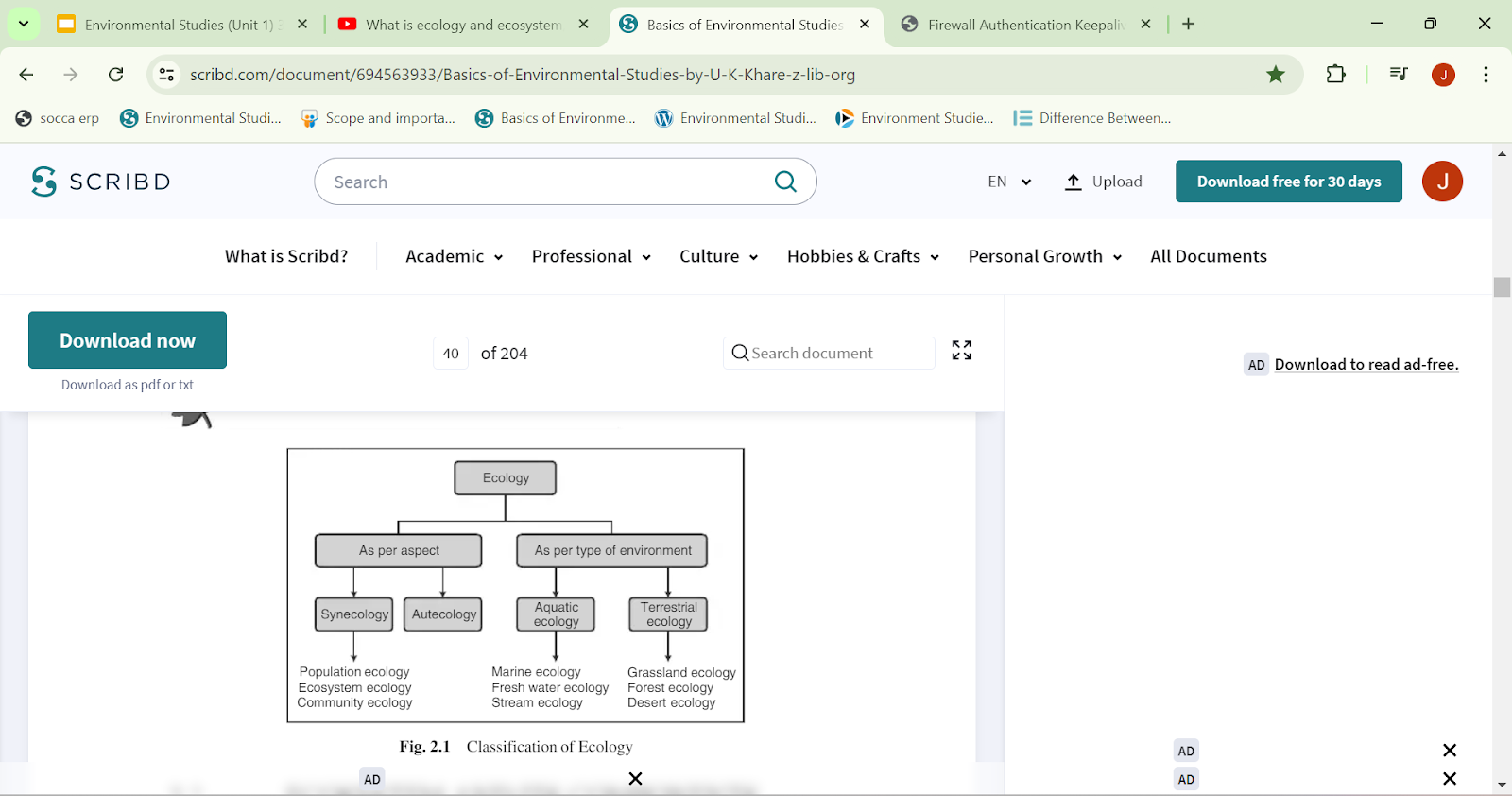
There are two important divisions of Ecology namely
(1) Autecology and (ii) Synecology
Autecology of Species Ecology is the study of individual species, their behavior and adaptation (adjust to be suitable for a new use or condition) to the environmental conditions
Synecology or Community Ecology refers to the study of different communities (groups of organisms that are associated together as a unit) , their composition, their behavior and relation to the environment. eg study of trees in a forest.
Levels of Organization in Ecology
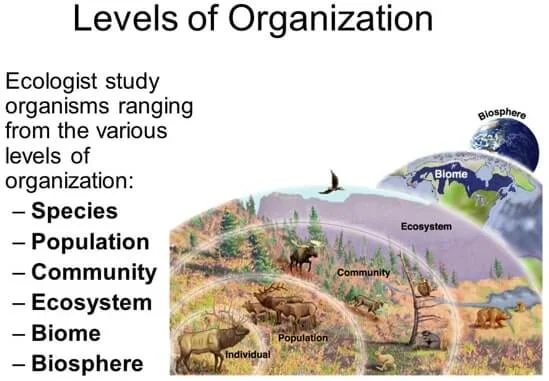
1. Individual (Organism):
The individual level in ecology refers to a single living entity, such as a plant, animal, or microorganism. This level focuses on the basic unit of study in ecology, where the primary concern is understanding how an individual organism interacts with its environment. This includes studying its behavior, physiology, and life cycle. For example, researchers might study how a particular species of bird builds its nest, forages for food, or migrates during different seasons.
2. Population:
A population consists of a group of individuals of the same species that live in a specific geographical area. At this level, ecologists study various aspects such as population size, density, and dynamics, including birth rates, death rates, and migration patterns. Understanding populations helps in comprehending how species interact with each other and their environment, and how they adapt to changes. For instance, studying the population of deer in a forest can provide insights into their reproductive strategies, habitat preferences, and the impact of predation.
3. Community:
The community level includes different populations of species that live together in a common environment and interact with each other. This level of organization focuses on the relationships and interactions between species, such as predation, competition, and symbiosis. Communities are dynamic and can change in response to various factors like environmental changes or human activities. An example of community study might involve examining how various plant species in a meadow compete for sunlight and nutrients, and how herbivores and pollinators interact with these plants.
4. Ecosystem:
An ecosystem encompasses the community of living organisms (biotic factors) and their interactions with the nonliving (abiotic) components of their environment, such as air, water, and soil. This level is crucial for understanding the flow of energy and the cycling of nutrients through different parts of the environment. Ecosystems can be as large as a forest or as small as a pond. For example, a forest ecosystem includes trees, animals, insects, and microorganisms, as well as elements like sunlight, rainfall, and soil nutrients, all interacting in complex ways.
5. Biome:
Biomes are large geographic areas characterized by specific climate conditions and particular types of plants and animals. They represent major ecological communities that extend over large areas and share similar climates, flora, and fauna. Examples of biomes include deserts, forests, grasslands, tundras, and aquatic environments. Each biome has unique characteristics and adaptations that allow organisms to survive and thrive in those conditions. For instance, desert biomes have plants and animals adapted to survive with minimal water, while rainforest biomes support a diverse range of species due to their warm, moist conditions.
6. Biosphere:
The biosphere is the global ecological system that integrates all living beings and their relationships, encompassing all ecosystems on Earth. It represents the sum of all biomes and includes every part of the planet where life exists, from the deepest oceans to the highest mountains. The biosphere is a closed system where energy flows and nutrients cycle through different levels of organization, maintaining the balance necessary for life. Understanding the biosphere is crucial for studying global processes like climate change, biodiversity loss, and the impacts of human activities on the planet's health.


