Friday, 9 September 2022

Theories: Marxist, Ecocritical, Feminist and Queer Criticism

Hello! This blog is assigned by Dr. Dilip Barad sir. It deals with various literary theories like Feminism, queer study, eco-criticism, and Marxism. This blog deals with Feminism, other blogs which deal with other theories are hyperlinked in the end.
 
Feminist criticism

What is feminism? It is an advocacy of women's rights on the grounds of the equality of the sexes. Equality on political, social, personal and economic grounds. The fight for feminism is not for having more value than men/ male gender in society but for having equal value in society. Feminism emerged as a socio-political movement before a literary movement.


Feminism is seen in waves. The first 19th and early 20th centuries comprised women's suffrage movements of the 19th and early 20th centuries, promoting women's right to vote. The second wave Mid-20th century, the women’s liberation movement, began in the 1960s and campaigned for legal and social equality for women. In or around 1992, a third wave Late 20th and early 21st centuries was identified, characterized by a focus on individuality and diversity. Additionally, some have argued for the existence of a fourth wave, starting around 2012, which has used social media to combat sexual harassments, violence against women and rape culture, and it is best known for the me too movement.

Feminism as a socio-political movement inspired literature to look for the women in itself. The books that played an important role in bringing and looking for feminism in literature are-

Mary Wollstonecraft’s A Vindication of the Rights of Woman (1792),
John Stuart Mill’s The Subjection of Women (1869), and
The American Margaret Fuller’s Woman in the Nineteenth Century (1845).

The very important precursor of feminism in literature is Virginia Woolf, who, in addition to her fiction, wrote A Room of One’s Own (1929) and numerous other essays on women authors and on the cultural, economic, and educational disabilities within what she called a “patriarchal” society, dominated by men, that have hindered or prevented women from realizing their productive and creative possibilities. Other important writers in this field are Simone de Beauvoir’s The Second Sex (1949), Mary Elman's Thinking about Women (1968), and Kate Millett’s Sexual Politics.

There is a long detailed Wikipedia page on this theory. CLICK HERE


The question also arises about the fundamental concerns in feminism. (M.H. Abrams)
The basic view is that Western civilization is pervasively patriarchal

It is widely held that while one’s sex as a man or woman is determined by anatomy, the prevailing concepts of gender

The further claim is that this patriarchal (or “masculinist,” or “androcentric”) ideology pervades those writings that have been traditionally considered great literature gynocritics—that is, a criticism that concerns itself with developing a specifically female framework for dealing with works written by women, in all aspects of their production, motivation, analysis, and interpretation, and in all literary forms, including journals and letters.

One concern of gynocritics is to identify distinctively feminine subject matters in literature written by women—the world of domesticity, for example, or the special experiences of gestation, giving birth, and nurturing, or mother-daughter and woman-woman relations—in which personal and affectional issues, and not external activism, are the primary interest.

Another concern is to uncover in literary history a female tradition, incorporated in subcommunities of women writers who were aware of, emulated, and found support in earlier women writers, and who in turn provide models and emotional support to their own readers and successors.

A third undertaking is to show that there is a distinctive feminine mode of experience, or “subjectivity,” in thinking, feeling, valuing, and perceiving oneself and the outer world. Related to this is the attempt (thus far, without much agreement about details) to specify the traits of a “woman’s language,” or distinctively feminine style of speech and writing, in sentence structure, types of relations between the elements of discourse, and characteristic figures of speech and imagery.

Often we realize or get questioned that this is only a patriarchal society that is trying to pull the leg of the female society. And we see no, women are majorly not even supported by women. For a glance if we just take an example of our TV shows/ Television series where women are always planning and plotting against other women. We rarely find women supporting women. Television plays an important role in shaping society.

Patriarchy is not only male society dominating women or females but it has turned to be an ideology. We see the old-age women are the agency of patriarchy. In the family grandmother or in movies the old character will always give morals on how women should and take care of the family. Women are created to take care of male society. Adichie Ngozi in her speech on feminism said- we/ society always try to create a boy hard/ tough man which gives them a fragile ego and we train girls to cater to that ego and shrink them.

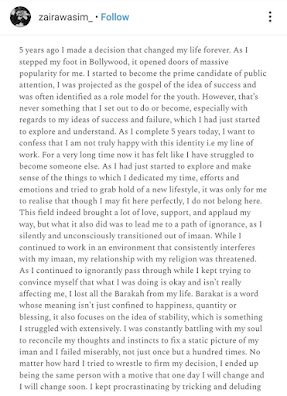
Religion has always tried to tie women. Religion gave an idea of women doing fast for their family and children. It gives stories where women are doing only household work. बेटी तो पराया धन होती है। is a strong concern from religion. It plays an important role in shaping women as Indian ideal wife material. Still today we see that women are more in to follow the religious path, in spite it forcing them to shrink. One of the examples is Zaira Wasim. She played a role in the Bollywood movie Dangal in a young age but suddenly later she dropped Bollywood and went close to her religion, the Islamic religion. For walking on the path of religion she dropped her whole career despite being a talented actress. Here is her FB post. A recent example of how women can't grow. The whole society in one or another way traps and stops, it becomes necessary to come out of all this construction.

When we read literature, we connect ourselves in it. We find ourselves in that that suggests closely the relation of novels in our everyday ;life. Today the world is digitizing. Cinema is taking the place of literature and stories. Cinema plays an important role as a mirror of society and it also shapes society. As we discussed above women, and aged women like grandmothers/ aged women are the agencies of patriarchy. Women try to tie their daughters or daughters-in-law in the frame of ideal women.

The bollywood movie Thappad directed by Anubhav Sinha is a movie in which a woman fights back and stands for herself only for one slap and asks for a divorce. In this mainstream story, we also see minor stories of a maid and a lawyer. Protagonist Amruta has a point about how her husband cannot slap her in any situation. During the emotional and mental breakdown of Amruta, we find her mother and mother-in-law saying

बस यही सुनना बाकी रह गया था कि बेटी डीवोर्स करेगी|
जाने दे बेटा, थोड़ा बर्दाश्त करना सीखना चाहिए औरतों को.”
This is an example of how women shape women in order to cater male ego, how women are the agency of patriarchy.


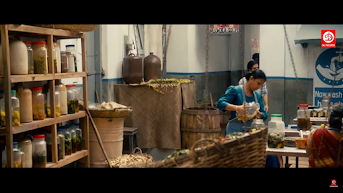
Women are always permitted. They don’t have to do anything without permission. We find many people who think they are superior for letting women grow, work and earn. They boast that they are open minded to let their daughter- in- law work and earn. Such characters are represented in various Bollywood movies also. Here is Rahul Bose and Manav in Dil Dhadakne do (2015) directed by Zoya Akhtar.


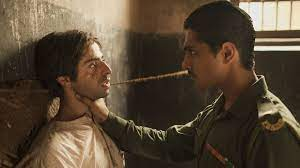
Pink is a 2016 Bollywood movie directed by Aniruddhsinh Chowdhary. A patriarchal male-dominated mindset is represented in a movie by the character of Rajveer Singh. How the minds of men are conditioned. They feel their rights of women and how women are expected to shrink themselves to safeguard their dignity and chastity is aptly shown in these women.


In the contemporary period, we feel we are growing. Women are getting their places, they are having their domination. But if one woman is earning and free or independent doesn't mean everyone is. Till every woman or majority of don't get their place, independence we can never say that women are not under control anymore. One TVC telecom tried to show a woman out of her traditional conventional work, in a way to show progress

But here in this TVC, we see that the ad fails to show women's progress. Even after she is the boss in the office. She has to cook food for her husband after office work and invites her husband for food. Despite being a boss. This in a way reflects the mindset of the society which boasts about letting their wife and daughter- in law work. Society is trying to show off its ‘independent mindset’.


Moving towards feminist criticism is locating women in the literature. The issues they face in society and how they lose their identity. Today we are living in the 21st century but still, the most loved Bollywood movies are movies in which heroines feel themselves complete after the hero enters their life.


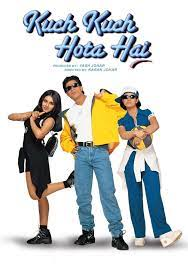
These are a few examples of movies where female protagonists are independent and bold but they feel complete in their life when they find a man in their life.

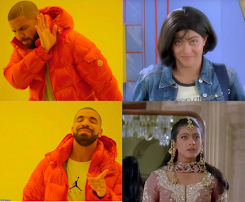
Here is also a meme of Anjali of Kuch Kuch hota hai. She was an independent blog sports girl but wasn't loved by Rahul. In the second part of the movie, she is an ideal wife material. Girl with long hair and so-called beauty and Rahul falls in love with her. This is a real cringe. Bollywood gives a frame of what type of girls are loved and to boys, whom to love.

Recently the #wokyaboli is also trending by BBC News. One must check out it on the Instagram page of BBC news and on Twitter also.


We must not forget that feminism is for equal rights. Women are physically and biologically not as strong and hard as men adding to it they have soft and emotional conditioning of mind. And to have equality firstly equity is necessary in society. Slowly and steadily ideologies will change and the world will change. This change cannot be brought in a day or year.

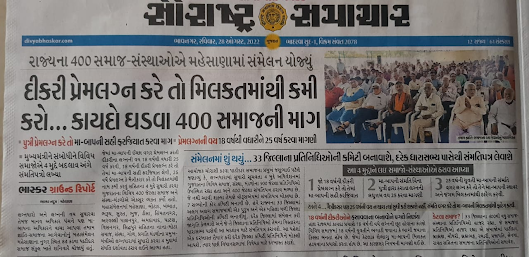
Looking over contemporary times we realize even today society is not ready to accept girl’s freedom. They are not ready to give part of their property to their daughters if they don't follow them. દીકરી ને ગાય દોરે ત્યાં જાય. Girls are expected to follow and not to question.


I hope this blog is useful. Thanks for visiting.

Monday, 5 September 2022

Virtual Teachers' Day 2022- Celebration


THE ROAD NOT TAKEN
Robert Frost


Hello everyone, as we know 5th September is celebrated as Techers' day. on this day generally students enact their teacher and take their place in class (in Schools). we students of Department of English celebrate it in unique way. (suggested and guided by our Head of Department Dr. Dilip Barad Sir.

We celebrate Teachers' day virtually. For the celebration of this day we are supposed to create whole content. we make a small lecture video, a google quiz and provide an auto- generated certificate to all  to respond to quiz. a way of future teacher, teacher for digital world is being shaped in this process. This year we are also adding our video on a ed. ted platform as an educator.

I have been participating in this celebration and I have prepared a short video lecture on Robert Frost's poem 'The Road Not Taken'.

Here is the Preview of my Lecture video

Here is my short video Lecture.


I have also shared my video on a Ed.Ted platform

CLICK HERE TO VISIT


Please attempt a small google quiz. Link is given below.

you will receive a certificate as below in your mail 


Thanks for visiting and I appreciate your sincere participation. Your kind participation motivates us. 

Thursday, 1 September 2022

Midnight's Children- Salman Rushdie (Part II)

 MIDNIGHT'S CHILDREN (PART-2)

Writer:


Sir Ahmed Salman Rushdie (born 19 June 1947) is an Indian-born British-American novelist. His work often combines magic realism with historical fiction and primarily deals with connections, disruptions, and migrations between Eastern and Western civilizations, typically set on the Indian Subcontinent.

Recently, Salman Rushdie was attacked in New York on 12 August 2022, based on a fatwa issued on Feb. 12, 1989, for his work ‘The Satanic Verses’ (1988). Read the news in detail CLICK HERE


Novel:


Midnight’s Children is the Second novel by Salman Rushdie. Midnight's Children sold over one million copies in the UK alone and won the Booker Prize and James Tait Black Memorial Prize in 1981. It was awarded the "Booker of Booker" Prize and the best all-time prize winner in 1993 and 2008 to celebrate the Booker Prize's 25th and 40th anniversaries. In 2003 the novel appeared at number 100 on the BBC's The Big Read poll which determined the UK's "best-loved novels" of all time.

The novel basically is from Kashmir in 1917 to Bombay in 1977, it brings us through the ending of British rule, the birth of a nation, the Partition of India and Pakistan, later the war of independence of Bangladesh, and finally, the Emergency under the government of Indira Gandhi.

Amidst the torrents of history emerges the main character Saleem Sinai. The film begins with his grandfather Dr. Aziz (Rajat Kapoor) in Kashmir, examining his patient and future wife Naseem (Shabana Azmi) through a perforated sheet. Then comes the next generation of Saleem’s parents Amina (Shahana Goswami) and her husband Ahmed Sinai (Ronit Roy), moving to Bombay, giving birth to a baby boy at the stroke of midnight, the dawn of India’s independence on August 14, 1947. But baby Saleem is a changeling with another baby born at the same time, Shiva, by the hands of Mary (Seema Biswas) the nurse.

Themes and Symbols (if film adaptation is able to capture themes and symbols?)

Perforated sheet

The perforated sheet has symbolized the fragmented life of the characters throughout the novel. It symbolized not a whole view, a fragmented view, and also a material used to preserve the chastity and purity of female characters. Aziz falls in love with a perforated sheet and The perforated sheet makes one final appearance with Jamila Singer: in an attempt to preserve her purity.

Silver spittoon


Spittoon is a symbol of memory and memory loss. It was given to Amina as part of her dowry by the Rani of Cooch Naheen which was the only memory of the family with Saleem. But later this memory, spittoon gave him a memory loss. Spittoon was responsible for Saleem’s Amnesia. The spittoon is the symbol of a vanishing era, which, in retrospect, seemed simpler and easier.

Pickles


Pickles are a symbol of preservation and destruction. Saleem tries to preserve his stories in pickles and chutney. By telling his stories he is trying to preserve the dying man. This connection between pickles and the preservation of stories endures until the very end of the book.

Knees and nose
The knees and nose are the symbols of the power of Saleem and Shiva, the two firstborn midnight’s children who got changed in the hospital. Shiva is suspected of killing a string of prostitutes with his powerful knees, while Saleem uses his nose to discover the most decrepit prostitute in the city. Knees and nose—just like Shiva and Saleem, destruction and creation, faith and humility—are inextricably related. This symbolizes both power/ strength and weakness, creator (Saleem) and destructor (Shiva).

Saleem and Shiva


Shiva and Saleem are binary to each other. They are contemporary. Complete each other. As Yin Yang. Saleem in allegorical India and India story is incomplete without Shiva.


History and Individual
Reading Midnight’s children we can read a connection made by Rushdie of Saleem Sinai with the History of India. The section that Rushdie establishes between every personal event in Saleem's life and that of his family and the political and historical events that unfold in independent India is carefully maintained throughout the novel, even though sometimes it can sound a bit forced as in the latter part of the novel. The language riots of the 1950s, Indo- Pak war of 1971, and Indira Gandhi’s ‘Emergency” in 1975 all these India stories can be read through Saleem. Also, the story begins with Kashmir which even today is a ‘hot spot’. The parallel drawn between Aziz and Jallianwala Bagh Massacre. His parents, grandparents, and an aunt me killed on 23 September 1975, the day India's Airforce bombs Rawalpindi. The book is full of such demonstrations which connect Saleem and India.

Colonialism and neo- Colonialism in India
Midnight’s Children attacks British colonization and they were symbolized through the characters like Methwold. He is used as a symbol of evil and moral degeneration rather than a fully fleshed-out character. He is used as a symbol of colonization, exploitation, and demoralization in the novel. The seduction of Vanita in absence of her husband Winkee is a metaphor for appropriating and exploiting what rightfully belongs to another. How Britishers came to India and tried to exploit India. They controlled India and also tried to be an owner not only of land but people also.

Fragmentation, Migrancy, and Memory
This is not the main theme but the novel. The novel's narrative technique which is stories inside the stories presents us with the fragmentation in the novel. The novel is all about memory and loss of memory. The novel begins with Dal lake and ends in Pickles factory. The cracks and disintegration in the novel bring newness in the novel.

These are the themes and the symbols of the novel which are aptly described and adapted in the movie also. Cinematography has also beautifully captured all the symbols with the help of long and short shots and focus. The movie has held the essence of the novel through and in which its symbols and themes played an important role.

The texture of the novel (What is the texture of the novel? Well, it is the interconnectedness of narrative technique with the theme. Is it well captured?)

The texture is a word that is used to describe the combination of word choice, mood, and what the authorial lens focuses on in a piece. Looking at Midnight’s Children we see getting introduced to this novel is getting introduced to a new texture of the book. The book does not describe anything in chronological order. It oscillated between past and present and even sometimes the future through the dreams of Salem. The novel has a unique narratological style combining both Indian and western methods, including magic realism and first-person narration also. The novel captures India from 1915 to 1978. Adding to it, the novel has a wonderful connection between symbols and narration. The symbols indicate binary, negative, and positive aspects. E.g. symbol of a pickle- destroyer and preserver.

What is your aesthetic experience after watching the screening?


We had a wonderful movie screening of Midnight’s Children 2012 film directed by Deepa Mehta and screenplay written by the Author himself. We already had a background of the novel and the changes made in the novel and film adaptation. So we knew that it's not completely what is in the novel. But overall it was great, it brought the texture of the novel, and themes and symbols were aptly used in the film. It didn't have the complete storyline of the novel but it significantly gave the ideas and themes of the novel. The movie used the same dialogue as the movie, especially in the beginning. The ending in the movie and novel is different. But we can understand the difficulty of bringing the whole thing in motion is a difficult task.

I hope my blog is useful. Thanks for visiting. 

Monday, 22 August 2022

Sunday Reading: Talks by Chimamanda Ngozi- Learning Outcome

Hello! While reading the future of Post- Colonial Studies we came across the prominent Nigerian Writer, Chimamanda Ngozi Adichie. So we are assigned a task to listen her ideas about singles story, Feminists and Importance of truth in Post- Truth Era. In this blog, I am sharing my learning outcome after watching her videos.

Talks by Chimamanda Ngozi Adichie


Chimamanda Ngozi Adichie


Chimamanda Ngozi Adichie is known for her books that use the history of the Nigerian civil war to create stories that tell people the tales of war, pain, love, and happiness. Amanda Ngozi Adichie, born 15 September 1977) is a Nigerian writer whose works include novels, short stories and nonfiction. Through her hard-work, dedication and passion, she managed to redefine how feminism is viewed in society, and wrote novels that portrayed what it was like to be and stay African in a very westernized world.


Dangers of single story
Chimamanda Ngozi Adichie's "The Danger of a Single Story" Ted Talk, in July 2009, explores the negative influences of a “single story”. By sharing her personal experience of being a trap of single story she pressures on having more than one perspective for looking towards the world. She grew up reading American literature and later her works also had blue- eyed characters and later when she went to white land for education she realized the single story of Americans towards Africans.

This idea can be or must be experienced by everyone, in a fight between two when we hear a story of only one we start making prejudices for the opposite person and without having any personal grudges we start hating them.

Taking an example of literature. Jane Eyre (1847) by Charlotte Brontë hasn't grown a character of Bertha Mason and so we feel like what's happening with her is to happen because she is made. But then Jean Rhys's Wide Sargasso sea (1966) gave readers a new perspective. It broke the prejudices towards Bertha and her single story got new perspectives.

Reading characters is the novel or meeting people from different communities, groups, schools, streams etc . We have a habit of generalizing a single person for the whole group/ community/ or nation.


Adichie also tackles the effect of political and cultural power on stories. Power controls “how [stories] are told, who tells them, when they're told, [and] how many stories are told”.

In 20112 when petrol prices were hiked, various Bollywood actors tweeted about it, following the orders of political power. At present, when the same political power is ruling and prices are increasing, touching 100 they are deleting their tweets. This is how stories and told and controlled by power.


Read in detail- CLICK HERE

Citing Palestentine poet Mourid Barghoti’s quote “if you want to dispossess people the simplest way to do it is to tell their story and to start with secondly. Begin with arrows of native Americans and not the British; start with failure of the African state.`` She gives us a mantra to look at things in a new way, a path to look at things with a new perspective.


She ended her speech with a wonderful line “When we reject a single story, we regain a kind of paradise”. Grow various perspectives to see the world.

We should all be feminists


The second video I watched of Chimamanda Ngozi is on Feminists. She has shared wonderful ideas which are sarcastic to patriarchal society. She stated that a words Feminists comes with baggage, heavy and negative baggage, u hate men, bras, African culture that sort of things. And the worst is that men or society don't know what women are facing or going through for them “सब चंगा सी|”. On a personal level also I have experienced the answers on sharing any experience. It's normal that everyone is falling, we can't do anything about it, women are blessed with endurance. Blessed with endurance ! So should they keep on suffering?

Not only in society but also in the workplace men have occupied more positions of power and prestige and on the other hand men are paid more than women for the same work, dedication and talent. Adding to it she also said that today we don't need physical strength but attributes like more creativity, innovation and intelligence and this are not on hormones, it's equal for both genders.

Society plays a significant role, humans are its by-product, it is inherited that men are to be respected, women are below them. Boys are molded to be hard- men subsequently a fragile England women are molded to cater that ego, taught to shrink and feel inferior, emasculated. Marriage turns out perhaps the right of a specific man or respective women. Women a trophy, a property. Marriage seems like a social idea favoring men and patriarchal society. For a peaceful marriage men will have to give up bad habits while women will give up her whole life and career, dreams and hobbies. A Bollywood movie ‘Thappad’ by Anubhav Sinha very significantly plants the idea of a girl giving up her passion after marriage. Girls are taught to be good wife material.


Women would be hesitant in looking to masculine and vice- versa; women are to cook food for the family while the high [position of chef is occupied by men; virginity in women is praised. We evolved but ideas of gender had not evolved.

Even our cinema shapes the mindset that women are incomplete without men and to be perfect they need to be feminine and have a men supporter. E.g: Kajol from Kuch kuch Hota hai, Jab we met, kabhi alvida na kehna, etc

Ngozi’s idea which i loved the most is


In this world gender communication is difficult. The simple answer we get is it was and is meant to be like this. women are considered subordinate to men culture and culture keeps changing. People make culture, culture doesn't make people.


Chimamanda Ngozi Adichie addresses Harvard's Class of 2018

In 2018 Ngozi was invited as a guest speaker in Harvard University and she gave a speech to the batch of 2018 for their further life outside the Harvard. The main idea/ aim/ message is be courageous to say the truth in this post- truth era. Be the change you want to see in the world. Tell the truth. Here I am writing some of her ideas which attracted me the most.

It's always difficult to acknowledge our own lies and tell the truth. We should not lie because it's good manners but because telling the truth will give us a good sleep. “We lie because we don't have the courage to embrace truth.” stay truthful not only to others but to oneself also. “it's hard to tell ourselves the truth, our failures, fragilities, uncertainties. It's hard to tell that we haven't done our best, which we could have.”

“There is a difference between malice and mistake, outrage but always remember the context and never disregard intent.”

Whether you are a leader or a led urge to bend towards the truth, to err on the side of truth. Live a life where humans are at center not abstractions. If you can't take support of literature which always says- we humans are flawed, all of us are flawed. We don't need to be perfect, we need to be right and just. Be courageous to recognize the things which come in your path of telling the truth.

Telling the truth is an act of courage, be courageous. Never silence yourself from fear. Always listen to the other side whether the person is in position or not.

Be courageous to admit what you don't know. If you feel dissatisfaction, nurture that dissatisfaction. Get into the system you want to change.

When the fear of failure holds you back, the truth to overcome is easy to forget, forget your failure. In life nothing is a waste of time, everything is an experience and experience is all we need in life. We cannot make or do without self- doubt and self- belief.

If you fail in life, think of literature and literary writers who bloomed early and who bloomed late. The experimenting literature which broke all the rules of traditional writing. They were not known in their time but are classics today.

Life is all about being truthful and courageous.

Mahesh Dattani's Final Solution

Hello readers, this blog is an assigned task by Vaidehi Hariyani Ma’am. This deals with Mahesh Dattani’s play and a movie ‘Final Solutions’, it answers the various assigned questions.

FINAL SOLUTIONS (1993)

Mahesh Dattani


Mahesh Dattani, born on 7 August 1958 is an Indian director, actor, playwright and writer. He was born in Bangalore to Gujarati Parents. He is the forest Indian playwright in English to be awarded the Sahitya Akademi Award for his remarkable contribution to the world of drama and is also awarded for his book of plays, Finals solution and other plays.

His various Works are-
Where There's a Will (1988)
Dance Like a Man (1989)
Bravely Fought the Queen (1991)
Final Solutions (1993)
Do The Needful
On a Muggy Night in Mumbai (1998)
Seven Circles Round The Fire (Radio play for BBC) (Seven Steps around the Fire) (1998)
30 Days in September (2001)
The Girl Who Touched the Stars (2007)
Brief Candle (2009)
Where Did I Leave My Purdah (2012)
The Big Fat City (2012)

His critically acclaimed works include Where There’s a Will, Dance Like a Man, Tara, Bravely fought the Queen, Final Solutions, Night Queen, and Thirty Days in September.

Dattani's approach is not only to just raise questions that exist in contemporary Indian society but to think about the best possible solution for these problems and try to recognize the identity of the marginalized class in society.


Final Solution

बटने का दर्द कहने से कम हो ता है क्या? 
फर्क रंगों में तलाशो तो अच्छा है, पैदाइशी में फर्क होता है क्या?
-Final Solutions (Zee5 2019)


The play Final Solutions, written by Mahesh K. Dattani discusses the theme of communal riots, hatred and bitterness of Hindus and Muslims against each other, social vision, social exclusion. The plot is set in Gujarat (after the 2002 Riots). The communal hatred is at peak. problems of communalism and gender, class and caste discrimination found everywhere and every time in the contemporary Indian society.

Final Solutions revolves around a Hindu family that gives refuge to two Muslim boys during a communal riots. Hardika, Ramnik Gandhi, Bobby and Javed are important characters in the play, In this play Two Muslim boys, Javed and Bobby (Babban) take refuge in the house of a Hindu businessman, Ramnik Gandhi while a Communal riots rage outside.


What is the significance of the title ‘Final Solutions’?
Final Solutions talks about the communal riots of Hindu and Muslim community. The play aptly shows the Hindu family which is trying to help Muslim boys but they are afraid of their community. Ramnik, calling himself a liberal tries to help Muslim boys but in the raged conversation between them we realize that somewhere Ramnik is trying to wash or balance his or his family’s mistake done in past where because of him a Muslim family had to suffer and face loss. Ramnik knew that Muslims are not bad while the female of the family felt that unpleasant happened in the past was because of Muslims and so they couldn't trust the Muslim boys but later in the end truth was revealed. We realize that here no one is the be blamed. There is always a powerful person who is benefited by this type of riots. And today all this has reached a level where we don't have a solution to stop it. The title can be said to be reversible or communal. Reading the title one might think it will give a solution, a Final Solution but we realize there is no Final Solution to the various communal riots in this world.

Do you think Mahesh Dattani’s ‘Final Solutions’ makes any significant changes in society?


The theme of the play Final Solutions is to highlight human weaknesses, selfishness, avarice and opportunism. Woven into the play are the issues of class and communities and the clashes between traditional and modern life style and value systems. I cannot surely say if Mahesh Dattani's' ‘Final Solutions' have made or is making any significant changes or not because even today we are seeing the riots in the society and various issues based on Hindu- Muslim Community issues. We can assume that perhaps in subsequent times readers will grasp its morals and will understand the real reason and story behind the communal riots in society and it will bring significant changes in society.

How are the beginning and the end of the movie? Do you feel the effect of communal disturbance in the movie?
The narration in the movie oscillates between past and present. The movie begins with female protagonist Daksha (whose name is changed after marriage to Hardika) reading her diary at an older age. She is confused about what to write and comes to a point to write something which is big and notable for the world. And she begins with August when the nation got its independence and this brought her to the remembrance of communal riots in the nation that happened because of partition. And in this partition she lost her father. She recollected how she and her mother were holding the Krishna murti and hoping for her father to return but he didn't return.

Moving towards the end of the movie, the truth gets revealed to Hardika/ Daksha that Zarina’s Family (Muslim Community) was not at fault. It was her father- in - law and husband who tried to destroy Zarin’s father’s shop and bought it at half price. The root cause of all this happening and lack of friendship from Zarin’s side was also the Hindu- Muslim Communal riots.

Here we can see the effect of communal riots in the beginning and ending of the movie.

The movie comes up with many different symbols and colors. Write about any two symbols which caught your attention. What does it signify?
Mahesh Dattani’s film ‘Final Solutions', latest adaptation on ZEE5 platform of his 1993 work ‘Final Solutions’ has one of the best cinematography. It has wonderfully used the colors, chorus and symbols in the movie. There are various symbols like, Chair, Photo frame, saffron, green and white color, diary, Pooja bell, Taqiyah (Muslim cap), Krishna, singers and songs, and fire. According to question we will discuss to symbols-

1. Photo in Hardika’s room- The photo was of her favorite singer who was Pakistani, Noor Jahan. And the song she sang mostly was

Jawan hai mohabbat
Haseen hai zamana
Lutaya hai dil ne
khushi Ka khazana

This frame of Muslim singer in Hindu house suggest that how the nation was one before partition. Everyone used to celebrate each other’s art and enjoy it but with the time and because of partition the differences began. The frame also symbolized the deep love of Hardika/ Daksha for music and her dream of being a singer.

2. Diary- diary comes as a symbol of past and present. It also suggests an ambition of women to make her voice reach to everyone. Hardika began to write a diary with an idea of how larger society will read and what type things should be shared with them. Diary also came out as a friend and a secret keeper for Daksha/ Hardika. In the movie and also in the novel diary is a vehicle which takes us to the past and the present.

3. Colors- the Movie makes use of colors very aptly it is a play performed in a traditional light with the use of modern techniques and method. Chorus is wonderfully used in the play as an observer, narrator, voice of conscience and in times of blood-lust, participants. Dattani uses the chorus to directly address the audience and help them visualize the action. And the lights on chorus and the props color used by the chorus without the use of words clearly suggest whose ideas are shared or displayed by them. It can also be a satire on owning a color in the name of religion. Saffron- Hindu, Muslim- Green.

Is Ramnik a liberal thinker? If yes then why? If not then why?


Literal meaning of liberal is willing to respect or accept behavior or opinions different from one's own; open to new ideas. Here in the movie various times we see that Ramnik Gandhi is trying to be a liberal thinker and wants to help Javed and Bobby. He gives them shelter in his house, safeguarding from the mob instead of his conservation wife, Aruna. Ramnik’s character grows as a sympathetic person and as a viewer we also love him, thinking him to be rational. But when the arguments begin between Javed and Ramnik we realize that somewhere Javed is having a strong point like when he said u r helping cause you are in majority and you have power to help us we (Muslims) are ‘bichara’ poor and disabled. And later when Javed’s character grows we realize that it was his childhood trauma who constructed him to be a part of riots and we as a community are to be blamed for the happenings with Javed. After knowing about Javed, Ramnik forcibly wanted to give him a job. In between he also says, “yahi to ek liberal person karta hai na”. Which shows he was trying to be good and act like a liberal. Also when Javed says something Ramnik directly points out about the whole Muslim community which shows that in his mind there difference between both te communities and he hasn't accepted the community but is trying to balance his sins, what was done by his father and grand father. So after reading Ramnik's fully grown character of Ramnik we cannot consider him to be a Liberal thinker.

Does education make any difference? Comment with the reference to the women characters.
In this movie we have four women. Daksha (young Hardika) and Zarine, Hardika (grandmother), Aruna and Smita (Tasneem). This work has a wonderful symbol or diary writing which directly suggests the level of education in women in that period. Daksha/ Hardika was a literate and that character was really indulges in Muslim community which an be seen through her song and singer interest and also his love for Zarine. She was hugely interested in having friendship with Zarine and the same things are seen in Smita, her granddaughter. But as the society has moved further by two generations we find that she has a Muslim best- friend. Smita is studying in college but unlike Hardika she didn't had to go against family to have friendship with Muslim girl. And she could also take her own stand. The difference grew in society can be clearly seen in these two characters. On the other hand, Aruna is a so-called ideal Hindu woman. We don't see glimpses of education in her character. Majority of the time she is seen doing pooja or veneration of Lord Krishna. And she is the one who feels touchable towards Muslims and these types of character traits are also noted in Gajju’s Hardika's Mother- in -law's description by Hardika herself. So here we can conclude that yes education does make a difference in the way of looking towards society.


I hope my Blog was useful. thanks for visiting.

Sunday, 21 August 2022

Foe- J.M. Coetzee

This blog is written in response to a blog task assigned by Yesha Bhatt Ma’am based on J. M. Coetzee’s Foe which is a retelling of Danial Defoe's Robinson Crusoe. It deals with several assigned questions as a task.

How would you differentiate the character of Cruso and Crusoe?


The Swiss philosopher Jean-Jacques Rousseau applauded Crusoe’s do-it-yourself independence, and in his book on education, Crusoe is never interested in portraying himself as a hero in his own narration. He does not boast of his courage in quelling the mutiny, and he is always ready to admit unheroic feelings of fear or panic, as when he finds the footprint on the beach. Crusoe prefers to depict himself as an ordinary sensible man, never as an exceptional hero. Crusoe seems incapable of deep feelings, as shown by his cold account of leaving his family—he worries about the religious consequences of disobeying his father, but never displays any emotion about leaving. As an individual personality, Crusoe is rather dull. His precise and deadpan style of narration works well for recounting the process of canoe building, but it tends to drain the excitement from events that should be thrilling.Crusoe is nonetheless very interested in possessions, power, and prestige. When he first calls himself king of the island it seems jocund, but when he describes the Spaniard as his subject we must take his royal delusion seriously, since it seems he really does consider himself king. His teaching Friday to call him “Master,” even before teaching him the words for “yes” or “no,” seems obnoxious even under the racist standards of the day, as if Crusoe needs to hear the ego-boosting word spoken as soon as possible.

Cruso, a parody of Daniel Defoe's character Robinson Crusoe, is first seen living on the island that Susan washes up on. He is shown to have made a life for himself on the island, but Susan notes his lack of enthusiasm to be "rescued" and he is portrayed as somewhat stubborn by her. Cruso tries to exert his dominance over all things on his island, whether it's the monkeys that share the island with him, or the new addition of Susan. He is shown to be an aging man and takes ill a number of times in the first part before dying on board the ship that saves them. He also enjoys telling stories about how he ended up on the island and how he found Friday, all which contradict each other and vary greatly, suggesting to the reader either forgetfulness due to old age or that Cruso repeatedly tells lies to suit his needs and in this case, the story. Both cause Cruso to be portrayed as a highly unreliable character.

This table brings out the major difference between both, Cruso and Crusoe.

Coetzee’s Cruso

Defoe’s Crusoe

Change in spelling- exclusion of e

Cruso’e’

Finds no need of documentation- “Nothing I have forgotten is worth remembering”

Keeps written document/ habit of documentation

Cruso in Foe has not put any effort towards building tools, as he only has a bed when Susan arrives at the island, and from the quote, it seems like he may not have the mental capacity to build these tools. 

Crusoe builds are to improve and aid in his growth on the island, and he must be mentally sharp in order to build these items. 

For Cruso, the island did not lead him to make any significant changes in his character or ideals.

This newfound lifestyle gave significant meaning to Crusoe’s daily actions as they represented growth in his faith, and a positive change in character. 


Friday’s characteristics and persona in Foe and Robinson Crusoe.
Robinson Crusoe names the man Friday, with whom he cannot at first communicate, because they first meet on that day. The character is the source of the expression "Man Friday", used to describe a male personal assistant or servant, especially one who is particularly competent or loyal.


If Crusoe represents the first colonial mind in fiction, then Friday represents not just a Caribbean tribesman, but all the natives of America, Asia, and Africa who would later be oppressed in the age of European imperialism.

The first and most obvious point about Friday's relationship with Crusoe is that Friday is Crusoe's subordinate. Friday always calls Crusoe "master," for example. Crusoe also mentions that their relationship is much like that of "a Child to a Father". Foe deconstructs Robin Crusoe and gives its postcolonial reading. We find the change in the center point of both the novels. Foe has Susan Barton, the interloper character and female narrator. But we find Friday, the only similar character across both books.

Defoe’s Friday is exploring the themes of religion, slavery and subjugation. While Coetzee’s Friday is used to explore more strong themes like of slavery, black identity and the voice of oppressed or subaltern.


In Coetzee’s Foe Friday is without voice and he has left the disturbing question of who has cut Friday’s tongue or mutilated it open. This question is never answered and the attempts to communicate with Friday leaves us wondering whether the slaves that capture Friday remove his tongue or was done by the colonist Cruso, who felt no need of a great stock of words.

We also find that Defoe’s Cruso gave a lot more care and interest to language than Coetzee’s Cruso. Defoe’s Cruso, appreciated documentation in his own language and also took pleasure in teaching Friday to speak.

Defoe’s Crusoe was certainly concerned with language, but never investigated the language that was Friday’s own, erasing Friday’s history by naming him, and teaching him English. In this way, he could only voice the thoughts that Crusoe had given him language to speak. This was challenged by the voiceless Friday in Coetzee’s work, a character who literally couldn’t speak. In this, it could be argued that Coetzee was asserting that it was not his right to give voice to an oppressed black character, and let Friday stand for the victims of apartheid and slavery, where Defoe (due to the beliefs of society at his time) believed that it was right and natural for Crusoe to claim the position of Master to Friday, and to speak for him.

Friday was somehow better than the average Caribbean tribesman As Friday in Foe stood for the victims and slavery whereas Crusoe’s Friday was not doing all that and is portrayed as being a anglicized version of Caribbean man.

In Coetzee’s work, Friday is allowed to be sullen and unpleasant, easy to see, but hard to like, he is created to be the embodiment of all the oppression experienced by a racial group, to only be able to take in, never to give out ideas or understanding, to be central to a story he can have no part in. The silence of Coetzee’s Friday could also be said to reflect the reader, who, like Friday, can only react and respond to situations.

The representation of Friday in these two texts is vastly different, and one could hardly believe that the two were in fact the same character. With different histories, and different personalities, in fact all both have in common is playing the role of the non-white slave in the text, to serve a literary purpose, in both reflecting the views of wider society towards non-white people, and in showing the development of other characters.


Is Susan reflecting the white mentality of Crusoe (Robinson Crusoe)?


I lie against Cruso; with the tip of my tongue I follow the hairy whorl of his ear. I rub my cheeks against his harsh whiskers, I spread myself over him, I stoke his body with my thighs. “I am swimming in you, my Cruso.” (44)

Major difference between two novels Robinson Crusoe and Foe is inclusion of women’s voce in Foe. This female voice is presented by Male author J.M. Coetzee. She is a female castaway but fails to award her a voice of strength Crusoe dominates not only the island they are both on but also the whole story itself.

“I presented myself to Cruso, in the days when he still ruled over the island, and became his second subject, the first being his manservant Friday” (Coetzee 11)

Throughout the novel, she describes the island as “Cruso’s island.” She finds herself as the mere female companion to the king and his manservant, Friday. Coetzee makes Barton the woman behind the man, defining her as a “free and autonomous being like all human creatures that finds herself living in a world where men compel her to assume the status of the Other” (Dragunoiu 15). Barton is quick to assume the submissive role on the island as the assertive character of Robinson Cruso takes the lead on the island and in her story.

Susan is a sensual woman, and as the only female character in both Defoe’s novel as well as Coetzee’s novel, she is represented through her sexuality. She also views her sexuality as therapy for Cruso at the end of his life when he suffers from a raging fever. She spends many nights with him while they are on board the ship that rescued them, holding him and using her body to cure him.

Susan Barton’s voice is projected through the words of the male author who created her. Using the text as evidence, it seems as though Coetzee purposefully creates a female character of weakness. She goes through a myriad of roles throughout the novel—each of which clearly point to her as a minor character in a book that is supposed to be about “the female castaway” (67). Although Susan Barton is the voice of the novel, she is not the main character because she is most concerned with telling the story of “Cruso’s island.” J.M. Coetzee is a male author who uses the voice of Barton to convey a deeper understanding of Defoe’s male character, Robinson Crusoe. Coetzee uses her as merely a device to relay the stories of Cruso and Friday. Hence, she doesn't reflect the white mentality of Crusoe.


I hope this blog is useful. Thanks for visiting.

My Learnings from the National Workshop on Academic Writing (2026)

The National Workshop on Academic Writing  I recently had the opportunity to participate in the National Workshop on Academic Writing (2026)...