Showing posts with label figures of speech. Show all posts

Friday, 3 March 2023

I Love all Beauteous Things by Robert Bridges

I Love all Beauteous Things
Robert Bridges

About poet Robert Bridges
Robert Bridges (1844-1930) was an English poet, essayist, and physician who served as the Poet Laureate of the United Kingdom from 1913 until his death. He was educated at Eton and Oxford before studying medicine in London and practicing as a physician. However, his true passion was for poetry and literature, and he published several collections of poetry over the course of his career, including "The Growth of Love" and "Eros and Psyche". Bridges' poetry is characterized by its lyrical and meditative qualities, and its use of traditional forms like the sonnet and the ode. He was a friend and supporter of Gerard Manley Hopkins, and he edited an edition of Hopkins' poetry after the poet's death. In addition to his work as a poet, Bridges was also a noted essayist and literary critic. His contributions to English literature were recognized with a knighthood in 1913.


Poem Analysis
Robert Bridges' poem "I love all beauteous things" is a reflective and contemplative piece that celebrates the beauty of the natural world. A fourteen-line sonnet is a traditional form of poetry that originated in Italy and has been used by many poets throughout the centuries to explore a wide range of themes and emotions.

In this poem, Bridges expresses his deep love for all things beautiful in nature, from the "great sea's self" to the "humming-bird among the flowers." The speaker acknowledges that beauty can be fleeting and that it is often accompanied by sadness, but he still cherishes it and finds comfort in its presence.


The poem's central theme is the beauty of the natural world and the way in which it can bring solace and joy even in difficult times. Bridges' use of the sonnet form helps to convey this theme in a concise and impactful way, with the first two quatrains establishing the theme and the two tercets exploring it in more depth.

The tone of the poem is contemplative and reflective, with the speaker expressing his thoughts and feelings about the beauty of the natural world. The use of literary devices like alliteration, metaphor, and personification helps to convey the speaker's emotions in a powerful way, and the repetition of the phrase "I love all beauteous things" adds to the poem's impact.

Overall, "I love all beauteous things" is a beautiful and uplifting poem that celebrates the beauty of the natural world and the way in which it can bring comfort and joy to our lives. Bridges' use of the sonnet form and his skillful use of language and imagery make this poem a timeless masterpiece that continues to inspire readers to this day.

Themes: 
The primary themes of the poem are beauty, nature, and the transience of life. The speaker celebrates the beauty of the natural world, but he also acknowledges that it is fleeting and can be accompanied by sadness. Additionally, the poem touches on the theme of the role of beauty in human life, suggesting that it can bring solace and joy even in difficult times.

Form, Tone, and Structure: 
The poem is a sonnet, a traditional form of poetry that originated in Italy and typically consists of fourteen lines. The Rhyming scheme of the poem in ABCB The tone of the poem is contemplative and reflective, with the speaker expressing his thoughts and feelings about the beauty of the natural world. The structure of the poem is a traditional sonnet, with two quatrains that establish the theme and two tercets that explore it in more depth.

Literary Devices: 
The poem uses several literary devices, including-
  • Alliteration: "golden glory" and "windy waves"
  • Assonance: "humming-bird among the flowers"
  • Enjambment: "But man's chief end is still to / glorify and enjoy"
  • Metaphor: "the great sea's self"
  • Personification: "the winds that will be howling"
  • Repetition: "I love all beauteous things"
Thanks for visiting I hope it's Useful.

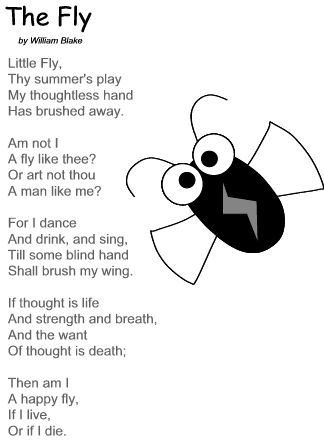
The Fly by William Blake

THE FLY
William Blake

About Poet William Blake
William Blake (1757-1827) was an English poet, artist, and visionary who is considered one of the most significant figures of the Romantic era. Blake's work was marked by his rejection of traditional Enlightenment values, his interest in mysticism and the supernatural, and his belief in the power of the imagination. Blake's poetry was characterized by his use of vivid imagery, bold symbolism, and a highly individualistic and idiosyncratic style. His most famous works include "Songs of Innocence" and "Songs of Experience," which explored themes such as childhood, innocence, and the corrupting influence of society.


Poem Analysis
William Blake's The Fly is a short, yet powerful poem that explores life's fleeting nature, death's inevitability, and existence's beauty and fragility. First published in 1794 as part of his collection "Songs of Experience," the poem uses the image of a fly to symbolize the transience of life and the human struggle to find meaning in the face of mortality.

The poem begins with the speaker observing a fly, which is struggling to escape from a window pane. The fly's movements are erratic and desperate, and it seems to be driven by a sense of urgency and panic. The speaker then begins to reflect on the fly's brief existence and the futility of its struggles, remarking:

"Am not I A fly like thee? Or art not thou A man like me?"

Here, the speaker draws a parallel between the fly and himself, suggesting that both are subject to the same laws of nature and the same fate. This comparison highlights the universality of the human experience and the fact that all living beings must face the inevitability of death.

The poem then takes a darker turn as the speaker crushes the fly, bringing an abrupt end to its struggles. This act of violence is sudden and unexpected, and it seems to echo the arbitrary and unpredictable nature of death. The speaker then reflects on the fragility of life, remarking:

"For I dance And drink and sing, Till some blind hand Shall brush my wing."

Here, the speaker acknowledges the fleeting nature of life and the fact that it can be taken away at any moment. The image of the "blind hand" suggests the randomness of death and the fact that it can strike without warning.


Despite its bleak themes, "The Fly" is a beautiful and poignant poem that encourages us to appreciate the beauty and wonder of life, even in the face of mortality. By using the image of a fly to symbolize the human condition, Blake highlights the fragility and transience of life, while also celebrating its beauty and complexity.

Overall, "The Fly" is a powerful meditation on the human experience and a reminder that life is both precious and fleeting. It urges us to embrace the present moment and to find meaning and purpose in our brief time on earth, even in the face of the inevitability of death.

Figures of speech in William Blake's poem "The Fly"
  • Metaphor: The speaker compares himself to the fly, saying, "Am not I a fly like thee?" This metaphor highlights the idea that all living beings are subject to the same fate, regardless of their status or importance.
  • Personification: The fly is personified throughout the poem, with its struggles and movements described in human terms. For example, the fly is said to "mark its way with an inconstant wing" and to "wear its fretful wings." This personification serves to emphasize the fly's vulnerability and fragility.
  • Symbolism: The fly is used as a symbol for the transience of life and the inevitability of death. By using the fly as a metaphor for the human condition, Blake is able to explore themes of mortality and the fleeting nature of existence.
  • Allusion: The line "And are not you and I/But men like all the flies" contains an allusion to the Christian concept of the fall of man, which suggests that all human beings are subject to sin and mortality.
  • Irony: The final line of the poem, "For I dance/And drink and sing/Till some blind hand/Shall brush my wing," is ironic in that it suggests that the speaker is enjoying life, even as he contemplates his own mortality. The irony serves to underscore the theme of the poem, which is the tension between the joy of life and the inevitability of death.

Thanks for visiting I hope it is useful.

My Learnings from the National Workshop on Academic Writing (2026)

The National Workshop on Academic Writing  I recently had the opportunity to participate in the National Workshop on Academic Writing (2026)...