
Cinematic Adaptation Salman Rushdie’s Midnight’s Children
Abstract:
The film adaptation is the process of creating a new work based on an existing source material, literary work. This process has become increasingly prevalent in the film industry many popular films being adapted from previously published works. The study of film adaptation offers valuable insights into the creative process and the cultural significance of films. This paper will examine the process of adapting Midnight's Children and the challenges that filmmakers faced in translating the complex and multilayered narratives of these novels into film. Salman Rushdie’s Midnight's Children is a magical realism novel that explores the lives of children born at the stroke of midnight on the day of India's independence and a prominent work of Indian literature that has been adapted into a film by Deepa Mehta. Rotten Tomatoes (an American review-aggregation website for film and television)'s critical consensus states that. “...fails to bring the story together cohesively." We will analyze the film adaptation of Midnight's Children and how closely they adhered to or deviated from the spirit of the original novels. This film has been praised for its visually stunning portrayal of India and its ability to capture the magical realism of the source material and has been criticized for its lack of depth and its failure to fully capture the complexity of the novel. Some also felt that the adaptation was too simplistic and didn't do justice to the rich cultural and political themes of the original work. The aim of this paper is to provide an in-depth examination of the process of adapting Midnight's Children for the screen and to analyze the successes and challenges of this adaptation. It will also provide insight into the cultural significance of this work and how it is represented in the film medium.
Keywords: Midnight’s Children, Complex novel, Film Adaptation
Introduction:
Cinematic adaptation has been a subject of much scholarly and critical attention and continues to evoke strong opinions and passions. “Literary adaptations gave cinema the respectable cachet of entertainment-as-art” (Hayward, 2013, 4). This observation highlights the significance of cinematic adaptations in shaping our understanding of literature and cultural values. The cinematic adaptation of literary texts has been a popular and well-debated topic among scholars, filmmakers, and audiences alike. The translation of written works onto the big screen has sparked discussions about the preservation of the original text and the creative freedom of filmmakers.
The measure of the original literary text is what adaptation is rather than a failure of the imagination. This sentiment highlights the challenges and opportunities that arise when adapting a literary work for the screen. Film adaptations have the potential to bring new interpretations and perspectives to the source material, but they also risk straying from the original intent and meaning of the text.
In the words of film theorist Walter Benjamin, "Every epoch dreams the one to follow" (Benjamin, 1986) This concept applies to the realm of cinematic adaptation as filmmakers bring their own interpretations and ideas to the text, shaping it for their own time and audience.
The debate about the value and success of cinematic adaptations has continued for decades, with opinions ranging from dismissiveness to reverence.
One of the key debates surrounding cinematic adaptation is the issue of fidelity to the original text. The degree to which an adaptation catches the essence of the original is the surest sign of its success. On the other hand, The goal of adaptation is to appropriate rather than to copy. These opposing perspectives highlight the tension between preserving the essence of the original work and taking creative liberties in order to bring a new vision to the screen.
Additionally, the process of adaptation often reveals deeper cultural and societal values and attitudes. As film scholar Linda Hutcheon argues, "Adaptations are not just retellings of stories, but also retellings of cultural history" (Hutcheon & O'Flynn, 2013). This observation underscores the importance of considering the cultural context and motivation behind each adaptation.
The cinematic adaptation of literary works is a challenging and intricate process that demands a deep understanding of both the source material and the cultural context in which it was produced. The art of adapting a literary work for the screen involves striking a delicate balance between preserving the essence of the original text while also creating a distinct vision for the screen. One of the most highly anticipated adaptations in recent years has been the film version of Salman Rushdie’s Midnight’s Children. This novel is widely regarded as a seminal work of postcolonial literature, with its complex themes and unconventional narrative style presenting a significant challenge for filmmakers. This research paper will undertake a critical examination of the cinematic adaptation of Midnight’s Children, exploring its strengths and weaknesses and evaluating its ability to capture the essence of the original text while presenting a unique vision for the screen. It will delve into the various artistic and technical decisions made by the filmmakers and assess the extent to which they have succeeded in bringing Rushdie’s vision to life. By exploring the challenges of adapting a literary work for the screen and evaluating the success of this particular adaptation, this research paper will contribute to the ongoing discourse on the art and craft of cinematic adaptation.
About Novel:
Midnight’s Children is a rich and complex novel that explores themes of identity, nationalism, and the intersections of history and personal narrative. As Salman Rushdie notes, “I wanted to write a kind of magic realist history of India” (Rushdie, 2021). The protagonist, Saleem Sinai, is born at the exact moment of India’s independence and is gifted with telepathic powers that allow him to communicate with other children born at the same time. Through Saleem’s life story, Rushdie reflects on the legacy of colonialism and the formation of modern India.
The novel has been widely celebrated for its innovative narrative style, blending elements of magic realism, political satire, and historical fiction to create a unique and captivating vision of India’s past and present. Midnight’s Children has been praised for its ability to challenge traditional notions of history and offer a powerful critique of the political and cultural forces that have shaped modern India.
Additionally, the novel’s themes of identity and the search for self are central to its narrative and are depicted through the character of Saleem Sinai, who must navigate the complexities of growing up in a rapidly changing India. As Rushdie states, “The idea of a child being born at the exact moment of a nation’s birth, and then the child growing up to reflect the nation’s journey, is a powerful one” (Rushdie, 2021). The novel’s exploration of the intersections between personal and national identity has been widely lauded and has solidified Midnight’s Children as a seminal work of postcolonial literature. Midnight's Children is a creative literary success and a potent indictment of the forces that have produced modern India,"
Cinematic Adaptation:
The adaptation of Midnight’s Children for the screen presented a significant challenge for filmmakers, as the novel’s unconventional narrative style and complex themes are difficult to translate to a visual medium. The film adaptation, directed by Deepa Mehta and released in 2012, received mixed reviews from audiences and critics alike.
Critics of the film have noted that while the adaptation successfully captures the political and cultural themes of the novel, it falls short in terms of its narrative structure and character development. The film's storyline doesn't exactly hold together, but there is no denying its depth of imagination and scope of history... Some have argued that the film’s heavy reliance on visual effects and its simplified storyline detract from the richness and complexity of the original text.
On the other hand, supporters of the film have praised its visual spectacle and its ability to effectively convey the essence of Rushdie’s vision. As noted by film critic Peter Bradshaw, “Mehta’s film has real sweep and grandeur, even if it does simplify and reduce the book’s complexities” (Bradshaw, 2012). Many have also noted that the film’s imaginative visual style and its use of magical elements serve to reinforce the themes of the novel and create a unique vision for the screen.
Despite the mixed reviews, the adaptation of Midnight’s Children has been widely recognized for its visual impact and its success in bringing Rushdie’s novel to a wider audience. The film’s imaginative use of special effects, such as the creation of a magical world where the midnight’s children can communicate telepathically, has been praised for its ability to evoke the fantastical elements of the novel.
Moreover, the film’s exploration of political and cultural themes, such as the legacy of colonialism and the formation of modern India, has been widely recognized for its relevance and its impact. Insightful and provocative, the movie looks at the cultural and political influences that have influenced India's past and present. The film’s ability to bring these important themes to a wider audience has made it a valuable contribution to the larger conversation about postcolonial literature and the impact of cultural and political forces on national identity.
Comparison:
Salman Rushdie's "Midnight's Children" and Deepa Mehta's film adaptation of the same name offer two distinct interpretations of the novel's themes and narrative style. While both works explore the legacy of colonialism and the formation of modern India, they differ significantly in terms of their approach to character development, narrative structure, and visual style.
One major difference between the novel and the film is their treatment of the protagonist, Saleem Sinai. In the novel, Saleem is a complex and multi-faceted character, whose experiences and relationships are central to the exploration of themes such as identity and nationalism. It is a book about the birth of a country as well as the birth of a person. This shift in character development has been criticized by some as detracting from the richness and complexity of the original text.
Another key difference between the novel and the film is their use of visual style and effects. While the novel is characterized by its imaginative and richly detailed prose, the film relies heavily on visual effects to convey its themes and narrative. Critics have noted that while the film's visual spectacle is effective in capturing the essence of Rushdie's vision, it falls short in terms of its narrative structure and coherence.
Narrative Structure:
The narrative structure of Salman Rushdie's novel "Midnight's Children" and its film adaptation directed by Deepa Mehta differ in several significant ways. The novel is known for its unconventional narrative style, blending elements of magic realism, political satire, and historical fiction to create a unique and captivating vision of India's past and present. The protagonist, Saleem Sinai, narrates the story of his life, interweaving personal experiences with historical events to explore themes of identity, nationalism, and the intersections of history and personal narrative.
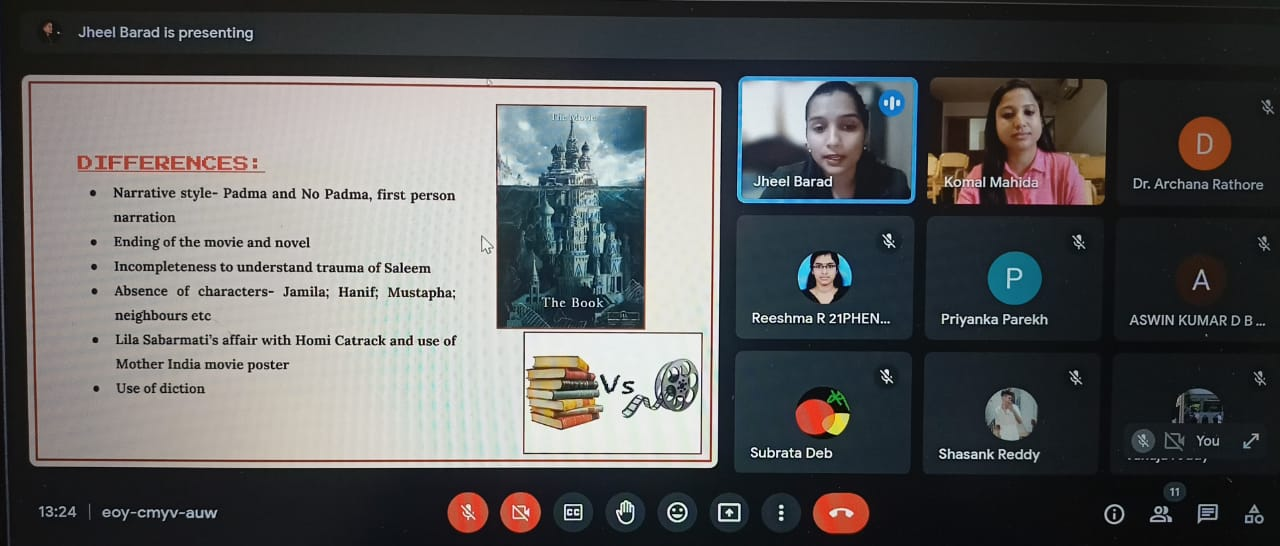
In contrast, the film adaptation simplifies the narrative structure, opting for a more straightforward and linear approach. While the film still captures the political and cultural themes of the novel, it often sacrifices the complexity of the original text in favor of a more accessible and visually appealing narrative. The film's storyline doesn't exactly hold together, but there is no denying its depth of imagination and scope of history. One notable difference in the film adaptation the removal of this subplot simplifies the narrative but also reduces the richness and complexity of the original text. The notable change is the absence of various subplots that play important roles in the novel but are left out in the film adaptation.
Absence of Padma:
One of the significant differences between Salman Rushdie's novel Midnight's Children and Deepa Mehta's film adaptation is the absence of the character Padma. In the novel, Padma is a significant figure in Saleem's life and rushes the story forward, pleading with Saleem to stick to the plot and avoid digressing, and she frequently expresses questions about the truth of Saleem's testimony. She serves as a love interest and a symbol of the political and cultural forces that shape India. However, in the film adaptation, Padma is not present, and her absence has been criticized by some as a significant loss to the narrative and character development.
Saleem's account is diminished by Padma's absence and becomes little more than a dry, if occasionally colorful, history lecture. Padma is Saleem's devoted friend and carer; towards the book's conclusion, they will be engaged. She serves as Saleem's story's target audience. Padma stands in contrast to Saleem's enchanted, enthusiastic, free-wheeling tale with her muscular, hairy forearms, a name connected to excrement, and a jaded and sometimes irritated ear. She rushes the story forward, pleading with Saleem to stick to the plot and avoid digressing, and she frequently expresses questions about the truth of Saleem's testimony. Padma gives Rushdie the ability to directly recognize any misgivings or disappointments the reader may have in reaction to the book as a rhetorical strategy. She is the voice of reasoned critique. She encourages the novel's most purposefully outrageous indulgences since she is there to offset its most extreme impulses. In some ways, Padma's emotions of uncertainty and annoyance make Saleem's repeated interruptions, ramblings, and self-obsession feasible. Together, the two sides contribute to a rich reading experience. Rushdie is able to get over the narrative's problems by acknowledging them directly. Without Padma, the film fails to fully capture the complexities of Saleem's relationships and the impact of his experiences on his personal growth. Critics have argued that the absence of Padma in the film adaptation is a result of the filmmakers' desire to simplify the story and focus on the more visual aspects of the narrative. However, this decision has been criticized as a significant loss to the richness and complexity of the original text and as a missed opportunity to explore the themes of identity, nationalism, and the intersections of history and personal narrative that are at the heart of Rushdie's vision.
Despite these differences, both the novel and the film have been widely celebrated for their ability to challenge traditional notions of history and offer a powerful critique of the political and cultural forces that have shaped modern India. While the film simplifies and reduces the complexities of the original text, it still captures the sweeping grandeur and imaginative vision of Rushdie's novel. As noted by film critic Peter Bradshaw, "Mehta’s film has real sweep and grandeur, even if it does simplify and reduce the book’s complexities" (Bradshaw, 2012).
While both the novel and the film adaptation of ‘Midnight's Children offer compelling interpretations of Salman Rushdie's vision, they differ significantly in their approach to character development, narrative structure, and visual style. However, both works serve as powerful reflections on the legacy of colonialism and the formation of modern India and are widely celebrated for their ability to challenge traditional notions of history and offer a powerful critique of the political and cultural forces that have shaped modern India.
Conclusion:
This research paper delves into the field of cinematic adaptation, seeking to shed light on the complexities of translating literature into film. Through a close examination of selected adaptations and the perspectives of scholars, filmmakers, and critics, this paper strived to offer new insights into this dynamic and ever-evolving field. The adaptation of Salman Rushdie’s Midnight’s Children for the screen presents a complex and challenging task that requires careful consideration of the source material and the cultural context in which it was created. While the film has been met with mixed reviews, it can be argued that the adaptation successfully captures the political and cultural themes of the novel while also presenting a unique vision for the screen. Ultimately, the adaptation of Midnight’s Children serves as a testament to the ongoing significance of Rushdie’s work and to the enduring impact of postcolonial literature. The adaptation of Salman Rushdie’s Midnight’s Children presents a complex challenge for filmmakers, and the 2012 film has received mixed reviews. While the film has been criticized for its simplified storyline and heavy reliance on visual effects, it can be argued that the adaptation successfully captures the political and cultural themes of the novel and presents a unique vision for the screen. The adaptation serves as a testament to the ongoing significance of Rushdie’s work and to the enduring impact of postcolonial literature.

(n.d.). Salman Rushdie Official Author Website. Retrieved January 31, 2023, from https://www.salmanrushdie.com/
Benjamin, W. (1986). Illuminations (H. Arendt, Ed.; H. Zohn, Trans.). Schocken Books.
Bradshaw, P. (2012, December 20). Midnight's Children – review | Drama films. The Guardian. Retrieved January 31, 2023, from https://www.theguardian.com/film/2012/dec/20/midnights-children-review
Hayward, S. (2013). Cinema Studies: The Key Concepts. Routledge.
Hutcheon, L., & O'Flynn, S. (2013). A Theory of Adaptation. Routledge.
Malamud, R., Kureishi's, H., Frears, S., Auster's, P., & Wang, W. (2012, October 8). 'Midnight's Children' Flourishes in Screen Adaptation. The Chronicle of Higher Education. Retrieved January 31, 2023, from https://www.chronicle.com/article/midnights-children-flourishes-on-screen/
Mehta, D. (Director). (2012). Midnight's Children [Film].
Mendes, A. C., & Kuortti, J. (2016, December 21). Padma or No Padma: Audience in the Adaptations of Midnight’s Children. Sagepub. Retrieved January 31, 2023, from https://doi.org/10.1177/0021989416671171
Quazi, M. (2017, December 8). Salman Rushdie's Midnight's Children and its Incarnations. Tandfoline. Retrieved January 31, 2023, from https://doi.org/10.1080/02759527.2014.11932960
Rushdie, S. (1981). Midnight's Children. Vintage.
Rushdie, S. (2021, April 3). Salman Rushdie on Midnight's Children at 40: 'India is no longer the country of this novel'. The Guardian. Retrieved January 31, 2023, from https://www.theguardian.com/books/2021/apr/03/salman-rushdie-on-midnights-children-at-40-india-is-no-longer-the-country-of-this-novel


