Showing posts with label Gian. Show all posts

Sunday, 13 November 2022

Gian Course E- Literature- Learning Outcome (Part-2)

Electronic Literature and Artificial Intelligence (AI): Theory and Practice of Digital Storytelling

Recently I attended an Online course on the Gian platform on ‘Electronic Literature and Artificial Intelligence (AI): Theory and Practice of Digital Storytelling’ hosted by Prof. M. Rizwan Khan, The Department of English Aligarh University, Aligrah, U.P. in a virtual mode. This blog deals with my learning out of attending this interesting course.
Day-3

Lecture 5: Prof. Paola Carbone [Foreign faculty, Department of Humanities IULM University, Milan] on Locative Narratives: Definition of “Locative narrative” as a way to write with the Physical World, to read within the Physical World and give Place and History a voice, Examples
And How to project Locative Narratives. Locative Narratives and the Meta-verse

Locative narrative is a way to write within the physical world, to read within the physical world and to give place and history a voice”; “to write with place, object and absence as well as textuality.


Locative narratives are writing with space Flaneur, Street art/writing, Performance art and Land art.

Land art artists were interested in the combination of body, line, surface, site and materials and it opened up a perspective of experimenting with place and space through what Stiles described as ‘an amplification of the process over the product’– a shift from the representational object to further modes of action / presentation of experience.

geographical space = canvas

Immersive aesthetic experience
1. The place is de-familiarized in order to see differently
2. The genius loci becomes a framework for re-experience

Media artists started to explore the possibility of turning these principles into a digital artistic experience
Real world spaces are augmented with artistic contents – primarily audio and/ or textual – and mediated by mobile devices. E.G: Google maps

Locative mobile social networks – LMSN: to coordinate sociability in the city
location-based mobile games – LBMG
narration of places: enhancing the value of places through new technologies
site-specific fictional stories, stories written just for that particular environment

The user is set into a communitas, commonly referring either to an unstructured community in which persons are equal and are allowed to share a common experience, Communitas is characteristic of people experiencing liminality together, and more specifically in this case a space between organic and inorganic.
It offers to other users my sense and my knowledge of the place, my awareness of other people's behaviors, in other words my story.

The experience of public spaces especially in urban areas mainly consists of transit, a transition from one place to another... mostly a solitary experience.

Private space within public space

How can digital media draw one into an awareness of place?
narration of places: enhancing the value of places through new technologies
site-specific fictional stories, stories written just for that particular environment

Locative media is an instance of 'unframed' media practice, unframed in the sense of unbound from the desktop, detached from the singular screen and thus a fixed spectatorial perspective.

To read is to recognize that a critical engagement requires a range of cognitive and bodily activities, only one of which is reading in the sense of the visual processing of linguistic signs.

Reading involves seeing, moving, listening, touching = it is a challenge to the hegemony of words.


Examples

The design of a Locative Narrative
an idea on how to structure your contents, of what you want to say, and how you want to communicate it. This is called storytelling.
You need to activate your attention.
Before the scripting, the storyteller must :
1. survey the potential attractors distinguishing them between main and secondary >> they will become episodes of the core or satellite
2. select the myths, which will define the paradigms on which the narrative will be built visit the place
3 define the characters
4.choose the narrative typologies of the story: the choice will depend on:
the context: quantity and quality of the POI and eventual additional materials (documentation, archives, etc.)

users: if universal, it will have to refer to all typologies; if you have in mind a target, you have to adapt the choice to this, economic availability.

Vertical narration: a main plot must be identified without secondary subplots and a route that moves between the objective is the sensory immersion of the visitor in the narrated context, to be achieved through a detailed script of the movements of the user and the character.

Horizontal narration: once the main plot is established, the visitor has all the material at his disposal and can explore it as he likes and assemble it as he likes during the visit.

Example:


Lecture 6: Prof. Mohd. Rizwan Khan [Host Faculty, Department of English Aligarh Muslim University, Aligarh. U.P., India] on AI and the Discipline of Humanities

Humanities: The humanities include the study of all languages and literatures, the arts, history, and philosophy. It is a critique of human conditions.


AI education is valuable not only in the fields of Computer Science and Engineering but also in humanities. It will become an essential component in education like mathematics, language and Science. The English department has started a course in digital Humanities.
  • Literature
  • Electronic Literature
  • AI Generated Literature
  • Cyborg/ Robot Literature

Use of AI
Art historians
Historians
Archaeologists
AI in Art, Music, Dance
AI is seen as the sole generator or a collator.
Artwork can be generated.
AI song contest.
AI in film and media
Role of VFX, movie editing and creating trailers.
The film ‘Her’ depicts the story of a man who falls in love with a Virtual assistant.
‘Coded bias’- facial recognition treats dark-skinned faces unfairly’.


DAY-4
Lecture 7: Prof. Paola Carbone [Foreign faculty, Department of Humanities IULM University, Milan] on Podcast: What it is, Typologies and Examples and Discussion

Podcasts are an increasingly successful form of communication.

Three determining factors
  • The podcast is currently very fashionable and therefore the more people talk about it, the more they want to do it.
  • The on-demand characteristic of podcasts makes them suitable for multitasking listening, i.e. while doing other activities.
  • The podcast does not have interaction as its peculiarity and it is this 'lack' that makes it such an intimate and profound content.

Podcasting communicates in one direction:
  • you construct your content
  • you reason it out
  • you write it down
The word podcast comes from the combination of iPod and broadcasting.

It first appeared in an article published by Ben Hammersley for "The Guardian" on 12 February 2004.

In 2005, the New Oxford American Dictionary declared 'podcast' to be word of the year.


The term podcasts refers to original audio content, usually of an episodic serial nature, that is made available on demand over the internet.

RADIO VS PODCAST
  • Podcasts and radio are not the same thing. Not only are they based on two different technologies, but they also present two different types of content.
  • A podcast is not a web radio. Web radio is streamed by users through an internet connection. A podcast, on the other hand, can also be listened to offline, after being downloaded via an Internet network;
  • Radio is interactive, podcast is not
  • A difference and advantage of the podcast compared to radio is also the availability of time.
Intimacy: the radio tends to address, through the radio speaker, an indistinct mass of potential receivers while in the podcast you really have the feeling that the narrator is addressing the single person wearing his headphones.

Podcast range in time from 10 minutes to an hour long (for example for Crime Podcast)

CATEGORIES OF PODCASTS
  • Interviews + Panel Discussion
  • Free talk
  • Scripted fiction
  • Documentary + educational
  • Scripted non-fiction
  • News-recap

Example

Identify your podcast goals- To generate leads, To share an important message and To have fun
The only requirement is passion

Find two stories: same topic but with two possible endings or perspectives.
Find a story you like and then find another that somehow matches that story. This is because each episode of Shadow Lines is basically made up of two stories. Once the first story has been selected, the objective of the second story is clear. It has to be somehow similar to the first story (not only by similarity but also by contrast).

There are two types of stories:
  • Exceptional stories, out of the ordinary, able to arouse strong emotions and leave us stunned.
  • Ordinary and common stories, which precisely because of their "simplicity" allow us to identify with and relive, through the story, the events and themes that are somehow part of us.


DAY- 5
Lecture 8: Prof. Paola Carbone [Foreign faculty, Department of Humanities IULM University, Milan] on AI and Literature: Ontological Issues with examples

Ontology: the branch of metaphysics dealing with the nature of being.
In AI, an ontology is a specification of the meanings of the symbols in an information system.

Machine learning
Machine Learning is based on algorithms designed to perform a/one task.
Machine learning is able to find values not perceived by the human eye, but useful for making future predictions or behaviors based on algorithms..

Deep learning
Deep Learning works on a set of techniques that allows the system to automatically discover the representations needed for feature detection classification from raw data. Such representations are often hidden to our human comprehension. The data used by an AI to identify an image, for example, is very different from what humans would use. Through the neural network an image is analyzed and transformed into smaller representations (feature maps) that the computer can recognize so precisely to be used to identify content. The same features maps would appear as scribbles or random lines to the human eye.

Digital culture vs AI:
Digital culture defines flow of content (immaterial) distributed across various intersections of media human behaviors determined by virtual reality in its relationship with a real-world environment.

AI acts on the playground of reality since it acquires data from it in order to do things, to carry out actions, to perform tasks in the real world.

We should not consider AI as a tool (a hammer, for example) because an AI processes and interprets information. It is not even an environment (matrix) since it inhabits products and services that surround us (see internet of things).

AI vs Hyperreal:
AI emulates and determines (rational) behaviors rather than their simulation
“Hyperreal” simulates, it is a simulacrum or a “real” without origin or reality


Definition of AI:
(…) the artificial intelligence problem is taken to be that of making a machine behave in ways that would be called intelligent if a human were so behaving.” [1955, John McCarthy, Marvin Minsky, Nathaniel Rochester, and Claude Shannon]

Luciano Floridi: “ … were a human to behave in that way, that behavior would be called intelligent.”
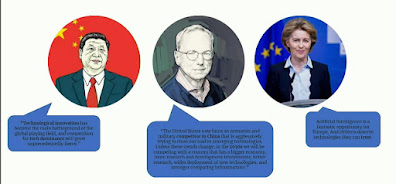


Fears of AI:
  • Question of an advanced aligned AI system and human values.
  • A machine lacks those specific peculiarities of human intelligence that are generalization and abstraction
  • Is the AI aware of the fact that it is playing chess? No, it is simply applying an algorithm
  • Likewise, also emotions and doubts are essential human distinctiveness that a machine, trained to proceed algorithmically, cannot experience or understand.
  • Today research is trying to go farther and control emotions. Next-generation AI aims to capture these moments with webcams so as to adapt responses to emotions.
  • Machines must have the ability to understand emotions and to articulate responses in terms of both content and facial expressions, tone of voice, and body management = communication.

  1. Understanding AI means being aware of the risks
  2. transparency problems > who does what
  3. inequality, accountability problems: human bias processes on algorithms (exclusion of minorities)
  4. Manipulative problems echo chamber

This 'advanced' form of computer-assisted processing is still working on the idea that a screenplay, like a literary text, is a formal structure, but the neural networks allowed the generation of a text that is new in so far as it is a priori unpredictable and based on hidden learning features.

The text generated could only be written by that specific AI and from that particular dataset.

I hope this blog is useful. Thanks for visiting.

Gian Course E- Literature- Learning Outcome

Electronic Literature and Artificial Intelligence (AI): Theory and Practice of Digital Storytelling

Recently I attended an Online course on the Gian platform on ‘Electronic Literature and Artificial Intelligence (AI): Theory and Practice of Digital Storytelling’ hosted by Prof. M. Rizwan Khan, The Department of English Aligarh University, Aligrah, U.P. in a virtual mode. This blog deals with my learning out of attending this interesting course.
What is Gian?
Gian is Global Initiative of Academic Networks. It is Govt. of India’s approved new program in Higher Education aimed at tapping the talent pool of scientists and entrepreneurs, internationally to encourage their engagement with the institutes of Higher Education in India so as to augment the country's existing academic resources, accelerate the pace of quality reform, and elevate India's scientific and technological capacity to global excellence. [Visit GIAN website]


The basic knowledge I had about Digital Humanities and Electronic Literature.
The title, Digital Humanities contains two terms- digital and hiumanitites.it combines traditional and modern modes of critical understanding. Humanities in its traditional Avatar consists of various text-based disciplines which study classics, literature, philosophy, performing arts, media and communication and cultural studies. Digital Humanities is a new variant which uses informational Technology as a method of research in traditional human disciplines like literature and the performing arts.


Digitalising Humanities, Literature is always helpful for easy and fast reading and references along with digitizing text increases its availability. We know how tiring it is to go to the library and search for books. Ctrl F works as a magic wand to easily take the reference of what we want in a particular book if it's digitalised.

Today technology is also able to create literature, generate literature which has emerged as ‘generative Literature’.

Electronic Literature

There is no specific definition of E- Literature. Basically, Pdfs, Written and posted can not be considered E- literature. Electronic literature is coded literature.

N. Katherine Hayles defines electronic literature as "'digital born' (..) and (usually) meant to be read on a computer", clarifying that this does not include e-books and digitized print literature. A definition offered by the Electronic literature Organization (ELO) states electronic literature "refers to works with an important literary aspect that takes advantage of the capabilities and contexts provided by the stand-alone or networked computer".

This can include hypertext fiction, animated poetry (often called kinetic poetry) and other forms of digital poetry, literary chatbots, computer-generated narratives or poetry, art installations with significant literary aspects, interactive fiction and literary uses of social media.

E- literature has no specific author, it is collaborative (Reading + Writing). A reader itself can select what he/ she wants to read and after which chapter what to read. There is no continuation. Every reader forms his/ her own story. It’s a non- sequential reading, pioneer less narratology, multilinear, plotless, anti- novel, lack of particular meaning and interpretations keep on changing.

Digital humanities in a way saves our time of re- reading and helps us to come to our conclusion.
As an e- literature I have read Sultana’s Dream by Aphra Shafiq.


Further this blog will deal with blogger’s learning outcome from the online Gian course.


Day- 1
Lecture 1: Prof. Paola Carbone [Foreign faculty, Department of Humanities IULM University, Milan]- about ‘Definition of E-Literature

E-Lit was founded by the Electronic Literature Organization in 1999.
Elit- written with a digital device and need a digital device to be read/experienced.
Joseph Tabbi on Electronic Literature "an emerging cultural form" (2007). And here are various FOUR volumes of E- Lit: Electronic Literature Collections

Digital Literature

Electronic  Literature

Digitized text

Requires digital computation

Includes printed literature

Verbal- audio- visual works which cannot be turned into printed books.

E,g,: online books, ebooks, digital hypertext

E.g: hypertext fiction, locative narratives, codework, generative art, cyber literature etc


Examples of E-Literature is ‘Love Letter’ (1952) by Chtistopher Strachey. One can generate a love letter, E- Love letter.
Techno-logique is the logical process determined by a technology.
Writing in a digital environment means designing narrative and reading processes. That is a network of possible readings and a human–machine interaction mediated by machine code

(Images are hyperlinked)

Digital writing: a non-linear type of writing.

Precursors- its roots in experimentalist writing and the work of European vanguards such as Laurence Sterne, Stephane Mallarmé, Tristan Tzara, T.S. Eliot, William Burroughs, Julio Cortazar, Italo Calvino, George Perec, and Marc Saporta, as well as OULIPO, Futurism, and Dadaism.
Formal ideas crucial to digital communication, such as abandonment of linearity, narrative fragmentation, montage, and multimedia convergence.

(Images are hyperlinked)


Philippe Bootz:
[In eLit it] is not only (or no longer) the product of a process that is represented but the process itself.

Process
  • The process is written in the algorithm.
  • The poetics of the work is enshrined in the
  • algorithm
  • The human-machine interaction defined by
  • the process is called cyber-feedback-loop

Rosemarie Waldrop:
“We do not usually see words, we read them, which is to say we look through them at their significance, their contents. Concrete poetry is first of all a revolt against this transparency of the word (…). Concrete poetry makes the sound and shape of words its explicit field of investigation (…). Further, it stresses the visual side which is neglected even in the ‘sound and sense’ awareness of ordinary poetry

Concrete Poetry- “the new poem is simple and can be perceived visually as a whole as well as in its parts. It becomes an object to be both seen and used; an object containing thought but made concrete through play-activity,


Lecture 2: Prof. Mohd. Rizwan Khan [Host Faculty, Department of English Aligarh Muslim University, Aligarh. U.P., India] - ‘Digital Humanities’.

What is Digital Humanities?
Use of Digital tools in the analysis of language, literature, visual and performing arts. Use of computer- related technologies in analysis, research, production and publication.

First work relating DH in the 1940s by Father Busa Index Thomisticus.
DH involves collaborative, transdisciplinary and computationally engaged research, teaching and publishing.
Features- Accessibility, Malleability and Interdisciplinary.
Two waves of Digital Humanities. First wave work was quantitative; second wave work is qualitative, interpretive, experimental, emotive, generative in character.


Examples:


Day-2

Lecture 3: Prof. Paola Carbone [Foreign faculty, Department of Humanities IULM University, Milan] on Definition of Digital Storytelling: Difference between 'telling a story' and 'creating storytelling

“Storytelling” is considered the realm of those who work in communication. For them rhetoric, for example, does not seem to have anything to do with literature. Not even narratology! It is not unusual to hear 'communicators' take on the authorship of things already said by, for example, Aristotle.

Digital Storytelling
Storytelling does not mean 'telling stories', it is more like “talking through stories”
“Telling a story” does not mean to create a story. Storytelling consists in 'creating' representations' (textual, visual, acoustic, perceptive) made in order to move, to touch, and to establish a relationship with the audience.

Storytelling is the shaping of a reality in order to connect people/readership to it, shaping an experience for the audience.

eLIT is made of process + experience
Digital + storytelling = digital media and narration
Narration/Literature: content + form + medium

Digital Media: different technologies + reading/writing surfaces/interfaces + interaction

Create emotions in the audience!
Stories are used to inspire, to persuade.
The one who writes for a digital environment is an experience designer

Types of stories:
Sequential: the different dramaturgical lines of the story follow each other without overlapping

Parallel: the different dramaturgical lines of the story run side by side without ever clashing in the different platforms

Simultaneous: multiple lines begin and end by sharing the same portion of the story across multiple media

Non-linear: storylines are fragmented and reconstructed in deliberately disjointed sequences

Example of Digital stories:
  • Stories on Instagram
  • Short videos used both for advertisements (Patagonia) or to activate social campaigns [Little lobbyst]
  • Cultural communication [Library of the congress using story maps; The PALABRA Archive from the Hispanic Reading Room]
  • VR/metaverses: characters, environments, themes, coherent creative and narrative universes, conflicts, identification and personification >> metaverses are creative universes to build

Case Study:

Definition of Hypertext as a Topographic form of writing; Peculiarities of a Non-Linear writing; Flowcharts; Hypertext; Flowcharts and Hyperlinks.

While writing digital media, we have to keep in mind the process of reading.

A book is organized linearly and hierarchically (in chapters; you read one page after the other); a digital textuality is not! Instead of linearity we talk about non-linear storytelling, even if the reading process is sequential (that is one Lexia after the other). This form of writing is called “hypertext”. The term was coined in 1965 by Ted Nelson

"non-sequential writing -- text that branches and allows choices to the reader, best read at an interactive screen. As popularly conceived, this is a series of text chunks connected by links which offer the reader different pathways"


Non-sequential reading
(user chooses where to start and how to continue browsing)
No fixed reading time
(the reading ends when the user is satisfied)
Links can be internal
(within the same website)
or external (to other websites)

The main feature that distinguishes hypertext from other literary works is, what Jay Bolter calls, the space of writing.

Michael Joyce, Of two Minds, states:
“Electronic writing is both a visual and verbal description”, says Bolter, “not the writing of a place, but rather a writing with places, spatially realized topics […] signs and structures on the computer screen that have no easy equivalent in speech.” For Bolter, hypertext’s “electronic symbols […] seem to be an extension of a network of ideas in the mind itself.”


Lecture 4: Prof. Mohd. Rizwan Khan [Host Faculty, Department of English Aligarh Muslim University, Aligarh. U.P., India] on AI and Employability

Career opportunity in AI is directly proportional to Advancement. Employability skills can be defined as the Transferable skills needed by an individual to make them employable. Communication and interpersonal problem solving skills, organizational skills, team working etc.

What is AI?
Artificial intelligence is a field that combines computer science and robust datasets to enable problem solving, a human human cognitive capabilities such as reasoning, recognizing patterns, categorizing objects and similar, identify images and so on, it's an interdisciplinary enterprise.


How does the AI system work?
Machine learning algorithms are the heart of AI.


It is a structured training set carefully curated by humans.
AI is widespread. It is an integral part of everyday life and culture Smart home, devices, E-mail filtering, product recommendation, etc. marketing and e-commerce, Healthcare, Automotive hiring and education.

AI will lead to a decline in jobs for humans but it is an emerging discipline with the new demand in the workforce. Challenges in the AI implementation is the need for more AI skills and training. We need to invest more in AI courses. This discipline prefers a dynamic job profile that requires interdisciplinary knowledge and has a Digital participation.

AI Is to support human work instead of the replacement. human beings and machines need to work together in partnership, the triangle of Technology, human and Organization. human creativity, nonlinear thinking, common sense, the ability to make decisions, emotional intelligence and communicative and special abilities cannot be replaced.

AI in the future will be integrated into all disciplines including music, literature, etc. humanities discipline not only Engineering courses. Which will increase the scope of employability.


I hope this blog is useful. Thanks for visiting.

My Learnings from the National Workshop on Academic Writing (2026)

The National Workshop on Academic Writing  I recently had the opportunity to participate in the National Workshop on Academic Writing (2026)...