Showing posts with label Charlie Chaplin. Show all posts

Thursday, 3 February 2022

Frame Study- The Great Dictator

 
FRAMES OF THE GREAT DICTATOR

Study of ‘The Great Dictator'


The Great Dictator is a 1940 film directed by Charlie Chaplin. It is a satirical- comedy drama. Chaplin's film advanced the expression of very strong disapproval of Adolf Hitler, Benito Mussolini, fascism, antisemitism, and the Nazis. At the time of its first release, the United States was still formally at peace with Nazi Germany and neutral during what were the early days of World War II. The Great Dictator conveys Chaplin’s view that people must rise up against dictators and unite in peace.

The Modern times is a complete silent movie whereas it has some dialogues, which exhibit the advancement of cinema.

What is frame study?
A frame is a single image of film or video. Framing (a shot) involves composing the visual content of a series of frames as seen from a single point of view, i.e., a fixed camera. When framing a shot, the filmmaker creates a visual within the dimensions of the lens just as a painter creates a visual within the dimensions of a canvas. A frame study is the study or understanding of the frame by a camera which is describing or indicating a lot of things to actually understand the meaning behind the fixed camera image.


Characters of the movie is an allegorical representation of the political leaders/ dictators. As below. 

REAL

REEL

Adolf Hitler (Dictator of Germany)

Adenoid Hynkel (Dictator of Tomainia)

Joseph Goebbels (Minister of Propaganda)

Garbitsch- Garbage

Hermann Goring (Minister of War)

Herring

Benito Mussolini (Dictator of Italy)

Benzino Napaloni(Dictator of Bacteria)


Let's read the frames of the movie-

Frame 1:


The movie is set in the period between the two world wars, The period of madness and lack of humanity. It is the very beginning of the movie which displayed condition on the border, constant fight with the heavy weapons, bombs. World war period believed the country with the most powerful weapons is the most powerful country. We can clearly witness the 20th century, time of war and weapons. It suggests the malevolence of machines, the horror of war, and the senselessness of destruction.

Frame 2:


This frame shows how the orders are passed from the powerful authoritative person to the powerless, unauthoritative person which can be considered as the ‘obedient’ one who has to follow the orders. It seems like there is no value in their life and they are meant to follow the orders.

We see this condition even in contemporary times in all the political houses.


This is the system which is known as the pyramid of the capitalist system. We see that capital is the head. We never know how the orders are passed and who is taking the order and we keep on blaming or saluting the person who is in front of us but they are only pawns. They're working for laymen because they are ordered by the authority, if the authority/ capitalist authority will order them to go against the layman. they will do their work the main point here is the order are passed from the higher authority to the Laymen, is powerless and the have to follow the orders blindly even if they are harmful for their self. which we keep looking in the society now and then.

Frame 3:
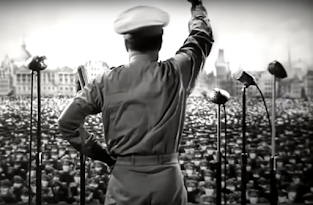

“Only the voice of Hynkel was heard.” Hynkel which is an allegorical representation of the Hitler, this frame shows that it was the time in which only the voice of Hitler was heard the political party of Hitler was so strong. Hynkel was so strong and he had great power of speech which used to easily hypnotize the people. In the movie Hynkel’s speech is gibberish which symbolizes that whatever he spoke was just ‘bla...bla...bla...’ thing of use. Many mic around Hitler symbolize that no one should hear anything other than Hynkel, every mic is only for Hynkel and every speaker is for his voice.

Frame 4:


This video is of a gibberish speech by Hynkel. In this video we see that Hynkel raises hand and everyone will clap for his speech and the minute he will sign to stop everyone will stop. This shows the control of Hynkel. Authoritativeness, dictating nature of an Hynkel. It seems like the public and his officers are ‘Puppets’ in his hand.

Frame 5:


This frame shows not specifically Hynkel/ Hitler but all the political leaders. People who play with children are considered to be warm hearted, an emotional public will always fall in this type of emotional trap. The public feels the leader is so lovely and caring towards children as warm/ kind hearted humans are easily attracted towards the children. This type of things we see in the contemporary world, also the political leaders playing with other children to show themselves emotional and kind, public falls in this type of trap because they are untutored for rational thinking the public is emotionally susceptible.

The Bollywood movie Nayak (2001)by S. Shankar, we witness such a type of political leader. This movie is a satire on the political parties and leaders. We find many scenes resembling ‘The Great Dictator’ and ‘Nayak’. (Full movie is available on youtube)


Frame 6:


These two frames in the movie are not specifically e a symbolizing anything together but in this we find that in the first picture the barber is helping an officer and he is working in the army for the nation but once he is returning to the Ghetto He is abused by the same authority for whom he was working.

The cast ‘ jew’ was written on the walls of the shop so that they could be boycotted. The same happened in India in 2002 after the ‘Godhra riots’ similarly the Muslims were economically boycotted. As a result Muslim started using the English names for hiding their identity, on the shops.

Frame 7:


The first image shows the ‘passion for exhibition’. we also see the sculpture ‘The Thinker (French: Le Penseur)’ Is changed according to the system of Hynkel. as it is hailing to the Hynkel. Here we also see that Hynkel has subdued The Artists. Creative people also don't have freedom of what they have to do. They are completely controlled by the authorities. Whenever the authority is free they are asked to work and if they are not free they are sitting ideally waiting for the authority. They don't have the freedom to work according to their time and according to them. It is a satire on art in a way Sarasvati Devi/ muse being controlled by dictators.

Frame 8:


This frame shows dictators self love/ Narcissist ideology. The towering filing cabinet behind his desk is shown to have no drawers at all, but several concealed mirrors instead. dictators/ authorities are more worried about their image than the public who have elected them to work for them.

Frame 9:


Dictators and their Leisure activities. We do see that many leaders have their personal pastime activity; they actually don't have any mastery in any hobby but just their self love and to mesmerize the public.

Frame 10:


This frame in the movie seems to symbolize the dictator's behavior towards Jews in the society. We interpret this cage to be the symbolism of the Jews being caged in Ghetto.

Frame 11:


Billy Gilbert's Herring’s chest full of medals because he was a sycophant and on the other side Schultz went or gave opinion against order of Hynkel and was ordered him to send to concentration camp. People who pamper their egos are awarded and others are imprisoned.

Frame 12:


Playing with a globe is a maniacal dream sequence of Hitler. The dream of pleasure of ruling the whole world. Sycophant officers give air to their ego and dreams which was dreamt by Hynkel by playing with the globe, Playing the world. Climbing to the curtains can be interpreted as Hynkel flying with a dream of ruling the world.

Frame 13:


The bursting of is symbolic comment on the futility of the dictator, breaking of fallacies, dreams.

Frame 14:


In these two frames of the movie, the first frame is when Hynkel went to welcome Napolini, the dictator of Bacteria. They are seen as friendly with each other as if they were childhood friends but they were the real Rivals and for the means of a photograph, for the media which can be said as the passion for exhibition. And in the very next frame we see that both the dictators were in a private place and the way they are fighting for their agreement with each other. It seems the double standards of The Dictator, they have a different face to show to the public and a different face in a private place. This type of media face is also seen in the present or a contemporary period.

Frame 15:


The Hynkel Stadium. Napolini was taken to a Hynkel stadium to show off arms, Arm force and army to show off your power. We can relate some of this type of incident in a contemporary time that is a cricket stadium named after a political leader.

Frame 16:


In these two frames we see him cause different ways of showing himself superior to Napolini. Here Hynkel is trying to play psychologically with Napolini, by making him feel inferior. Chaplin concentrates on the character's vanity, stupidity and childishness. When Napolini pays a state visit from the neighboring country of Bacteria, the two men compete to have the higher chair while they are being shaved, and to have the more flattering position when they are being photographed.

Frame 17:


In the end of the film Babar, The Jew mistaken as a Hynkel was forced to give a speech in the rally. The first frame shows the popularity of Hynkel, the number of people gathered to listen to Hynkel. And in The second frame We see the word ‘Liberty’ when the Barber was climbing the stairs. this frame can be read in the two ways, the first can be the Liberty is for the sake of the name in the rule of Hynkel and second it can be read as when Barber, as a representative of a layman will be on the stage, on the in the rule the Liberty in the society will prevail.


The final speech in the movie by the barber is the voice of Charlie Chaplin himself. Speech is considered to be one of the best speeches the speed pleads for peace, tolerance and understanding .

Various newspaper bringing to us the setting of 20th Century:


Reflecting over the process:
After watching the movie The Great Dictator it seems like we have never seen the other side of a political area or a political society somewhere we can relate this to the contemporary period. It seems like an eye opener doing frame study is a very interesting activity.

The writer and philosopher George Santayana, "Those who cannot remember the past are condemned to repeat it.” After watching the movie Great Dictator it seems like it is really necessary to understand the history if one knows the history and has an historical sense he won't repeat it and the world would not go through the same condition. Nation will progress rather than regress.

I hope this blog was useful to you. Thank you for visiting.

If you like to read more about the frames of Chaplin’s Movie visit my blog on frame study of ‘The Modern Times’. CLICK HERE.

Work Cited:
Barber, Nicholas. “The Great Dictator: The Film That Dared to Laugh at Hitler.” Accessed February 2, 2022. https://www.bbc.com/culture/article/20210204-the-great-dictator-the-film-that-dared-to-laugh-at-hitler.

Clairmont, Nicholas. “‘Those Who Do Not Learn History Are Doomed To Repeat It.’ Really?” Big Think (blog). Accessed February 3, 2022. https://bigthink.com/culture-religion/those-who-do-not-learn-history-doomed-to-repeat-it-really/.

DQS ( DIVYA QUICK SUPPORT ). The Great Dictator [1940] Full Movie-720p.Mp4, 2020. https://www.youtube.com/watch?v=JDX2tCkCM4o.

[words- 2022]

Monday, 31 January 2022

Frame study- The Modern Times

This blog is a response to the blog task assigned by Dr. Dilip Barad sir. It deals with understanding of 20th century socio- political- economic- religion conditions. For better understanding of any literary text films or documentaries play a very vital role. And Charlie Chaplin's films 'The Modern Times' and 'The Great Dictator' serve a great purpose of better understanding of 20th century scenario. This blog concerns the setting of 20 century, demonstrating it through Chaplin’s films ‘The Modern Times’ and ‘The Great Dictator’ And few frame studies from the movie.

FRAME STUDY- 'THE MODERN TIMES'


Read my blog on the 20th century setting. CLICK HERE.


Charlie Chaplin:

Sir Charles Spencer Chaplin was an English comic actor, filmmaker, and composer who rose to fame in the era of silent film. He became a worldwide icon through his screen , and is considered one of the most important figures in the history of the film industry. Chaplin wrote, directed, produced, edited, starred in, and composed the music for most of his films. Through the films of Chaplin we can learn many things about the 20th century. If films are watched for the sake of fun it's mere comedy; it brings out the reality of Chaplin is a comedian but not a comedian.

Let’s discuss his films which are distinctly presenting the 20th century.

Study of ‘The Modern Times’


'The Modern Times' is a 1936 film directed by Charlie Chaplin. The movie talks about the little Tramp trying to adjust in the industrialized world. The movie is a complete comedy film but it shows the reality of an industrialist capitalist world. It is a silent movie but as it is said by Rumi, Persian poet 'Listen to silence, it has so much to say.’

What is frame study?
A frame is a single image of film or video. Framing (a shot) involves composing the visual content of a series of frames as seen from a single point of view, i.e., a fixed camera. When framing a shot, the filmmaker creates a visual within the dimensions of the lens just as a painter creates a visual within the dimensions of a canvas. A frame study is the study or understanding of the frame by a camera which is describing or indicating a lot of things to actually understand the meaning behind the fixed camera image.

Frame 1: Time Boundaries


The movie begins with this frame of a clock, the clock is a suggestion of a mechanical life. We hear from elders, people used to work with the rotation of the sun; they used to start their work with the rising of the sun and end their day with the setting of the Sun. so it was usually heard that not much work was completed in the winter as the days were short but today our life works on the hands of the clock. We wake up with an alarm, we sleep with the clock, we work according to the timing. The rising of the sun and setting of the sun doesn't bother, so the clock is a symbol of mechanical life. The frame of clock in the movie also suggests the industrialization that with the increase of industries the life of people has also turned like a machine and they work in a 9;00 am to 5:00 pm job, in a monotonous routine.


Frame 2: Sheep + people= sheeple


In the beginning of the movie there comes a frame of a herd of sheep running towards the pen and in a fade in transition comes the frame of a people who are moving in a crowd with one destination that is industry. This frame of people moving in a crowd shows that people don't have a different ideology, a direction they are running behind one man where society is taking to them. It can also be read as a sheep or animal following the order given by Shepherd similarly a crowd of people follows the order given by their head or industrial, mechanical world. We can call them ગાડરિયો પ્રવાહ, no direction, no individual ideology just following the orders.


Frame 3:


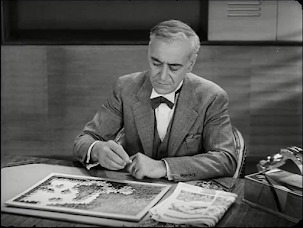
These three frames of the movie show how an aristocratic class, the head of the industries, are spending their leisure time by playing a Jigsaw puzzle which can also be interpreted as the industrialist is playing with the life of the working class people. In the second image we see that the president of an industrial industry is reading a newspaper, a cartoon Section of the newspaper and on the other side of the working class is working hard to run the industry. it indicates the difference in the life of upper class society and the working class society. Working class society have to do a lot of physical hard work while the upper class society do have their leisure time even being the head of the industry, they have their own power and there is no one to control them.


Frame 4: Muscle Power vs Mind Power


This frame suggests the mind power ruling over muscle power. In monarchy muscle power was force, strength with its help kings ruled their nation but in the 20th century mind power ruled to muscle power.


Frame 5/6: Man Vs Machine


The above frame of the movie shows how a man in an industrial world lives a life according to the machine. The president of the industry ordered to increase the speed of a section 5 where our hero the Tramp is tightening the bolt. as the machine speeded the tramp had to increase his speed of tightening the bolt, again and again he is falling behind but he is trying his best to cope up with the speed of a machine and this directly symbolizes how human beings are trying to cope up with the machine and have to run with the machine.

Through this we can also conclude that it is necessary to be smarter than technology. If technology gets smarter than us it will start dominating human beings as here the tramp had to work according to machines which demonstrate machines dominating the tramp. Technology has an ability to enslave human beings if human beings skip following the one direction.


It is a surreal (unreal, unusual) image. But it shows how humans are running according to the machine, working on the fingertips of the machine.


Frame 7: Control


These two frames of the movie suggest how the upper plus society in people had a control over the working class. The working class had to work on the order of their head. They didn't even get a time to freshen up, they had to completely work as a machine. As Josiah Bounderby of the novel 'Hard Times’ considered his workers to be emotionless, faceless “hands”. Here we can clearly see that technology, science, and machines are used to control life. while the main motive of the advancement in technology is to make the life of the people easier but here instead of giving freedom its controlling life.


Frame 8: Mechanization of Man


This video shows how the mechanical life of The Tramp came under the influence of machines and industrialization that he himself couldn't control his body and this resulted Into nervous breakdown of the Tramp in the movie. And he kept on tightening the bolt wherever he could, whether the buttons in the skirt of a lady or the buttons of the men's dress.


Frame 9:


This frame shows the rise of advertisement in the 20th century. A few people from the company came with a feeding machine and with an opinion that if the industry buys this feeding machine workers will work even in recess time the time will not be wasted for lunch. Again we see, technology is not used to make life easy but to increase the physical workload of the workers. When the machine malfunctioned no one was worried about the worker, everyone was busy repairing the machine. The industry was not ready to purchase this machine because it is not practical, not because it is dangerous.


Frame 10:


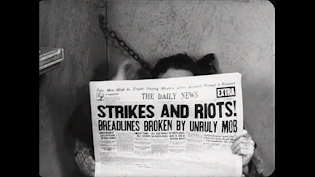
These frames of the movie show how industrialization was at the peak in the period that the unemployed working class people had to fight for their Liberation, for their employment. And the newspaper shows the strikes and riots and it shows the social condition of the 20th century. The Tramp was happy that at least he is getting food and a place to sleep because outside the jail he was unemployed, riots were going on, strikes were going on. He had no food to eat, no shade to live in which shows the image of the 20th century; the working-class didn't have even the basic amenities of life like Roti, Kapda, Makan.


Frame 11: Hunger


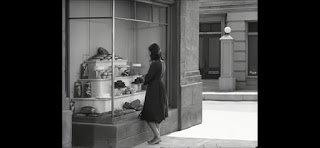
This frame of the movie shows the scenario of the 20th century, socio economic condition of the society. This child, Gamin, is stealing the food she has no mother and her father is unemployed. they don't have anything to eat and the condition is the people had to steal the food for their living. Comparing it with contemporary times we can see that even today, a crore of people need to give free food for their living because they are not employed and don't have money even for buying food.


Frame 12: Fact vs fancy


These images this frames of the movie shows that every working class people unemployed people have their dream life of having a basic necessities like Roti, Kapda, Makan but in real life they didn't had a house to sleep. They found a small house which was breaking now and then and the Tramp was being hurted by it. This clearly shows the socio economic condition of the society that the people were unemployed, there were riots in the society, strikes were going on for liberty and they were deprived of the basic necessities like food shelter and clothes.


Frame 13:


These images show that the Gamin was dancing in the street and then was selected by a bar owner for dancing in his cafeteria. This shows that time didn't permit anyone to follow their hobbies. Everything was to be done within economical insight, financial Insight. Everything done was only for money and The Gamin also started dancing in the cafeteria for money.


Frame 14:


This is the last frame I would like to discuss. In this scene officers were taking The Gamin to the Orphan house forcefully . After the death of Gamin's father her two younger sisters were taken to the orphanage house. This was the idea of the welfare state but the Gamin Escaped from this officer, this cruelty of taking a Orphan child forcedly to the orphanage also seems like enslaving the human being. It is the idea for the Welfare of the human but doing anything forcedly is not for the Welfare through this we can interpret that it even in the name of the Welfare human were enslaved or can be said are forced to follow the rules of the State, Authority or officers. Indicates dictatorial 20th century. 


Reflecting Over the process:
This is the first time where I had tried the frame study of the movie. watching a movie for the means of entertainment and watching the movie for the understanding of the literary text makes a great difference. Charlie Chaplin movie ‘The Modern Times’ is a comedy but watching this movie After studying about the setting of the twentieth century we realize That it is not just mere comedy but it is the reality of the society which prevailed sometime. Watching movies has always been entertaining but studying movies and understanding the framework of the movie seems interesting. It turned out to be a difficult task which needed a lot of thinking and understanding but was delightful.

I hope this blog was useful to you thanks for visiting.


Cited work:

Dickens, Charles. “Hard Times, by Charles Dickens.” Accessed January 30, 2022. https://www.gutenberg.org/files/786/786-h/786-h.htm.

“Framing in Filmmaking - Hollywood Lexicon.” Accessed January 30, 2022. http://www.hollywoodlexicon.com/frame.html.

Guerra. Charlie Chaplin Tempos Modernos Modern Times 1936 Legendado, 2020. https://www.youtube.com/watch?v=_7Blz8AWQXA.

News, A. S. V. “Study Frames of Charlie Chaplin’s Films The Modern Times and The Great Dictator - Asvnews.” Accessed January 30, 2022. https://asvnews.in/study-frames-of-charlie-chaplins-films-the-modern-times-and-the-great-dictator/.


For reading about the framework of the movie ‘The Great Dictator’ by Charlie Chaplin please CLICK HERE

[words- 2050]

My Learnings from the National Workshop on Academic Writing (2026)

The National Workshop on Academic Writing  I recently had the opportunity to participate in the National Workshop on Academic Writing (2026)...