This blog is a response to a task assigned by Megha Trivedi ma’am. This blog deals with Plagiarism.
PLAGIARISM
What is Plagiarism? Write in detail about its consequences, and forms.
PLAGIARISM
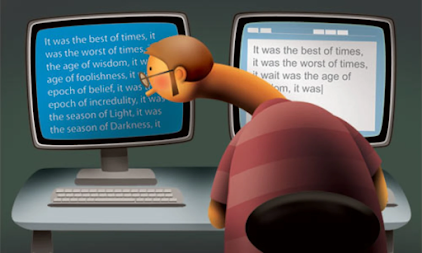
In simple words, Plagiarism means the practice of taking someone else's work or ideas and passing them off as one's own or presenting someone else's work or ideas as your own, with or without their consent, by incorporating it into your work without full acknowledgment.
to steal and pass off (the ideas or words of another) as one's own
to use (another's production) without crediting the source
to commit literary theft
to present a new and original idea or product derived from an existing source
In other words, plagiarism is an act of fraud. It involves both stealing someone else's work and lying about it afterward.
The word plagiarism was derived from the Latin word plagiarius which means ‘kidnapper’ and to plagiarize means ‘to commit literary theft.
Plagiarism involves two kinds of wrongs-
Using another person’s ideas, information, or expressions without acknowledging that person’s work constitutes intellectual theft.
Passing off another person’s ideas, information, or expressions as your own to get a better grade or gain some other advantage constitutes fraud.
CONSEQUENCES
Research has the power to affect opinions and actions, and responsible writers compose their work with great care. They specify when they refer to another's ideas, facts and words, whether they want to agree with, object to, or analyze the source. This kind of documentation not only recognised the work writers do; It also tends to discourage the circulation of errors. But plagiarists undermine these important values.
The charge of plagiarism is serious. Plagiarists are seen as incompetent, and incapable of developing and expressing their own thoughts.
When professional writers like journalists are caught as plagiarists, they are likely to lose their jobs and suffer public embarrassment and loss of prestige.
Students exposed as plagiarists may suffer from severe penalties, failure of assignments, or expulsion from school, which might also damage student-teacher relations and undermine institutional standards for assigning grades and awarding degrees.
Students who plagiarize themselves lose an important opportunity to learn to write a research paper.
Other consequences of plagiarism are:
Destroyed Student Reputation
Destroyed Professional Reputation
Destroyed Academic Reputation
Legal Repercussions
Monetary Repercussions
Academic Penalties
Poor Quality Content
Career Damage
Potential Legal And Criminal Action
FORMS
The most blatant form of plagiarism is to obtain and submit as your own a paper written by someone else.
There are four forms of plagiarism
1. Repeating and Paraphrasing wording
If we take/borrow the whole paragraph or words from the paragraph without documentation or without acknowledgment.
E.g- If we write the sentence from Shakespeare's novel, ‘ "Frailty, thy name is a woman." while writing our idea without citing the original text.
2. Taking a Particular Apt phrase
If we use/ borrow a particle phrase or word given or patented by a particular writer or initiator we need to cite the original text from where we have borrowed the word.
E.g.- The work ‘Chutnification’ is introduced very first time by Salman Rushdie in his work ‘Midnight’s Children’. So if we use this word we need to cite S. Rushdie.
3. Paraphrasing an Argument or Presenting a line of thinking.
Even if we don’t copy-paste a complete phrase or sentence and only take an idea and represent it with our words, it also needs citation.
How to know Plagiarism and how to avoid it. Explain
When you fail to cite your sources or when you cite them inadequately, you commit plagiarism, an offense that is taken extremely seriously in the academic world and is misconduct. Plagiarism is a very serious issue of academia. It severely harms academic integrity. Thus students and researchers are made aware of proper documentation. It can be only avoided by proper citation. Most universities use plagiarism detection software to uncover potential plagiarism and to deter students from plagiarizing. Academic integrity can be maintained by providing students with thorough orientations, required writing courses, and clearly articulated honor codes. By generating a uniform understanding among students and researchers that plagiarism is wrong
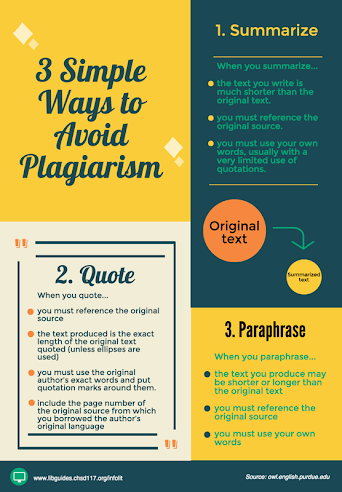
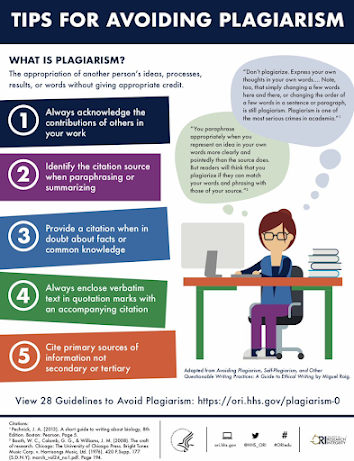
To avoid it the basic points that can be taken care of are:
Practice ethical writing honestly. Keep honesty in all scientific writings.
Crediting all the original sources.
Use quotation marks wherever required
Widely known scientific and historical facts
Avoid self-plagiarism by taking permission from the publisher/ copyright holder of the article.
Keeping track of the sources you consult in your research
Paraphrasing or quoting from your sources (and adding your own ideas)
Crediting the original author in an in-text citation and in your reference list
Using a plagiarism checker (Scribbr, Quetext, Grammarly, uncheck, etc.) before you submit
This blog is a response to a task assigned by Dr. Dilip Barad Sir. The syllabus of the Department of English, MKBU includes paper no.- 208 Comparative Literature and Translation Studies which includes around 9 articles. We (students) are assigned a task of classroom presentation of assigned articles in a pair. In this blog, we are supposed to write abstracts, key points/arguments, and concluding remarks on all two articles of Unit 2 of the paper Comparative Literatures and Translation Studies. It also includes the recording of class presentations presented by respective students. Blogger and her partner have made a presentation on the third article, presentation and a video of a particular article are embedded (as per the task).
Comparative Literature in the Age of Digital Humanities:
On Possible Futures for a Discipline
Todd Presner
The purpose of this chapter is to provide some preliminary signposts for figuring out what Digital Humanities means for the Humanities generally and for Comparative Literature more specifically.
After five hundred years of print and the massive transformations in society and culture that it unleashed, we are in the midst of another watershed moment in human history that is on par with the invention of the printing press or perhaps the discovery of the New World. The state of knowledge completely changed, providing the conditions of possibility for the Reformation, the Enlightenment, the Age of Humanism, and the rise of mass media. the opening up of the New World, Innovations in print technology became the very instrument for producing, sharing, and transforming humanistic and scientific knowledge.
Historicizing these technologies, one which spans the history of seafaring and voyages of discovery to the development of the “ new ” media of radio, film, and television, the construction of the infrastructure of the Internet, the posting of the first web pages, and the explosion of real-time social networking on handheld devices. In this regard, every technology has a dialectical underbelly, facilitating the potential democratization of information and exchange, on the one hand, and the ability to exercise exclusionary control and violence on the other.
Nicholas Negroponte in his book Being Digital- Internet. These technologies of networking and connection do not necessarily bring about the ever-greater liberation of humankind. will not only be used to enhance education, spread democracy, and enable global communication but will likely be used to perpetrate violence and even orchestrate genocide in much the same way that the radio and the railway did in the last century.
Or as Paul Gilroy analyzed- voyages of conquest, enslavement, and destruction. Indeed, this is why any discussion of technology cannot be separated from a discussion about formations of power and instrumentalized authority.
We barely appreciate the profound disciplinary, methodological, and institutional shifts that are occurring as print culture is enhanced and also displaced by the emergence of natively digital culture as contemporary changes are happening rapidly.
N. Katherine Hayles pondering over possible futures for comparative studies wonders how to rouse ourselves from the ‘somnolence [of] five hundred years of print’ in the second decade of the 21st century. While the materiality of the vast majority of artifacts that we study as professors of Comparative Literature has been print, the burgeoning field of electronic literature has necessitated a reconceptualization of “ materiality as the interplay between a text ’s physical characteristics and its signifying practices, ” something that, as Hayles argues, allows us to consider texts as “ embodied entities ” and still foreground interpretative practices
Situating the transformation of the literary in relation to a set of issues that have emerged over the past decade in the “ Digital Humanities” necessitates a fundamental rethinking of how knowledge gets created, what knowledge looks (or sounds, or feels, or tastes) like, who gets to create knowledge, when it is “ done ” or published, how it gets authorized and disseminated, and how it involves and is made accessible to a significantly broader (and potentially global) audience.
The Humanities of the twenty-first century, have the potential to generate, legitimate, and disseminate knowledge in radically new ways, on a scale never before realized, involving technologies and communities that rarely (if ever) were engaged in a global knowledge-creation enterprise.
Digital Humanities is an interdisciplinary practice for creating, applying, interpreting, interrogating, and hacking both new and old information technologies. Digital Humanities is an outgrowth and expansion of the traditional scope of the Humanities, not a replacement or rejection of humanistic inquiry. The role of the humanist is more critical at this historic moment than perhaps ever before, as our cultural legacy as a species migrates to digital formats and our relation to knowledge, cultural material, technology, and society at large is radical re - conceptualized. After all, it is to humanists that we should turn to help us to understand, critique, compare, and historicize.
Jeffrey Schnapp in “ Digital Humanities Manifesto, ”- it is essential that humanists assert and insert themselves into the twenty-first-century cultural wars, which are largely being defined, fought, and won by corporate interests. It questions humanists If new technologies are dominated and controlled by corporate and entertainment interests, how will our cultural legacy be rendered in new media formats? By whom and for whom?
Taking Robert Darnton’s assessment seriously that we are now in the fifth decade of the fourth information age in the history of humankind. Although the Internet is barely forty years old and the World Wide Web is barely two decades old, it is striking to ponder the sheer volume of “ data ” already produced. It is evident that we are producing, sharing, consuming, and archiving exponentially more cultural material, particularly textual and visual data, than ever before in the history of our species. While much of this data is not “ literature ” and may not be studied under the conventional academic rubric of “ Comparative Literature, ” it brings into stark relief the constitution of the tiny canon of print artifacts with which the field currently engages.
Presner's point, following Franco Moretti’s provocation, is to consider Comparative Literature as a “ problem ” that “ asks for a new critical method ” to analyze both the print world in the digital age and the digital world in the post-print age. The “ problem ” of Comparative Literature is to figure out how to take seriously the range of new authoring, annotation, and sharing platforms that have transformed global cultural production.
The central issue is the fact that the artifacts constituted by the world of print are comparatively different – in terms of material composition, authorship, meaning-making, circulation, reading practices, viewing habits, navigation features, embodiment, interactivity, and expressivity – from those artifacts constituted by digital technologies and which “ live ” in various digital environments.
It is to insist on the multiplicity of media and the varied processes of mediation and remediation in the formation of cultural knowledge and the idea of the literary. Just “ studying ” the technologies and their impact, Presner believes that we must actively engage with, design, create, critique, and finally hack the environments and technologies that facilitate this research, render this world as a world, and produce knowledge about who we are, where we live, and what that means.
We will have to design and employ new tools to thoughtfully sift through, analyze, map, and evaluate the unfathomably large deluge of data and cultural material that the digital age has already unleashed.
Moretti has already indicated one possible way of doing this in his articulation of “ distant reading, ” a specific form of analysis that focuses on larger units and fewer elements in order to reveal “ their overall interconnection [through] shapes, relations, structures. Forms. Models. ”
Hayles points out in her recent study on the transforming power of digital humanities, even if we were to read a book a day for our entire adult life, the upper end of the number of books that can be read is about twenty - five thousand, and this does not even take into consideration the reading and composition of digital forms of data and cultural material.
The question that we need to confront in the fourth information age concerns the specificity of the digital medium vis - à - vis other media formats, the various kind of cultural knowledge produced, the ways of analyzing it, the various platforms that support it, and, finally, the modes of authorship and reception that facilitate new architectures of participation and new architectures of power.
Presner discusses the three futures for “ Comparative Literature ” in the Digital Age.
Comparative Media Studies
Digital media are always already hypermedia and hypertextual. Both of the foregoing terms were originally coined in 1965 by the visionary media theorist, Theodor Nelson, in his early articulations of the conceptual infrastructure for the World Wide Web.
For Nelson, hypertext is a:
Body of written or pictorial material interconnected in such a
complex way that it could not conveniently be presented or
represented on paper [ ... ] Such a system could grow
indefinitely, gradually including more and more of the world ’ s
written knowledge.
Hypertextual or hypermedia documents deploy a multiplicity of media forms in aggregate systems that allow for annotation, indefinite growth, mutability, and non-linear navigation. comparative studies investigate all media as information and knowledge systems that are bound up with histories of power, institutions, and governing and regulatory bodies which legitimate and authorize certain utterances while screening out and dismissing others.
Comparative Media Studies also imply that the output or scholarly “ work ” is not uni - medial and might not even be textual. It draws attention to the design and interrelationship of every unit of the argument, whether a page, a folio, a database field, XML metadata, a map, a film still, or something else. Comparative Media Studies enable us to return to some of the most fundamental questions of our field with new urgency: Who is an author? What is work? What constitutes a text, particularly in an environment in which any text is readerly and writerly by potentially anyone?
Comparative Data Studies
By the work of Lev Manovich and Noah Wardrip - Fruin, the field of “ cultural analytics ” has emerged over the past five years to bring the tools of high-end computational analysis and data visualization to dissect large-scale cultural datasets.
Comparative Data Studies allow us to use the computational tools of cultural analytics to enhance literary scholarship precisely by creating models, visualizations, maps, and semantic webs of data that are simply too large to read or comprehend using unaided human faculties. performing “ close ” and “ distant ” analyses of data, Comparative Data Studies also radically broaden the canon of objects and cultural material.
As Jerome McGann argues with elegant analysis of “radiant textuality, ” the differences between the codex and the electronic versions of the Oxford English Dictionary, for example, illustrate that the electronic OED is “ a meta book [that has] consumed everything that the code OED provides and reorganized it at a higher level ” adding value through new indexing and search mechanisms, hyperlinks, editing and annotation tools, and even reading strategies.
The “ data ” of Comparative Data Studies is constantly expanding in terms of volume, data type, production and reception platform, and analytic strategy.
Comparative Authorship and Platform Studies
While the radically “ democratizing ” claims of the web and information technologies should certainly be critically interrogated. We no longer just “ browse ” and passively consume predigested content but are actively engaged in the production, annotation, and evaluation of digital media and software thanks to the open-source movement.
The real danger is not unauthorized file sharing but “ failed to share” due to enclosures and
strictures placed upon the world of the creative commons. The knowledge platforms cannot be simply “ handed off ” to the technicians, publishers, and librarians, as if the curation of knowledge – the physical and virtual arrangement of information as an argument through multimedia constellations – is somehow not the domain of literary scholars. While preserving the authority of peer review, the publication platform foregrounds collaborative authorship and public feedback through threaded discussion forums and annotation features.
This emphasis on openness and collaboration is, of course, nowhere more apparent than with Wikipedia, a revolutionary knowledge production and editing platform. While it is easy to dismiss Wikipedia as amateurish and unreliable or to scoff at its lack of scholarly rigor.
Presner believes-
Wikipedia represents a truly innovative, global, multilingual, collaborative knowledge - generating community and platform for authoring, editing, distributing, and versioning knowledge.
To date, it has more than three million content pages, more than three hundred million edits, over ten million registered users, and articles in forty - seven languages.
Conclusion:
Presner concludes by suggesting that it is actually a model for rethinking collaborative research and the dissemination of knowledge in the Humanities and at institutions of higher learning, which are all - too - often fixated on individual training, discrete disciplines, and isolated achievement and accomplishment.
At this moment in its short life, Wikipedia is already the most comprehensive, representative, and pervasive participatory platform for knowledge production ever created by humankind. In my opinion, that is worth some pause and reflection, perhaps even by scholars in a future disciplinary incarnation of Comparative Literature.
Video recording of this article's presentation, presented by my classmates Vachchhalata Joshi and Hirva Pandya
Presentation of the article by Vachchhalata Joshi and Hirva Pandya
It is common to find it challenging to read original articles and summarize them. As a result, I have simplified this article through my understanding and with the help of ChatGPT. Simplifying articles is helpful in achieving a better and clearer understanding of the concept, which will make reading the original article easier. The main aim is to help students or readers understand the concept so that they can read the original article with ease. CLICK HERE FOR A LAYMANISED ARTICLE.
This blog is a response to a task assigned by Dr. Dilip Barad Sir. The syllabus of the Department of English, MKBU includes paper no.- 208 Comparative Literature and Translation studies which includes around 9 articles. We (students) are assigned a task of classroom presentation of assigned articles in a pair. In this blog we are supposed to write abstract, key points / arguments and concluding remarks on all two articles of Unit 2 of paper Comparative Literatures and Translation Studies. It also includes the recording of class presentations presented by respective students. Blogger and her partner have made a presentation on the third article, presentation and a video of a particular article is embedded (as per the task).
ARTICLE 1
Introduction: What is Comparative Literature today?
Susan Basnett
This article is an Introduction chapter of Susan Basnett’s book ‘Comparative Literature- A critical Introduction, 1993’. The article begins with the simple answer to What is Comparative studies? The study of texts across cultures, that it is interdisciplinary and that it is concerned with the patterns of connection in literature across both time and space.
The journey of comparative studies begins with the desire to move beyond the boundaries of a single subject area or may be impelled to follow up what appear to be similarities between texts and authors from different cultures.
Mathew Arnold in Inaugural Lecture at Oxford in 1857 said-
Everywhere there is connection, everywhere there is illustration. No single event, no single lecture is adequately comprehended except in relation to other events, to other lectures.
One can assume that comparative literature is nothing more than common sense, a stage of reading by the availability of translations. But if we slightly change our perspective we find a history of debate that goes right back to the usage of the term at the beginning of the nineteenth century and still continues today.
What is the object of the study in comparative literature?
How can comparison be the objective of anything?
If individual literatures have canon, what might a comparative canon be?
How can a comparatist select what to compare ?
Is comparative literature a discipline? Or is it simply a field of study ?
Since the 1950s, we frequently hear about what Rene Wellek defined as ‘the crisis of comparative literature’. (And the crisis of comparative literature in the West pushes Susan Basnett to write this article. Comparative Literature began with the rise of National consciousness/ nationalism now it seems to be dying in the West but is increasing in the East, post- colonial countries.)
In 1903, Benedetto Croce argued that the term Comparative Literature was obfuscatory, disguising the obvious and the true object of study of Literary history. He claimed that he could not distinguish between Literary history pure and simple and comparative Literary History.
But in the same ear of Croce’s attack Charles Mills Gayley proclaimed working premise of the working student of Comparative Literature was:
“Literature as a distinct and integral medium of thought, a common
institutional expression of humanity; differentiated, to be sure,
by the social conditions of the individual, by racial, historical,
cultural and linguistic influences, opportunities, and restrictions, but,
irrespective of age or guise, prompted by the common needs
and aspirations of man, sprung from common faculties,
psychological and physiological, and obeying common laws
of material and mode, of the individual and social humanity."
Francis Jost claimed that comparative literature is ‘an overall view of literature, of the world of letters, a humanistic ecology, a literary Weltanschauung, a vision of the cultural universe, inclusive and comprehensive'. Comparative Literature is as some kind of world religion, Instrument of universal harmony.
Wellek and Werren in their ‘Theory of Literature’ (1949) suggested
Comparative Literature... will make high demands on the linguistic proficiencies of our scholars. It asks for a widening of perspectives, a suppression of local and provincial sentiments, not easy to achieve.
For Wellek and Warren go on to state that 'Literature is one; as art and humanity are one'. A decade after Theory of Literature appeared, Wellek was already talking about the crisis in comparative literature.
The great waves of critical thought that swept through one after the other shifted attention away from the activity of comparing texts and tracking patterns of influence between writers towards the role of the reader. And as each new wave broke over the preceding one, notions of single, harmonious readings were shattered forever.
In the 1950s and early 1960s, high-flying graduate students in the West turned to comparative literature as a radical subject, because at that time it appeared to be transgressive. By the late 1970s a new generation of high-flying graduate students in the West had turned to Literary Theory, Women's Studies, Semiotics, Film and Media Studies and Cultural Studies as the radical subject choices, abandoning Comparative Literature. Yet even as that process was underway in the West, comparative literature began to gain ground in the rest of the world, Post- colonial countries. However, not on any ideal of universalism but on the very aspect of literary study that many western comparatists had sought to deny: the specificity of national literatures.
Swapan Majumdar says-
‘It is because of this predilection for National Literature - much
deplored by the Anglo-American critics as a
methodology - that Comparative Literature has struck
roots in the Third World nations and in India in particular.’
Ganesh Devy also suggests that comparative literature in India is directly linked to the rise of modern Indian Nationalism.
Homi Bhabha sums up the new emphasis in an essay discussing the ambivalence of post- colonial culture, suggesting that:
‘Instead of cross-referencing there is an effective,
productive cross- cutting across sites of
social significance, that erases the dialectical, disciplinary
sense of 'Cultural' reference and relevance’.
Wole Soyinka and a whole range of African critics have exposed the pervasive influence of Hegel, who argued that African culture was 'weak' in contrast to what he claimed were higher, more developed cultures, and who effectively denied African history.
Today we have a very varied picture of comparative literary studies that changes according to where it is taking place.
Terry Eagleton's explanation of the rise of English ties in with the aspirations of many of the early comparatists for a subject that would transcend cultural boundaries and unite the human race through the civilizing power of great literature. As the question of what to include and exclude from an English syllabus is a very vexed one, Comparative Literature has been called into question by the emergence of alternative schools of thought.
The vexed question of Shakespeare in India, a canonical writer hailed in the nineteenth century as the epitome of English greatness. Indian students have the problem therefore of dealing with Shakespeare not only as a great figure in European literature, but also as a representative of colonial values: two Shakespeare's, in effect, and in conflict with one another. One way of tackling this problem is to treat Shakespeare comparatively, to study the advent of Shakespeare in Indian cultural life and to compare his work with that of Indian writers.
The growth of national consciousness and awareness of the need to move beyond the colonial legacy has led significantly to the development of comparative literature in many parts of the world, even as the subject enters a period of crisis and decay in the West.
Ganesh Devy's argument that comparative literature in India coincides with the rise of modern Indian nationalism is important, because it serves to remind us of the origins of the term 'Comparative Literature' in Europe, a term that first appeared in an age of national struggles, when new boundaries were being erected and the whole question of national culture and national identity was under discussion throughout Europe and the expanding United States of America.
Another rapidly expanding development in literary studies, and one which has profound implications for the future of comparative literature, is 'translation studies. Comparative literature has traditionally claimed translation as a sub-category, but this assumption is now being questioned. The work of scholars such as Toury, Lefevere, Hermans, Lambert and many others has shown that translation is especially significant at moments of great cultural change.
Evan- Zohar argues that extensive translation activity takes place when a culture is in a period of transition: when it is expanding, when it needs renewal, when it is in a pre-revolutionary phase, then translation plays a vital part. In contrast, when a culture is solidly established, when it is in an imperialist stage, when it believes itself to be dominant, then translation is less important.
As English became the language of international diplomacy in the twentieth century (and also the dominant world commercial language), there was little need to translate, hence the relative poverty of twentieth-century translations into English compared with the proliferation of translations in many other languages. When translation is neither required nor wanted, it tends to become a low status activity, poorly paid and disregarded
Comparative literature has always claimed translation as a sub-category, but as translation studies establishes itself firmly as a subject based in inter-cultural study and offering a methodology of some rigor, both in terms of theoretical and descriptive work, so comparative literature appears less like a discipline and more like a branch of something else. Seen in this way, the problem of the crisis could then be put into perspective, and the long, unresolved debate on whether comparative literature is or is not a discipline in its own right could finally and definitely be shelved.
Video recording of this article's presentation, presented by my classmates Janvi Nakum and Nidhi Dave
Presentation of the article by Janvi Nakum and Nidhi Dave
It is common to find it challenging to read original articles and summarize them. As a result, I have simplified this article through my understanding and with the help of ChatGPT. Simplifying articles is helpful in achieving a better and clearer understanding of the concept, which will make reading the original article easier. The main aim is to help students or readers understand the concept so that they can read the original article with ease. CLICK HERE FOR A LAYMANISED ARTICLE.
This blog is a response to a task assigned by Dr. Dilip Barad Sir. The syllabus of the Department of English, MKBU includes paper no.- 208 Comparative Literature and Translation studies which includes around 9 articles. We (students) are assigned a task of classroom presentation of assigned articles in a pair. In this blog we are supposed to write abstract, key points / arguments and concluding remarks on all three articles of Unit 1 of paper Comparative Literatures and Translation Studies. It also includes the recording of class presentations presented by respective students. Blogger and her partner have made a presentation on the third article, presentation and a video of a particular article is embedded (as per the task).
ARTICLE 1
Why Comparative Indian Literature?
Sisir Kumar Das
Detailed concept of article:
Article begins with an idea of attempt of finding unity is literature of India, the beginning of the century a group of scholars have been trying to project the idea of Indian literature emphasizing the underlying unity of themes and forms and attitudes among the various literature produced in different Indian languages to discover the essential threads of unity in our multilingual and multi religious country. It is commendable but these attempts in discovering the basic unity of the Indian creative mind are made at the risk of ignoring the plurality of expressions in our creative minds.
Recently a group of scholars is talking of ‘Comparative Indian Literature’ to add a new dimension to our literary studies. However one wonders, Whether it is being used to lend some respectability to the study of Indian language by linking up with comparative literature, a western discipline or indeed to indicate the proper framework within which Indian literature can be studied. The goal of a newly emerged discipline, comparative literature, is to visualize the total itinerary activities of man as a single universe.
Goethe spoke about Weltliteratur instead of European literature in 1827, perhaps attempting to bring together the literature of different civilizations; he was the first man in history to speak of Weltliteratur . Goethe in a conversation with Eckermann on 31st January 1827 said, “National literature is now rather an unmeaningful term, the epoch of world literature is at hand, and everyone must strive to Hasten its approach.” He did not tell us how to hasten the approach of world literature but we assume that by world literature he meant the memorable works in all languages of the world, rather than the assemblage of all literature.
The goal of comparatist is also world literature but not in the sense that Goethe or R. Tagore had used it but in the sense of literary traditions. The comparatist knows that comparative literature is a method of investigation while world literature, as Goethe meant, is a body of valuable literary works. Comparative literature differs from the study of single literature not in method but in matter, attitude and perspective. it can go on extending its area of operation- its ultimate limit is the literatures of the whole world. Its strength and its weakness lie in its cosmopolitanism (the concept that all of humanity could (and should) belong to a single community.)
Yet from the last hundred years Western comparatist has kept itself restricted to Western literature. If one goes through the enormous corpus of western work produced by them one would wonder about their awareness of the existence of any literature other than their. How is it that the votary of Cosmopolitanism is literary study is a pathetic victim of parochialism (narrow- mindedness)? The contact between West and East Literature began early in history.
Europe came to know of Hebrew Literature the day it accepted Christianity.
The ‘Panchtantra’ reached Europe through its Arabian and Syrian version before The Renaissance.
Cordova in Spain in the eleventh century was the center for Arabic literature.
By the end of the 18th century, Europe discovered Sanskrit, which brought about a revolution in linguistics.
When comparative literature was established in the universities of Europe and America translation of many works in Chinese and Japanese and of course in Arabic and Persian were available in European languages
Francois Jost admits that “Western criticism… is still reluctant to integrate into the Corpus literature, the literature of so-called Exotic continents for no reason other than ignorance of Exotic civilizations and languages.
Das says- But it cannot be only because of ignorance; it is more because of indifference, if not because of prejudice against these exotic civilisations to some extent. to plead ignorance of eastern literature made a euphemism for Macauleyean arrogance; The result is that comparative literature in the West began as compared to Western literature and it remains so even today.
Das is ready to admit that the charge of Eurocentrism against the western comparatist is unfair and that his choice of European literatures as the main area of investigation has been prompted more by pragmatism than by prejudice against oriental literatures. Ulrich Weinsstein expressed his hesitation to extend ‘the study of parallels of phenomena pertaining to two different civilizations’, reacting to Henry Remak’s definition of comparative literature which embraces a very wide field and Etiemble’s call for widening the scope of comparative literature. The academic justification for excluding Oriental literatures from comparative literature in the West comes from the necessity ‘to avoid all ahistorical parallels based solely on speculation’. Although there is no reason why such studies will necessarily be based on speculation, one considers the necessity of delimiting the area of comparative literature on the basis of certain principles. If the criteria of Civilization be accepted as a sound one, the European comparatist is within his rights to make Western literature a sole area of his investigation. If they prefer to remain ignorant about other literatures; our comparative literature comprising the study of Indian literature will be as valid as comparative literature in the West.
One can also argue that comparative Western literature is the study of different National literature, while comparative Indian literature is the study of literature of one Nation. Is not Comparative Indian Literature a retrograde step so far as the basic premise of Comparative literature is concerned?
When Europe defined Comparative Literature in terms of national literatures, it only thought of European Nation-states which are monolingual. Today when we talk about India, a nation- state or Soviet Union it consists of several nationalities with different languages, and is multilingual. Neither language or political boundary nor culture can be the sole criteria of Comparative literature. Comparative Literature has to be both Inter Linguistic and Intra Linguistic. If we agree to make language a sole Criterion of for the identification of literatures, we will certainly gain one kind of homogeneity, perhaps a tangible one but the idea of cultural homogeneity on which Western comparative literature rests will fall apart. Even if the exponents of comparative literature insist on the study of the relationship between different National literatures rather than other literatures of any group of people then they have to come to terms with nations which have a lot of literature or with National literature within many languages. e.g. India
Das talks about Comparative Indian Literature as a valid area in comparative literature not because Comparative literature in the West is exclusively a study of western literature. we should try to resist all parochialism in literary studies. Whatever be the goal of comparative literature it must be Terra Firma- a solid ground. Literature deals with the concrete, not with abstractions. It is born of language and yet it goes beyond language; it is nourished by a culture. Any attempt towards a literary belief that cosmopolitanism neglects the literature or literatures that are components of a cultural history is bound to turn into dilettantism. The lesson we must learn from the Western comparatist is the lesson of vigilance against dilettantism. Our comparative literature must be comparative Indian literature because nothing else can be the basis for our literary study. This is not chauvinism, but only an affirmation of the relation between literature and people. We cannot study literature as a body of impersonal knowledge without any relation to the people or to the time to which we belong.
Another argument: Will not the study of Indian literature alone breed a kind of literature Patriotism or a critical parochialism which must be avoided?
Multilingualism is a fact of Indian society and Indian literature. Indian not only have different languages interacted with each other but also gave the rise to new literary style such as manipravala but have also given birth to the new language and literature, example Urdu;
not only have writers used two languages simultaneously but also who have switched from one language to another;
not only do we have text which has been claimed as their own by different linguistic Groups (Charya songs, Mirabai songs) but text has been written in more than one languages e.g. Sanskrit plays.
There is hardly any society where we see that the languages belonging to so many families have been operated side by side and have interacted with each other for so many centuries
Inherent nature of Indian literature, or of Indian literature demands a wide literary perspective and there is no reason why the Indian comparatist should confine himself to his own literature. Comparative Indian literature not only justifies the need for a literary study but it provides the comparative study of literature with new range and vision. A text like Meghnavadham Kavya, unique in the history of literary relations involving two different Civilizations or the emergence of implied tragedy and the novel in India was a challenge to the Indian comparative to study Indian literature in relation to ancient Greek and modern European literature respectively. Indian literature is not merely Indian.
Video recording of this article's presentation, presented by my classmates Divya Sheta and Aamena Rangwala
Presentation of the article by Divya Parmar and Mayuri Pandya
In a recent article, ‘Towards comparative Indian literature’, Amiya Dev said, ‘Comparison is the right reason for us because, one, we are multilingual and two, we are third world.’ The effect of multilingualism is more or less appreciated by Indians scholars. The third world situation that lends Indian comparative literature of greater validity may need further comments. He points out that the tools of Western comparison are hardly adequate to deal with our literary situation. For example, the categories ‘influence’ and ‘imitation’ and ‘reception’ and ‘survival’ need serious modification to suit the third world literary situation. The third world situation has imposed certain psychological restrictions on us. Our idea of comparative literature will emerge only when we take into account the historical situation in which we are placed. Our journey is not from comparative literature to comparative Indian literature but from comparative Indian literature to comparative literature
It is common to find it challenging to read original articles and summarize them. As a result, I have simplified this article through my understanding and with the help of ChatGPT. Simplifying articles is helpful in achieving a better and clearer understanding of the concept, which will make reading the original article easier. The main aim is to help students or readers understand the concept so that they can read the original article with ease. CLICK HERE FOR A LAYMANISED ARTICLE.
This blog is a response to a task assigned by Dr. Dilip Barad Sir. The syllabus of the Department of English, MKBU includes paper no.- 208 Comparative Literature and Translation studies which include around 9 articles. We (students) are assigned a task of classroom presentation of assigned articles in a pair. In this blog we are supposed to write abstract, key points/arguments and concluding remarks on all three articles of Unit 1 of paper Comparative Literatures and Translation Studies. It also includes the recording of class presentations presented by respective students. Blogger and her partner have made a presentation on the third article, presentation and a video of a particular article is embedded (as per the task).
In his article, "Comparative Literature in India," Amiya Dev bases his discussion on the fact that India has many languages and literatures thus representing an apriori situation and conditions of diversity. He therefore argues that to speak of Indian literature in the singular is problematic. Nonetheless, Dev also observes that to speak of Indian literature in the plural is equally problematic. Such a characterization, he urges, either overlooks or obscures manifest interrelations and affinities. His article compares the unity and the diversity thesis, and identifies the relationship between Indian commonality and differences as the prime site of comparative literature in India. He surveys the current scholarly and intellectual positions on unity and diversity and looks into the post-structuralist doubt of homogenization of differences in the name of unity. Dev also examines the search for common denominators and a possible pattern of togetherness and Dev underlines location and located inter-Indian reception as an aspect of inter-literariness. It is t/here Dev perceives Indian literature, that is, not as a fixed or determinate entity but as an ongoing and inter literary process: Indian language and literature ever in the re/making.
Comparative Literature in India (Detailed points from article):
In this article, Amiya Dev is discussing an a priori location of comparative literature with regard to aspects of diversity and unity of India. Scholars of literature either for unity of Indian literature or for a diversity and distinctiveness of the literatures of India. Instead of this binary approach, Dev's proposal involves a particular view of the discipline of comparative literature because he argues that in the case of India the study of literature should involve the notion of interliterary process and a dialectical view of literary introduction. According to census and Sahitya Academy there are a total 22 major languages in India and literature in all these languages. In general, the perspective of India as a hegemonic language and literature area is ubiquitous.
We have a plurality of so-called major literatures in India, we are confronted by a particular problem: Is Indian literature, in the singular, a valid category, or are we rather to speak of Indian literatures in the plural?
Literary histories written in India by Indian scholars also focused and still focus on a single literature. This single-focus perspective is a result of both a colonial and a post-colonial perspective, the latter found in the motto of the Sahitya Akademi: "Indian literature is one though written in many languages" (Radhakrishnan). However, this perspective was opposed by scholars who argued that a country where so many languages coexist should be understood as a country with literature (in the plural). Presently, a different kind of resistance has emerged to the unity thesis in the form of what may be called "hegemonic apprehensions." In brief, arguments of unity in diversity are in Dev’s opinion suspect, for they encroach upon the individualities of the diverse literatures. In other words, a cultural relativist analogy is implied here, difference is underlined and corroborated by the fact that both writers and readers of particular and individual literatures are overwhelmingly concerned with their own literature and own literature only. It is from this perspective the Academy's motto "Indian literature is one though written in many languages," the retort is "Indian literature is one because it is written in many languages."
Dev mentions Gurbhagat Singh who has been discussing the notion of "differential multilogue". He rejects the notion of Indian literature because the notion as such includes and promotes a nationalist identity. As a relativist, Singh accords literatures not only linguistic but also cultural singularities. With regard to the history of comparative literature as a discipline, he rejects both the French and the American schools as well as the idea of Goethe's Weltliteratur. His insistence on the plurality of logoi is particularly interesting because it takes us beyond the notion of dialogue, a notion that comparative literature is still confined to; enabling us to understand Indian diversity without sacrificing the individualities of the particulars.
Singh's notion of differential multilogue reflects a poststructuralist trend in Indian discourse: poststructuralism understands difference as a notion of inclusion, that is, mutuality. Thus, it cannot accept the single-focus category "Indian" without deconstructing its accompanying politics. If Indian literature had not been so heavily publicized and hammered down, as it were, into our national psyche, if our individual literatures had been left alone and not asked to pay their dues to "Indian literature," there would be no resistance to the notion of unity in diversity.
Ironically, Indian poststructuralism inflicts upon itself a sameness with difference- speakers elsewhere and does not seem to recognize that difference-speaking in India may be different from difference-speaking elsewhere. At the same time, this poststructuralism does not seem to recognize that given all the differences pertaining to the Indian experience, underlying it and tying together the different entities, there may be a commonality, a sensus communis of a broadly cultural kind.
Jaidav develops an argument for this cultural differential approach. Jaidev's notion of an Indian sensus communis is instances of "national" and racial image formations which suggest homogeneity and result in cultural stereotyping. The concept of an Indian sensus communis in the context of Singh's differential multilogue or Jaidev's differential approach brings me to the question of situs and theory. That is, the "site" or "location" of theory and of the theorist are important factors. If situs means cultural and linguistic rootedness then the notion of commonality is applicable.
Jaidev's concept of oneness provides an ambience for particular concerns with regard to cultural and artistic expression such as the case of language overlaps, the bi- and multilinguality of authors and their readership, openness to different genres, the sharing of themes based in similar social and historical experiences, emphasis on the oral and performing modes of cultural and artistic transmission, and the ease of inter-translatability. On the other hand, Jaidev suggests these characteristics of Indian cultural commonalities are rooted in a situs of the premodern age of Indian literatures.
Aijaz Ahmad's In Theory: Classes, Nations, Literatures describes the construct of a "syndicated" Indian literature that suggests an aggregate and unsatisfactory categorization of Indian literature. Ahmad argues the notion of "European literature" is at best an umbrella designation and at worst a pedagogical imposition while Indian literature is classifiable and categorizable.
Further, he argues that while European and African literatures have some historical signifiers in addition to their geographical designation, these are recent concepts whereas Indian homogeneity has the weight of tradition behind it. In Ahmad's argumentation, the problem is that in the "Indian" archive of literature, Indianness ultimately proves limited when compared with the differential literature comprising each of the twenty-two literatures recognized by the Sahitya Akademi.An "Indian" archive of literature as represented by an "English" archive -- while non-hegemonic on the one hand by removal from a differential archive but hegemonizing by a latent colonial attitude on the other – also reflects the official language policy of the government: English, while not included in the Indian Constitution, is still recognized as a lingua franca of government, education, etc.
V.K. Gokak and Sujit Mukherjee who were speaking of an Indo-English corpus of literature that was created out of English translations of major texts from major Indian languages.
Ahmad's concern is with the hegemony of English, although he does not suggest its abolition in a way which would be close to Ngugi's arguments. It is true that the ideal of one language in India has been made real by now by ideological and political mechanisms. The official national language is Hindi and if literary texts from the other languages could be translated into Hindi, we could possibly arrive at a national Indian literature. However, in this case we would again arrive at a hegemonizing situation. On the other hand, it is clear that in the realm of education, English is the largest single language program in our colleges and universities.
Swapan Majumdar takes this systemic approach in his 1985 book, ‘Comparative Literature: Indian Dimensions, where Indian literature is neither a simple unity as hegemonists of the nation-state persuasion would like it to be, nor a simple diversity as relativists or poststructuralists would like it to be. He suggests that Indian literature is neither "one" nor "many" but rather a systemic whole where many subsystems interact towards one in a continuous and never-ending dialectic.
Same route of literary history, Sisir Kumar Das has taken with his planned ten-volume project, A History of Indian Literature, whose first volume, 1800-1910: Western Impact / Indian Response, appeared in 1991.
The underlying and most important finding is a pattern of commonality in nineteenth-century Indian literatures. Das's work on the literatures of the nineteenth century in India does not designate this Indian literature a category by itself. Rather, the work suggests a rationale for the proposed research, the objective being to establish whether a pattern can be found through the ages. One age's pattern may not be the same as another age's and this obviously preempts any given unity of Indian literature. Thus, Das's method and results to date show that Indian literature is neither a unity nor is it a total differential.
In many ways, Das's work is similar to K.M. George's two-volume Comparative Indian Literature of 1984-85. George's work was not as comprehensive as Das's: it only dealt with fifteen literatures and that too in a limited way. In Dev’s view George's work also demonstrates Western hegemony. For example Poetry was discussed in terms of "traditional" and "modern" but as if traditional was exclusively Indian and modern the result of a Western impact. Another problem of George's two volumes was that although they were titled Comparative Indian Literature, there was no comparison built into the findings and the fifteen individual literatures were placed simply side by side.
The Gujarati poet Umashankar Joshi -- a supporter of the unity approach -- was the first president of the Indian National Comparative Literature Association, and the Kannada writer U.R. Anantha Murthy is the current president of the Comparative Literature Association of India. Comparatists reflect the binary approach to the question of Indian literature as explained above. However, the Association also reflects a move toward a dialectic. The method of Comparative Literature allows for a view of Indian literature in the context of unity and diversity in a dialectical inter literary process and situation.
Dev suggests other aspects which support his understanding of Indian literature in an inter literary process: we are located in our own languages -- whether with an active or passive bilinguality -- where we have access to one or two other languages. Through inter-Indian translation we have also access to texts from a fourth and more languages. Now, as readers, consciously or subconsciously we place the texts in additional languages beside our original and first text. Inter-Indian reception presupposes that our situs is in our first text, that is, first language literature.
Video recording of this article's presentation, presented by my classmates Divya Parmar and Mayuri Pandya
Presentation of the article by Divya Parmar and Mayuri Pandya
In the concluding part of the article, Amiya Dev assures the readers, scholars and the students that the problems of unity and diversity are not unique to India. He discussed that if, for instance, Canadian diversity, it would have been from the outside, that is. from an Indian situs. Comparative Literature has taught us not to take comparison literally and it also taught us that theory formation in literary history is not universally tenable. He suggested that we should first look at ourselves and try to understand our own situations as thoroughly as possible. Let us first give full shape to our own comparative literature and then we will formulate a comparative literature of diversity in general.
It is common to find it challenging to read original articles and summarize them. As a result, I have simplified this article through my understanding and with the help of ChatGPT. Simplifying articles is helpful in achieving a better and clearer understanding of the concept, which will make reading the original article easier. The main aim is to help students or readers understand the concept so that they can read the original article with ease. CLICK HERE FOR A LAYMANISED ARTICLE.