Wednesday, 24 July 2024

Environmental Studies 3- Environment

 ENVIRONMENT


The word ‘environment’ is derived from the French word 'environ', meaning to encompass or encircle. It refers to ‘entoure’, or that which surrounds us. The human environment includes biotic (living), abiotic (nonliving), and socioeconomic factors, all of which interact to shape our surroundings and influence our lives.


Various Spheres of Earth
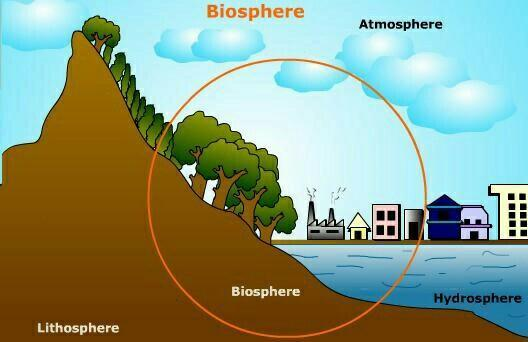
1. Lithosphere:

The lithosphere is the solid outer layer of the Earth, encompassing the crust and the uppermost part of the mantle. It is composed of rocks and minerals and is where we find landforms like mountains, valleys, and plains. This layer is crucial for providing natural resources such as minerals and fossil fuels, and it supports terrestrial life.


2. Atmosphere:

The atmosphere is the layer of gases surrounding Earth, extending from the surface into space. It is composed mainly of nitrogen and oxygen, with traces of other gases. The atmosphere is vital for life, providing the air we breathe, protecting us from harmful solar radiation, and regulating the planet's climate through the greenhouse effect.


3. Hydrosphere:

The hydrosphere includes all the water on Earth's surface, such as oceans, lakes, rivers, and glaciers, as well as groundwater. Water in the hydrosphere is essential for all living organisms and plays a key role in weather patterns and climate regulation. It is also crucial for various human activities, including agriculture, industry, and recreation.


4. Biosphere:

The biosphere encompasses all living organisms on Earth, from the deepest ocean trenches to the highest mountain peaks. It includes all ecosystems and the interactions between different forms of life and their environments. The biosphere is the global sum of all ecosystems and is essential for maintaining the balance and sustainability of life on the planet.


5. Cryosphere:

The cryosphere consists of all the frozen water on Earth, including ice caps, glaciers, sea ice, and permafrost. This sphere is crucial for regulating the Earth's climate by reflecting solar radiation and influencing ocean currents. The cryosphere also plays a significant role in the global water cycle and provides habitats for specialized forms of life.


6. Anthroposphere:

The anthroposphere, or technosphere, includes all human made structures and activities, such as cities, infrastructure, and technology. This sphere represents the human impact on the Earth and its systems. It is closely linked with the biosphere, lithosphere, atmosphere, and hydrosphere, as human activities significantly influence and are influenced by these natural systems.


Various Spheres of the Atmosphere

1. Troposphere:

The troposphere is the lowest layer of Earth's atmosphere, extending from the surface up to about 815 kilometers (59 miles) high. This is where most weather events occur, and it contains the air we breathe. Temperature decreases with altitude in this layer, which holds about 75% of the atmosphere's mass.


2. Stratosphere:

The stratosphere lies above the troposphere, reaching up to about 50 kilometers (31 miles) high. This layer contains the ozone layer, which absorbs harmful UV radiation and causes temperatures to rise with altitude. The stratosphere is stable and free of weather disturbances, making it ideal for high altitude flights.


3. Mesosphere:

The mesosphere extends from 50 kilometers (31 miles) to 85 kilometers (53 miles) above Earth. It is the coldest atmospheric layer, with temperatures decreasing with altitude. This layer is where meteors burn up upon entering the atmosphere, creating bright trails.


4. Thermosphere:

The thermosphere ranges from 85 kilometers (53 miles) to 600 kilometers (373 miles) high. Temperatures increase significantly with altitude due to the absorption of high-energy radiation. The thermosphere includes the ionosphere, important for radio communication and satellite operations, and is the site of the auroras.


5. Exosphere:

The exosphere is the outermost layer, starting around 600 kilometers (373 miles) above Earth and extending into space. It has very low density, with particles so sparse they rarely collide. The exosphere gradually fades into the vacuum of space and is where many satellites orbit.



Read in detail about

Thanks for visiting. I hope this blog was useful. Keep Learning.

Environmental Studies 2- Ecology

 ECOLOGY

  • Ecology is the science that studies the relationships between living things and their environment. It studies the structure and functions of nature. It is often considered to be a part of biology.
  • Ecology is relatively a recent discipline. The German biologist Ernst Haeckel coined the term in 1866. He defined it as 'the comprehensive science of the relationship of the organism to the environment.' 
  • The Danish botanist, Eugenius Warming, wrote the first textbook on the subject.
  • The term ecology is derived from two Greek words namely oikos meaning house or place to live and logos meaning study of. Ecology is the scientific study of interrelationships and interactions between different living organisms and their nonliving environment. In fact, it is the study of connections in nature.


Objectives of Ecological Study:

The primary objective of ecology is to understand the interrelationship and interdependence of biotic and abiotic parts of the environment.

Some of the objectives can be enlisted as under:

  • To understand the interrelationships between organisms in population and diverse communities.

  • To study the effect of temporal (related to time) changes (seasonal, annual, successional, etc.) in the occurrence of organisms.

  • To study the behavior of the organisms under natural conditions.

  • To study the structural adaptations and functional adjustments of organisms to their physical environment.

  • To understand the biological productivity and energy flow in the natural system.


Divisions of Ecology:

There are two important divisions of Ecology namely

(1) Autecology and (ii) Synecology 

Autecology of Species Ecology is the study of individual species, their behavior and adaptation (adjust to be suitable for a new use or condition) to the environmental conditions

Synecology or Community Ecology refers to the study of different communities (groups of organisms that are associated together as a unit) , their composition, their behavior and relation to the environment. eg study of trees in a forest.


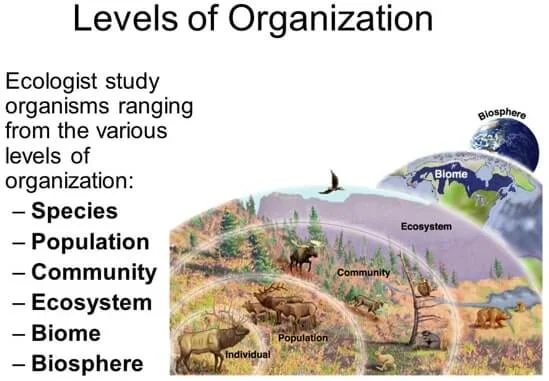
Levels of Organization in Ecology

1. Individual (Organism):

The individual level in ecology refers to a single living entity, such as a plant, animal, or microorganism. This level focuses on the basic unit of study in ecology, where the primary concern is understanding how an individual organism interacts with its environment. This includes studying its behavior, physiology, and life cycle. For example, researchers might study how a particular species of bird builds its nest, forages for food, or migrates during different seasons.


2. Population:

A population consists of a group of individuals of the same species that live in a specific geographical area. At this level, ecologists study various aspects such as population size, density, and dynamics, including birth rates, death rates, and migration patterns. Understanding populations helps in comprehending how species interact with each other and their environment, and how they adapt to changes. For instance, studying the population of deer in a forest can provide insights into their reproductive strategies, habitat preferences, and the impact of predation.


3. Community:

The community level includes different populations of species that live together in a common environment and interact with each other. This level of organization focuses on the relationships and interactions between species, such as predation, competition, and symbiosis. Communities are dynamic and can change in response to various factors like environmental changes or human activities. An example of community study might involve examining how various plant species in a meadow compete for sunlight and nutrients, and how herbivores and pollinators interact with these plants.


4. Ecosystem:

An ecosystem encompasses the community of living organisms (biotic factors) and their interactions with the nonliving (abiotic) components of their environment, such as air, water, and soil. This level is crucial for understanding the flow of energy and the cycling of nutrients through different parts of the environment. Ecosystems can be as large as a forest or as small as a pond. For example, a forest ecosystem includes trees, animals, insects, and microorganisms, as well as elements like sunlight, rainfall, and soil nutrients, all interacting in complex ways.


5. Biome:

Biomes are large geographic areas characterized by specific climate conditions and particular types of plants and animals. They represent major ecological communities that extend over large areas and share similar climates, flora, and fauna. Examples of biomes include deserts, forests, grasslands, tundras, and aquatic environments. Each biome has unique characteristics and adaptations that allow organisms to survive and thrive in those conditions. For instance, desert biomes have plants and animals adapted to survive with minimal water, while rainforest biomes support a diverse range of species due to their warm, moist conditions.


6. Biosphere:

The biosphere is the global ecological system that integrates all living beings and their relationships, encompassing all ecosystems on Earth. It represents the sum of all biomes and includes every part of the planet where life exists, from the deepest oceans to the highest mountains. The biosphere is a closed system where energy flows and nutrients cycle through different levels of organization, maintaining the balance necessary for life. Understanding the biosphere is crucial for studying global processes like climate change, biodiversity loss, and the impacts of human activities on the planet's health.


Thanks for visiting. I hope this blog was useful. Keep Learning.

Environmental Studies 1- Introduction

INTRODUCTION 


What is Environmental Studies?

  • Environmental studies is an interdisciplinary academic field that studies human interaction with the environment to solve complex problems. 

  • Interdisciplinary study of how we humans interact with the living and nonliving parts of the natural world.


Environment

The surroundings or conditions in which a person, animal, or plant lives or operates.
the natural world, as a whole or in a particular geographical area, especially as affected by human activity.


Environmental Science

  • An interdisciplinary field that integrates physical, biological, and information sciences to study the environment and find solutions to environmental problems.

Environmental Engineering

  • A branch of engineering focused on protecting human health and the environment by developing technologies and processes to manage natural resources and mitigate pollution.

  • Application of engineering principals, under constraints to the protection and enhancement of the quality of the environment, public health, and public welfare

Environmental Studies

  • A multidisciplinary academic field that examines human interaction with the environment to promote sustainability and conservation.


Differences

Ecology and Environment

Environment

Ecology

Environment refers to the interaction between the physical, chemical and biological components.

Ecology is the study of the relationship between organisms and their environment.

The environmental issues include pollution, deforestation, global warming, and other broader issues.

The ecological issues include population size, diversity, distribution of organisms, and competition between them.

Studies the internal and external factors affecting the environment.

Aims to understand life processes, distribution, adaptation and biodiversity.


Ecosystem and Environment

Environment

Ecosystem

It is the surroundings where organisms live.

It is the community where the biotic and abiotic components interact with each other.

It comprises physical components.

It comprises biological components.

It provides a living space for the elements

It provides interaction between the elements

It provides the condition to live.

It provides the relation between components to live.

Environment can be macro or micro.

Ecosystems can be aquatic or terrestrial.

An organism’s environment changes as it moves from one place to another.

The ecosystem remains the same no matter where the organism travels.

Environment is just a place in time.

Ecosystem depends upon all the essential life processes such as photosynthesis.


Ecology and Ecosystem

Ecology

Ecosystem

The interaction between the environment and living beings is the focus of ecology.

The study of various places and environments, such as streams, still water, desert, river, grassland, and woodland, is fundamental to the study of ecosystems.

Ecology is the study of the natural environment and its various ecosystems.

In general, the ecosystem is a subset of the larger ecology.

When it comes to ecology, there is no broad categorization.

The ecosystem, on the other hand, can be of several forms, such as a marine ecosystem, a forest ecosystem, or a pond ecosystem.

Ecology is the study of living entities or organisms, as well as their interactions and relationships with their surroundings.

The ecosystem, on the other hand, is a subset of ecology that encompasses all of the complex interactions between living and nonliving organisms in a community or area.

Ecology encompasses a larger view of the environment.

Every biotic and abiotic aspect in the environment makes up an ecosystem.


Ecology is the study of ecosystems whereas ecosystems are units that are formed by the interaction of a community of organisms with the environment.


Read in detail about

Thanks for visiting. I hope this blog was useful. Keep Learning.

Friday, 19 July 2024

Worksheet: Time Management (‘The 5-Minute Challenge’)

Teaching Time Management: Making Long Classes Interactive with ChatGPT

Inspired by Dr. Dilip Barad's insightful blog on integrating ChatGPT into educational practices, I, as an Assistant Professor at SOCCA, have prepared a comprehensive worksheet to help students grasp the concept of time management. The aim is not only to enhance their understanding but also to make long classes more engaging and interactive.

Objectives of the Worksheet:
Understanding Time Management: Introduce students to key principles and techniques.
Interactive Learning: Utilize ChatGPT to create a dynamic and engaging learning experience.
Practical Application: Provide practical exercises to apply time management strategies in real-life scenarios.

Here is the worksheet:

 ‘The 5-Minute Challenge’ Worksheet 

Instructions:

  1. Read the task assigned to you.
  2. Set a timer for 5 minutes.
  3. Complete the task to the best of your ability within the time limit.
  4. Reflect on your experience and answer the questions in the reflection section.

Task 1: Problem-Solving

Task Description: Solve the following logical puzzle.

Puzzle: A farmer has 17 sheep, and all but 9 die. How many are left?

Hint: The phrase ‘All but’ means ‘Everything except’


Task 2: Creative Writing

Task Description: Write a short story using the following prompt.

Prompt: "In a world where technology has taken over all manual labor, one person discovers a hidden talent that can't be automated..."


Task 3: Drawing

Task Description: Draw a simple sketch of a futuristic gadget you would like to invent.


Task 4: Coding

Task Description: Write a pseudocode for a program that sorts a list of numbers in ascending order.


Task 5: Brainstorming

Task Description: List as many uses as possible for a paperclip (min. 10). Try to think outside the box!


Reflection Section

After completing the task, please answer the following questions:

  1. Task Completed: How many tasks did you complete? Which task did you choose to complete first?
  2. Completion Status: Per your strategy, did you complete the tasks within 5 minutes? (Yes/No)
  3. Challenges Faced: What challenges did you face while completing the task?
  4. Strategies Used: How did you manage your time during the task?
  5. Improvements: How could you improve your time management for similar tasks in the future? 


The response from students was overwhelmingly positive. They found the worksheet both useful and engaging. Many appreciated the practical exercises and interactive format, which helped them grasp the concepts of time management more effectively. The use of ChatGPT made the long class sessions interesting and interactive, enhancing their overall learning experience. This feedback reinforces the importance of innovative teaching methods in making complex topics accessible and enjoyable for students.

Thursday, 18 July 2024

Pedagogical Session: Non- verbal Communication in the Digital Age

At Silver Oak University (recently joined as Assistant professor), each department hosts informative or interactive sessions every Saturday, where faculty members present to their peers. Recently, I presented on 'Non-Verbal Communication in the Digital Age', exploring how non-verbal cues are conveyed and interpreted in digital communication platforms, and their impact on effective communication in today's technologically driven world.

Non-verbal Communication in the Digital Age


Agenda: To improve understanding and effectiveness of communication in increasingly digital interactions.

Content:
  • Overview of Non-Verbal Communication
  • Impact of Digital Age on Non-Verbal Communication
  • Strategies for Effective Non-Verbal Communication in Digital Settings

Introduction:
  • Introduction to the fundamental aspects of non-verbal communication, encompassing body language, facial expressions, gestures, and tone of voice.
  • Explanation of how non-verbal cues play a crucial role in interpersonal communication, often complementing or contradicting verbal messages.
  • Emphasis on the evolving nature of communication in the digital age, where non-verbal cues are transmitted through video calls, emails, and social media platforms.

Contemporary Significance:
The digital age has changed how we communicate. Now, much of our interaction happens online through emails, video calls, and social media. This shift means non-verbal communication, like body language and facial expressions, can be harder to read and convey. Understanding and mastering non-verbal cues in digital communication is essential. It helps us build better connections, reduce misunderstandings, and communicate more effectively in our increasingly digital world.


Conclusion:
Understanding non-verbal communication in the digital age is crucial. By mastering these skills, we can improve our interactions online, making them clearer and more effective. Using the strategies discussed, we can better convey our messages and understand others, even in a digital setting. This knowledge helps us connect meaningfully and avoid misunderstandings, enhancing our overall communication in today's digital world.


Thank you for reading. Keep exploring.

My Learnings from the National Workshop on Academic Writing (2026)

The National Workshop on Academic Writing  I recently had the opportunity to participate in the National Workshop on Academic Writing (2026)...